53
out
VCF
out
5.105
There is no reason why
you
shouldn't,
at this
point, listen
to
the remaining two
output
waveforms available from
the 2600 oscil-
lators.
Take a patch
cord
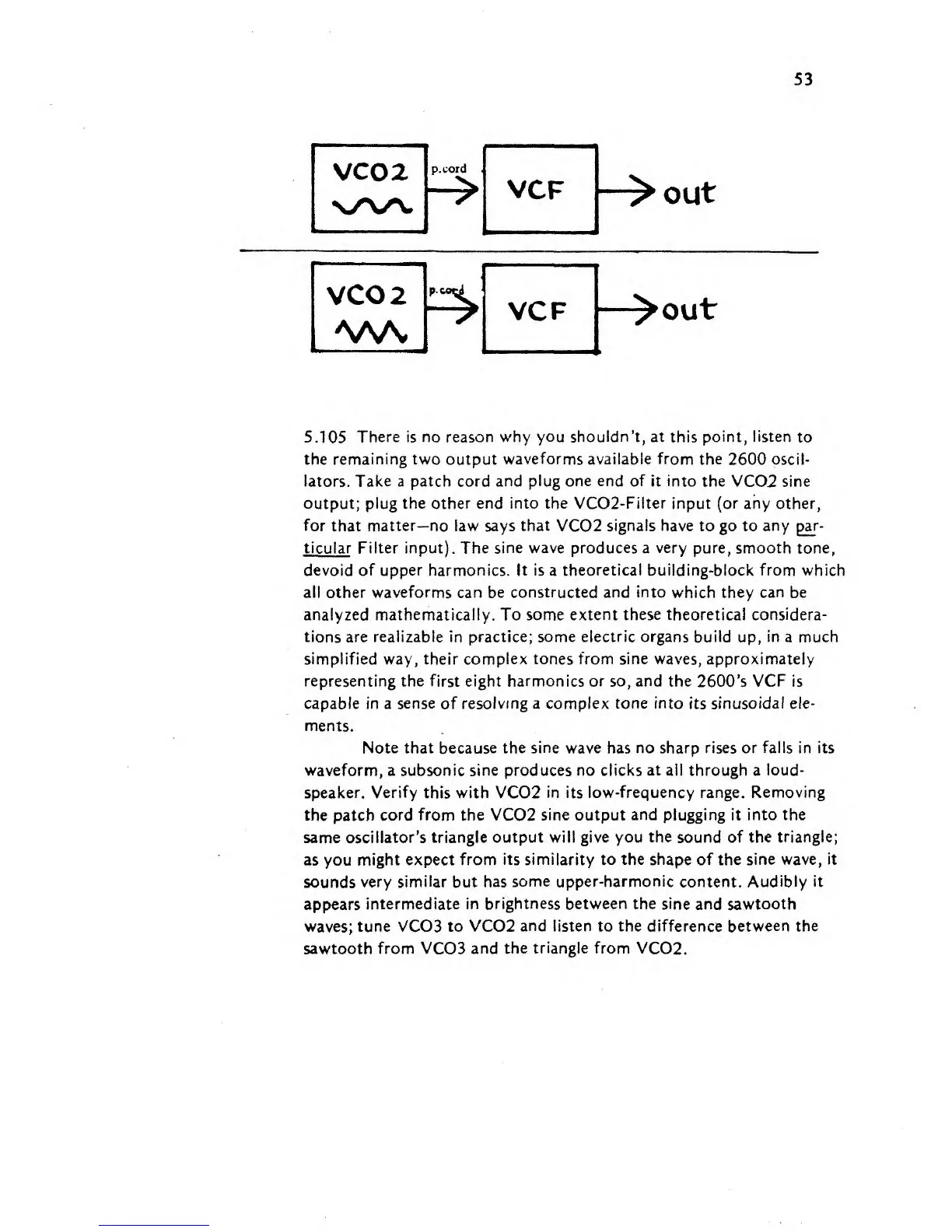
and plug one end
of
it into the
VC02 sine
output;
plug the other
end
into the VC02-Filter
input (or any other,
for
that
matter—
no
law
says
that
VC02 signals have to go to any par
-
ticular Filter input). The sine
wave
produces a
very
pure, smooth tone,
devoid
of upper
harmonics.
It is
a
theoretical building-block from which
all
other
waveforms can be constructed and
into
which they
can be
analyzed mathematically. To some extent these theoretical considera-
tions
are
realizable
in
practice;
some
electric organs build
up,
in
a much
simplified way,
their
complex tones from sine
waves, approximately
representing the
first eight
harmonics or so, and
the
2600*s
VCF is
capable
in
a sense of resolving a complex tone
into
its sinusoidal ele-
ments.
Note
that
because
the sine wave
has
no sharp rises or falls in its
waveform, a subsonic sine produces no clicks
at
all through a
loud-
speaker.
Verify
this
with VC02
in its low-frequency range.
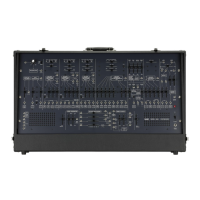
Removing
the patch
cord from the VC02 sine output
and
plugging it
into the
same oscillator's triangle
output will give you
the
sound of the
triangle;
as you
might expect from
its similarity to the
shape of the
sine wave, it
sounds
very similar but has
some upper-harmonic
content.
Audibly it
appears
intermediate in brightness between the sine
and sawtooth
waves; tune VC03 to VC02
and
listen
to
the difference between
the
sawtooth from VC03
and the triangle from
VC02.


 To Next Page