EasyManua.ls Logo

ARP 2600 - Adjusting Filter Cutoff Frequency (Fc) Effect

ARP 2600
118 pages
Print Icon
To Next Page IconTo Next Page
To Previous Page IconTo Previous Page
Loading...
55
Initial Filter
Frequency
slowly
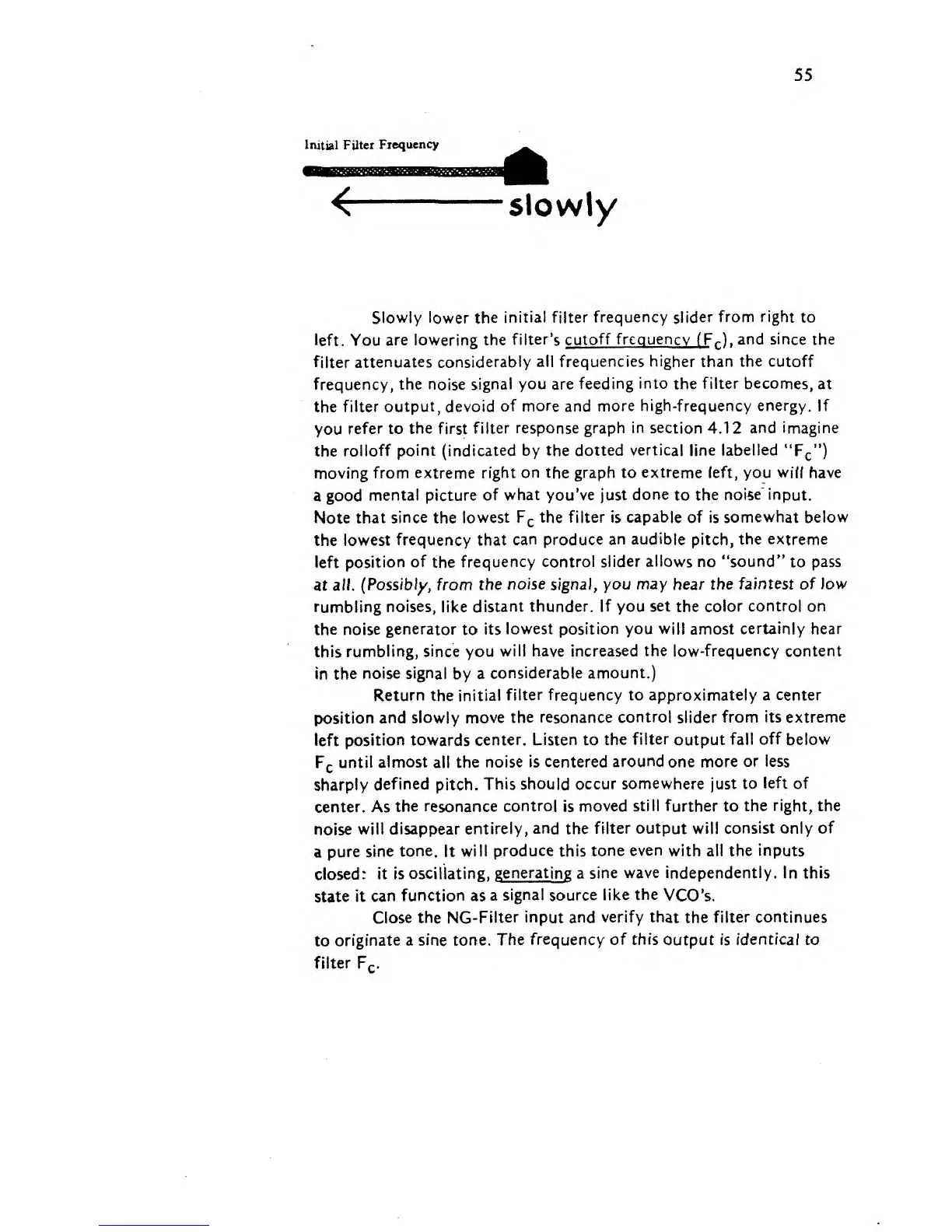
Slowly lower the
initial
filter
frequency
slider
from right
to
left. You
are lowering the
filter's cutoff
frequency
(F
c
).and
since the
filter
attenuates considerably
all frequencies higher
than
the cutoff
frequency, the noise
signal you
are
feeding
into
the
filter becomes,
at
the filter
output, devoid
of more
and
more
high-frequency energy.
If
you
refer to
the
first
filter response
graph in
section 4.12
and imagine
the
roiloff
point
(indicated
by the dotted
vertical
line
labelled
"F
c
")
moving
from extreme
right on
the
graph to extreme feft, you will have
a
good
mental picture of
what
you've
just
done
to
the noise" input.
Note that
since
the
lowest F
c
the filter is capable
of
is
somewhat below
the
lowest frequency that
can
produce
an audible
pitch,
the
extreme
left position
of
the
frequency
control slider allows no "sound"
to pass
<Lt all.
(Possibly,
from
the
noise
signal,
you may hear the
faintest of Jow
rumbling
noises,
like
distant
thunder.
If
you
set
the
color control on
the noise
generator
to its
lowest
position
you will
amost
certainly hear
this
rumbling, since you
will have increased the low-frequency content
in the
noise signal
by a
considerable amount.)
Return
the initial
filter frequency to approximately a center
position
and
slowly move the resonance
control
slider
from
its
extreme
left
position towards
center.
Listen
to
the
filter
output
fall
off
below
F
c
until almost
all
the noise
is centered
around
one more
or less
sharply
defined pitch.
This should occur
somewhere just to
left
of
center. As
the
resonance
control
is
moved
still
further to
the right, the
noise
will disappear
entirely, and the
filter output will
consist
only
of
a
pure
sine
tone,
tt
will
produce
this
tone
even
with all
the inputs
closed:
it is
oscillating,
generating
a
sine
wave
independently. In this
state
it
can function as
a
signal source like
the
VCO's.
Close the NG-Filter
input and
verify
that the
filter continues
to
originate a sine
tone. The
frequency
of this
output
is Identical to
filter F
c
.

Other manuals for ARP 2600

Related product manuals