EasyManua.ls Logo

ARP 2600 - Page 79

ARP 2600
118 pages
Print Icon
To Next Page IconTo Next Page
To Previous Page IconTo Previous Page
Loading...
1
4
When
the
resonance control
is
set
fairly
high, so that
the
filter
peaks
at
F
c
,
you
can hear
vividly
thechanging
response
char-
acteristics
of the
filter
as
the
input
voltage from
the ADSR
gener-
ator
rises
and
falls.
You have
heard
this
sort of
wah-wah
before,
when
you
experimented
with
other
control
voltages
and the
VCF;
but
they
were
never
synchronized
with
an
envelope. Try
adding
a
small
amount,
of
control from
the
VC02 sine
at
about 6-8Hz.
Now
you
have a
vibrato
in
addition
to
the
envelope
control.
If you
open
very
slightly
the
ADSR-VC02
control
slider, you
will
have
a
vibrato
that
changes its
speed
with
the
envelope;
the ADSR
voltage is
not
only
sweeping the
filter
frequency,
but
also
changing
slightly the
frequency
of VC02.
Under
direct
control
from
the
ADSR
voltage, this
change
in
the rate
of the
vibrato
can
only
be
directly
related
to
the filter F
c
.
In
other words,
the
higher the
instantaneous
voltage
from the
enve-
lope
generator, the
higher
will be
both the
filter F
c
and
the vibrato-
frequency from
VC02.
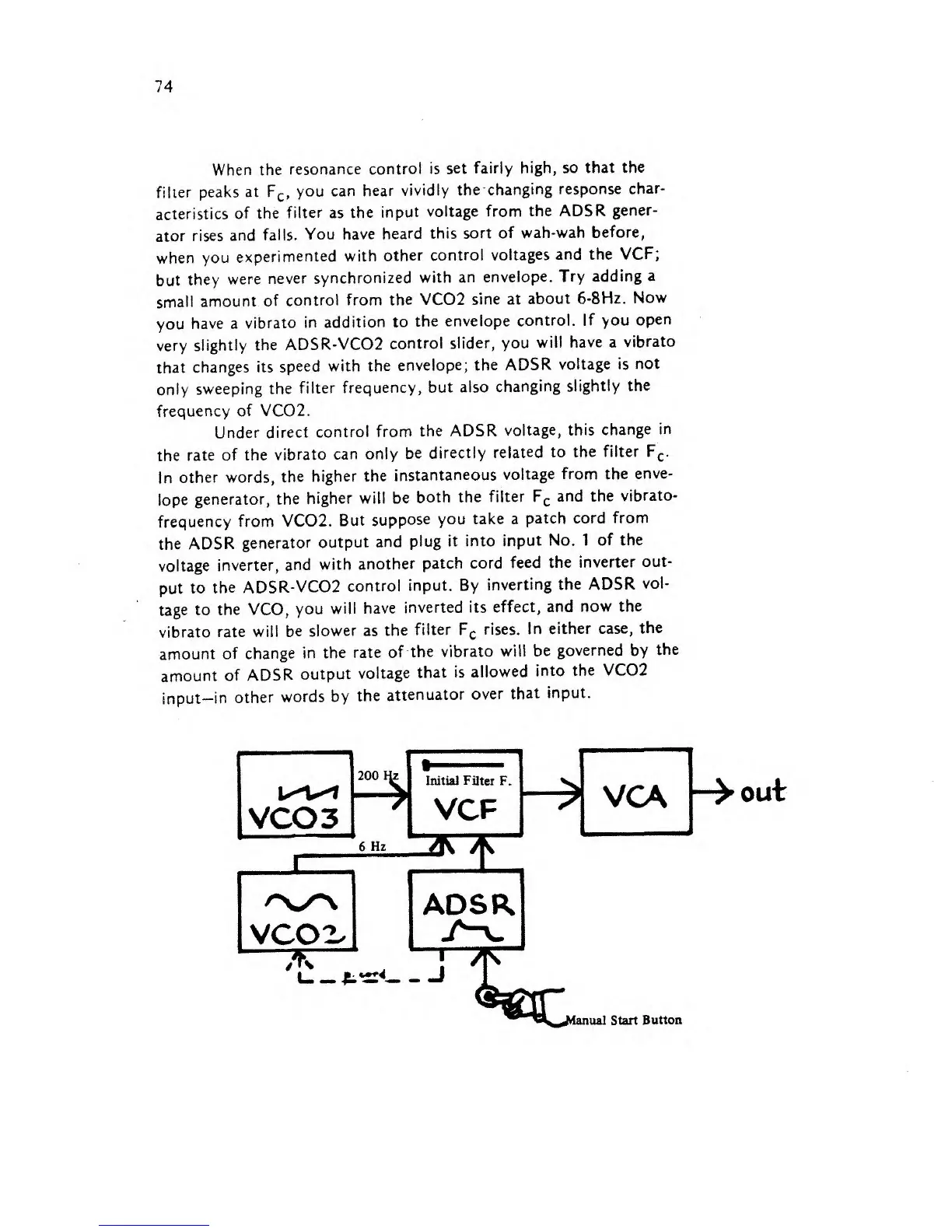
But
suppose
you take a
patch cord
from
the
ADSR
generator output
and
plug
it
into
input
No.
1
of the
voltage
inverter,
and
with
another
patch cord
feed
the
inverter
out-
put
to the
ADSR-VC02
control
input. By
inverting
the ADSR
vol-
tage
to
the VCO,
you
will
have
inverted
its
effect, and
now
the
vibrato
rate will
be
slower as
the
filter F
c
rises.
In
either case,
the
amount
of change
in
the rate of
the vibrato
will
be
governed
by
the
amount
of ADSR
output
voltage
that
is allowed
into
the VC02
input-in
other
words
by
the
attenuator
over
that
input.
out
ual Start
Button

Other manuals for ARP 2600

Related product manuals