EasyManua.ls Logo

ARP 2600 - Using External Equipment; Processing Externally-Generated Signals; Basic External Source Control Patch

ARP 2600
118 pages
Print Icon
To Next Page IconTo Next Page
To Previous Page IconTo Previous Page
Loading...
92
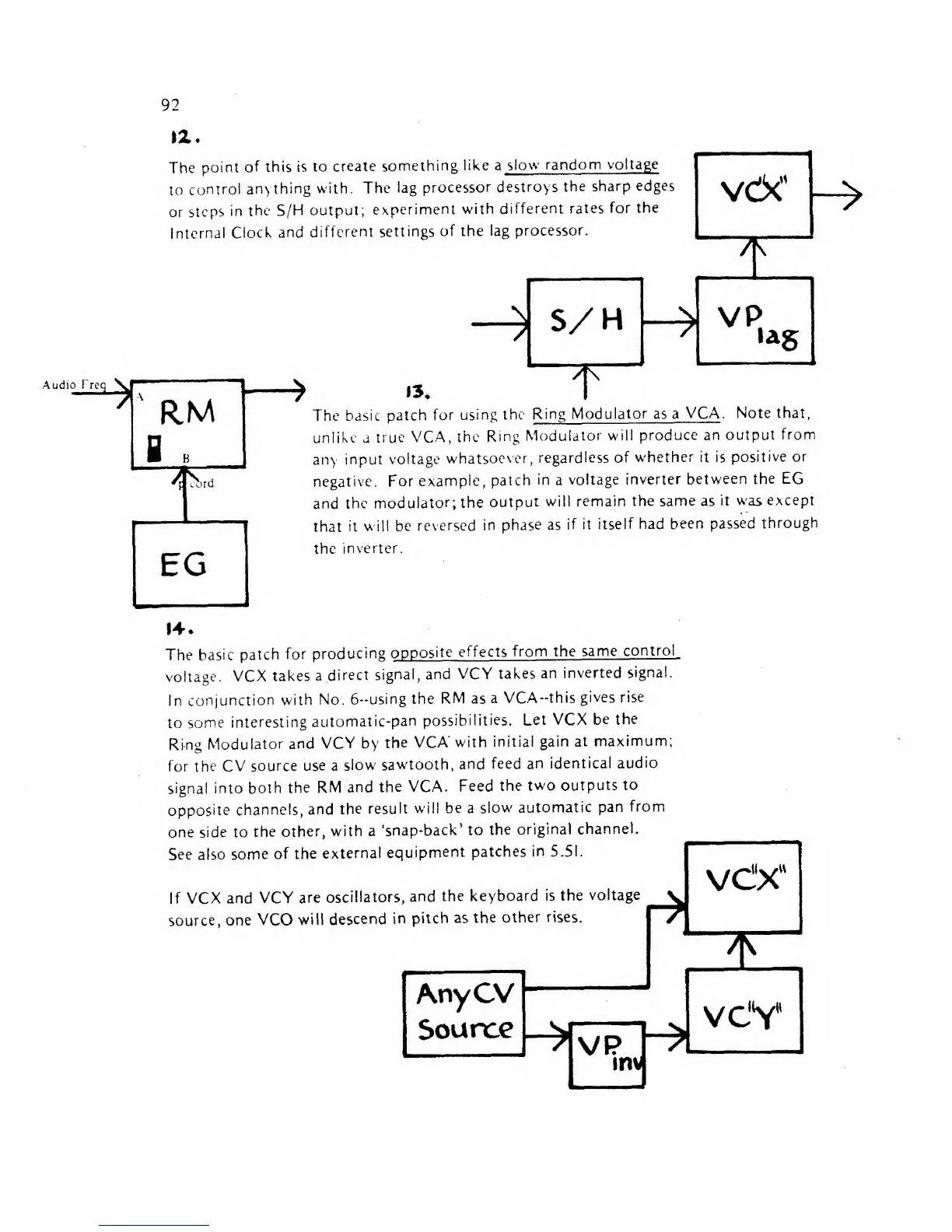
12*
The
point
of this is
to create
something
like
a
slow
random
voltage
to
control
anything
with. The
lag
processor destroys
the sharp
edges
or
steps
in
the S/H
output;
experiment
with
different
rates
for
the
Internal
Clock
and
different settings
of
the
lag processor.
Audio
Fre
a
13.
The
basic
patch for
using
the
Ring
Modulator
as a
VCA
.
Note
that,
unlike
a
true
VCA,
the Ring
Modulator
will produce
an output
from
any
input voltage
whatsoever,
regardless of
whether it
is
positive or
negative.
For
example,
patch
in
a
voltage
inverter
between the EG
and
the
modulator;
the
output
will
remain
the
same as
it
was
except
that
it
will be
reversed
in
phase as
if it
itself had
been
passed through
the
inverter.
14*
The
basic
patch for
producing
opposite
effects
from the
same
control
voltage. VCX
takes
a.
direct
signal,
and VCY
takes
an inverted
signal.
In
conjunction
with
No. 6--using
the
RM as
a
VCA-this
gives
rise
to
some
interesting
automatic-pan
possibilities. Let
VCX
be the
Ring
Modulator
and VCY
by
the VCA"
with
initial
gain
at maximum;
for
the CV
source
use a
slow
sawtooth,
and
feed an
identical audio
signal
into both
the RM
and
the VCA.
Feed
the two
outputs to
opposite
channels,
and
the
result
will
be
a
slow automatic
pan
from
one side
to
the other,
with
a
'snap-back'
to
the
original
channel.
See
also some
of the
external
equipment
patches
in
5.51.
If
VCX
and
VCY are
oscillators,
and
the
keyboard
is the
voltage
source,
one
VCO
will descend
in
pitch
as the
other
rises.

Other manuals for ARP 2600

Related product manuals