93
5.3 FEEDBACK
LOOPS.
A
little-explored
no-man's-land, including
control
of an
oscillator
by
its
own
output voltage, mutual
control of
two oscillators
each
by
the others output voltage,
and other
horrors.
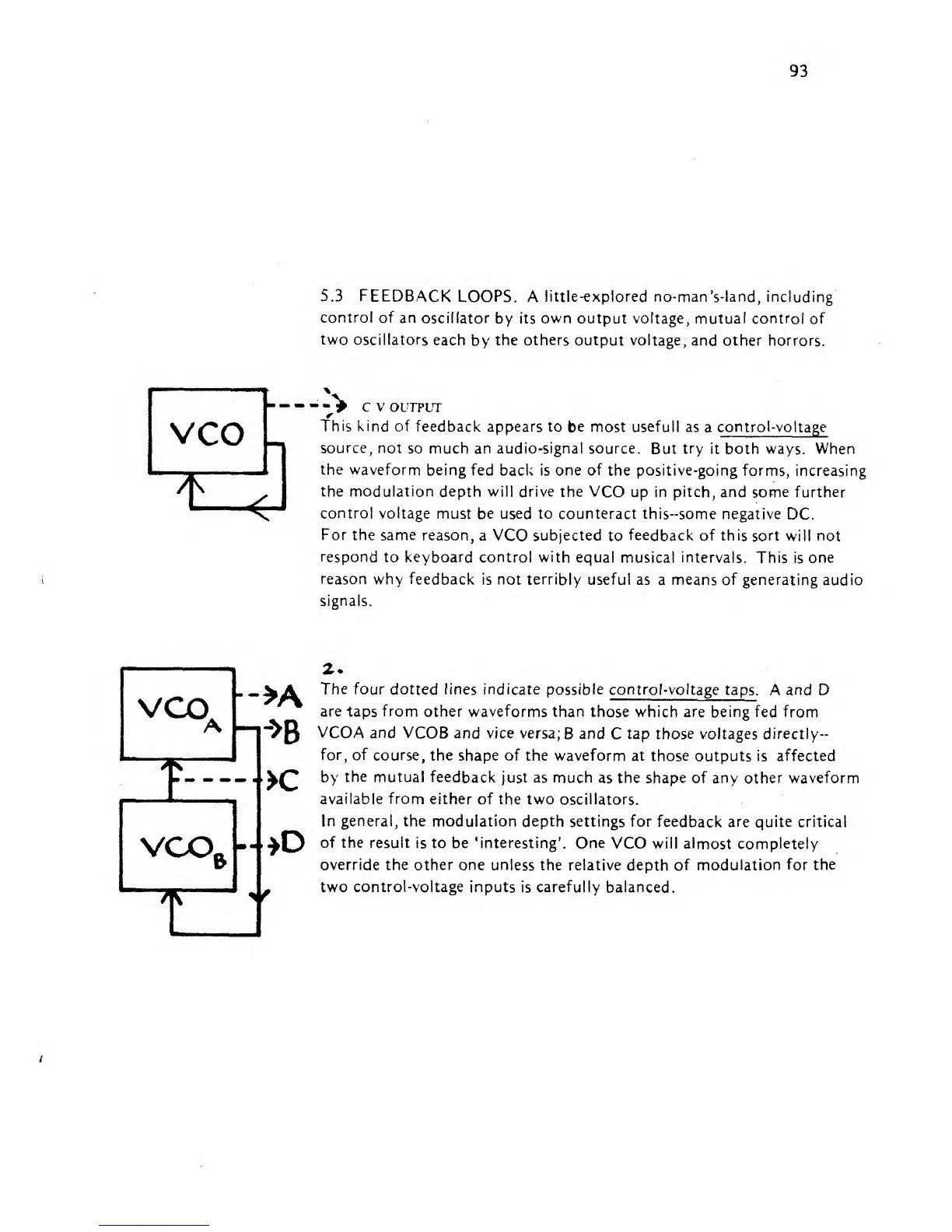
..:>
C V
OUTPUT
This
kind of feedback appears to
be most usefull as
a
control-voltage
source, not so
much an
audio-signal source.
But try
it
both
ways. When
the waveform being
fed back is one
of
the positive-going
forms, increasing
the modulation
depth will
drive
the VCO
up
in pitch, and
some further
control voltage
must
be
used to counteract this-some negative
DC.
For the same
reason, a VCO subjected
to
feedback of
this sort will
not
respond
to
keyboard control
with equal musical intervals.
This
is
one
reason why
feedback is
not
terribly useful as
a
means of generating
audio
signals.
The four dotted lines Indicate
possible
control-voltage
taps.
A and D
are taps from other waveforms than
those which are being fed
from
VCOA and
VCOB and vice versa;
B
and
C
tap
those voltages directly—
for, of
course, the shape
of
the waveform
at
those
outputs is
affected
by
the
mutual feedback
just
as
much as the shape of any other waveform
available
from either of
the
two
oscillators.
In general, the modulation
depth settings for
feedback are quite critical
of
the result
is to
be 'interesting'.
One VCO will
almost completely
override the other
one unless the relative depth of modulation
for the
two control-voltage
inputs
is
carefully
balanced.
/


 To Next Page