4.5.2. The EQ section
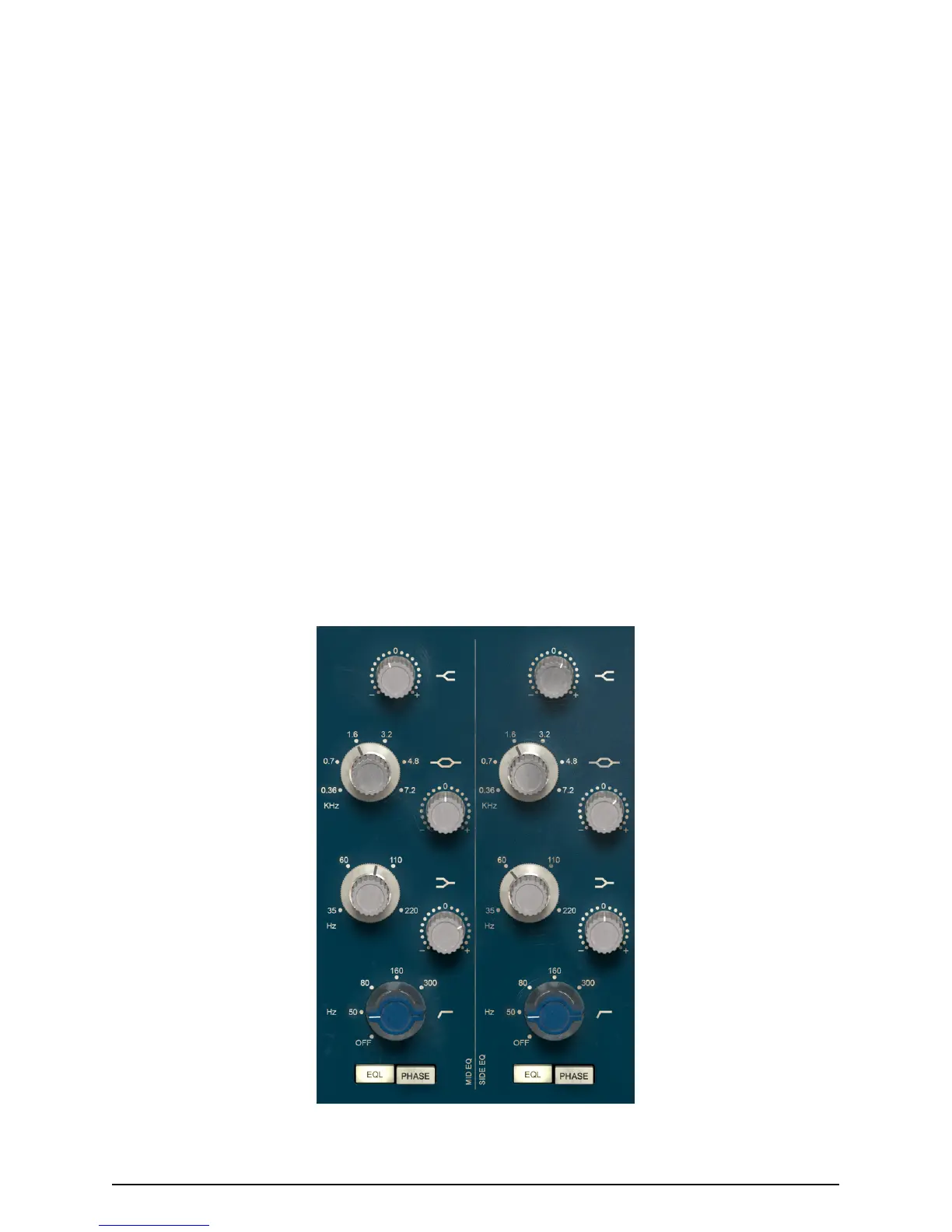
The EQ section allows three frequency bands at any one time, with sweepable values on
the Midrange and Low bands, while the High band has a fixed frequency. So, we have a
hybrid EQ, with two semi-parametric bands (a fixed Q or bandwidth factor, and selectable/
sweepable frequencies and boost/cut values). This goes beyond the original, which had
switchable fixed frequencies for both the Midrange and the Low bands, while the High band
had a single fixed frequency.
Another word about the type of filter slope we have on each band: High and Low bands
have a Shelf filter, while the Midrange has a Bell (Peak) filter. For those not familiar with this,
the differences are as follows:
A Shelf band boosts (or attenuates) all frequencies equally, above or below a certain point.
The frequency specified for a Shelf equalizer circuit is usually the point where it effectively
reaches its “shelf” state. A High Shelf EQ band boosts or cuts high frequencies and a Low
Shelf EQ band boosts or cuts low frequencies.
This is the type of circuit that’s used in Hi-Fi systems, but is also highly musical when applied
in a recording environment.
On the other hand, a Bell (Peak) EQ band is one that, as its name implies, has a center
frequency around which the boost or cut happens. The bell name derives from the type of
curve drawn by the filter. The frequency range over which it reaches its bell peak and then
falls down is known as the bandwidth (or Q).
Because this design reaches a peak and then falls away, it is possible to focus on a
particular area of frequencies and make adjustments on that, without affecting those
around them. This can be particularly useful when working with instruments such as
guitars, snare drums, or any kind of acoustic instrument that has a limited spectrum range.
However, that's not exactly what we will get with the 1973-Pre EQ.
1973-Pre Double Channel EQ section
22 Arturia - User Manual 1973-Pre - 1973-Pre OVERVIEW


 To Next Page