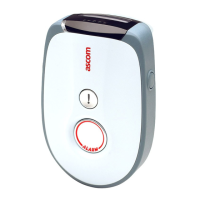
The Ascom Paging System is a comprehensive communication solution designed for wall mounting, either individually or adjacent to other units. The units are housed in ABS plastic, providing protection against dust and mechanical damage, though they should not be located in areas of high moisture or extreme humidity. The system is designed to operate within specific temperature ranges: -25 to +55°C for radio equipment and 0 to +40°C for other modules. For optimal service and longevity, units should be placed in dry locations with moderate temperatures, away from strong electromagnetic fields, vibration, or rapid temperature changes.
Function Description
The core function of the Ascom Paging System revolves around serial data transmission via a system bus. Units communicate using this bus, with adjacent units connected by ready-made modular system bus cables. For remote units, such as transmitters located near antennas or charging interfaces, twisted-pair cables are used. The bus network must always be open, never forming loops, and all data buses are polarized. The system supports a maximum of 32 modules in a bus network.
The system utilizes several data buses: A-bus, B-bus, C-bus, and D-bus, all operating on balanced lines according to EIA standard RS-485 and CCITT recommendations V.11 and X.27.
- A-bus and B-bus: These are identical and primarily used for data communication between modules and for connecting interface modules. They carry constant communication, visible as a pulse train on an oscilloscope, with a normal level of 8-10 Vp-p.
- C-bus: This bus is specifically for connecting Central Units together in a multi-central system, enabling communication between different system segments.
- D-bus: This bus transmits pagings in a transmit format from the Central Unit to one or several Terminal Transmitters. It is essential for enabling paging functions within the system. The D-bus is electrically identical to the A-bus, supporting up to 32 units with twisted-pair wiring over a maximum total length of 3 kilometers.
In addition to data buses, the system incorporates an FL-bus (Frequency Lock-bus). This is a one-way bus to Terminal transmitters, crucial for frequency-locked systems where transmitters in overlapping areas need to be synchronized. The Reference Module, containing a highly stable reference tone generator, is typically placed near the Central Unit. Each transmitter is equipped with a Frequency Lock T952 SM/FL module, which uses this reference tone to correct its carrier frequency.
The system also supports Fixed Receivers, which are connected to a Receiver Interface (RI). The RI, in turn, connects to the A-bus. Up to four receivers can be connected to a single RI, each via a separate twisted-pair R-line, with a maximum length of 1 km. The R-line carries a quality tone of about 2.0 ± 0.2 Vp-p when the receiver is inactive. When activated, a sinusoidal data signal of about 5.0 ± 0.2 Vp-p is superimposed on this quality tone, with four different frequencies corresponding to four quality levels.
Other Fixed Units within the system include:
- Central Unit: This unit contains all four data buses and controls all communication. It can support up to 60 addressable units.
- Unite Connectivity Manager (Unite CM): This module handles alarm management and connects to the Ascom Paging System via the A-bus. An Alarm Management Client (AMC) can be used for graphical alarm viewing via LAN.
- Output Module: Provides 16 outputs for indicator lamps or relays and an input for switches (e.g., push-buttons). Outputs and inputs are galvanically isolated and transient protected. It also includes a relay output for system fault indication.
- Alarm Module: Contains 8 or 32 inputs for fixed alarm points and an input for external acknowledgment. These inputs are galvanically isolated and transient protected.
Locators are an integral part of the system when paging is not the sole function. They transmit a location code (0000-FFFE) via infrared (IR) or low frequency (LF) signals. This code is selected using dip switches on the Locator and is received and stored by Transceiver/Transmitter handsets. When an alarm is sent, the location code is transmitted along with other alarm data. Locators can also have a monitor output with a breaking function, connectable directly to an alarm module.
- IR Slave Locators: Up to three IR Slave Locators can connect to one IR Master Locator, with a maximum total wiring length of 100 meters. They can have separate power supplies but must share a common ground with the Master Locator.
- LF Antennas: Up to two external LF antennas can be connected to an LF master locator, with a maximum total wiring length of 20 meters, using only twisted-pairs.
Usage Features
The Ascom Paging System is designed for flexibility in installation and configuration.
- Wiring Lengths: The system supports significant wiring lengths for its data buses: A-bus, B-bus, C-bus, and D-bus can extend up to 3000 meters for data communication between modules and systems. The FL-bus also supports up to 3000 meters for frequency lock to terminal transmitters, and the R-line for fixed receivers can be up to 1000 meters. For distances exceeding 3000 meters or more than 32 units on a bus, Bus Converters (T938BC2 for private lines) or Data Modems (T938D for leased or very long private lines) are used to amplify the data bus signal.
- Antenna Installation: Various antenna types are supported, including ground-plane, dipole, and helix antennas, chosen based on site suitability, terrain, and climatic conditions. Antennas should ideally be located centrally and unobstructed within the coverage area, away from metal-clad structures. When mounting multiple antennas on the same mast, a vertical spacing of at least 0.5 meters is required. Coaxial cables (RG-8 or RG-213) should be kept as short as possible to minimize attenuation.
- Frequency Locking: For frequency-locked systems, the Reference Module T938RM provides drive circuits for the FL-bus, controlled by the Central Unit, ensuring synchronized transmission in overlapping areas.
- Data Modem Integration: Data modems introduce a delay in the transmitter signal, which can cause distortion in overlapping coverage areas. To mitigate this, installations are planned to delay signals to transmitters equally, ensuring the same number of modem-pairs are used between the Central Unit and each Terminal transmitter.
- Addressing: Each unit connected to the system bus requires a unique hexadecimal address (0000-FFFE) for communication. This address is set via an address switch before power-up. The Central Unit always has address 00. In non-speech systems, transmitters typically use hex 0 as the first digit unless sequential transmission is employed. In speech systems, transmitters must be in the address range 80-FF.
- Location Codes: Locators use dip switches to set their location codes, which are then transmitted to and stored by handsets.
- Power Supply: All units operate on 12.5 V DC. A common power supply can feed multiple units in one location, connected in series. The wiring from the power supply must be dimensioned to ensure the voltage drop does not exceed 0.5 V at maximum load. Additional power supplies can be used if the total load exceeds the capacity of a single supply. Linear power supplies are generally recommended, especially for transmitters and line equipment in areas with strong electromagnetic fields.
Maintenance Features
The system includes several features to aid in maintenance and troubleshooting.
- System Check: After installation, a functional check is performed according to the installation guide for each unit. This includes verifying battery saving times (0.5, 2, or 5 seconds) for handsets, ensuring paging and alarms are transmitted with at least one repetition for reliability, and separately checking each fixed transmitter in multi-transmitter installations.
- Paging Function Check: Involves sending messages from various product/units (e.g., NetPage) to Transceiver/Receiver handsets to confirm correct reception. For messages requesting an answer, the response from the handset is verified at the initiating product/unit.
- Alarm Function Check: Alarms generated from Transceiver/Transmitter handsets are checked to ensure they are received by the Unite CM. If locators are used, alarms generated within a locator's coverage area are checked for correct location code reception by the Unite CM.
- LED Patterns for Fixed Units: Functional indicators (LEDs) on fixed units provide visual cues for status and potential malfunctions:
- Steady light: Normal operation, communication with the central unit established.
- No light: Indicates no power or a hardware fault, requiring power supply check or dealer contact.
- Slow blink (0.5 Hz): Suggests a program error, requiring a unit restart (power cycle).
- Fast blink (8 Hz): Points to a communication error, necessitating a check of bus polarity and unit addressing.
- One blink every fourth second: Indicates the unit is in test mode, requiring dealer contact.
- Antenna Tuning: For HF systems, the MFJ-901B antenna tuning unit is used between the transmitter and antenna to match impedance, especially in challenging installations (e.g., boat installations, culverts). An antenna transformer MAT-50 provides galvanic isolation and protection from over-voltage and lightning transients.
- Interference Mitigation: When antennas are mounted adjacently in two-way paging systems, measures are taken to prevent fixed transmitters from disturbing or blocking fixed receivers. Solutions include using bandpass or notch filters, or reducing output power on fixed transmitters to 100 mW and optimizing vertical antenna placement if frequency differences are small. Attenuators may be required for range tests when these solutions are in place.
- Address Register: Maintaining an address register for each installation, detailing the name, address, and location of each unit, is recommended for organized system management.

 Need help?
 General

 To Next Page