13
12 To stop spinning bring potentiometer E to zero. The cover is unlocked about 10
seconds after spinning has completely stopped.
13 Starting the heating power potentiometer from 0 repeat the cycle.
After about one hour of continuous work it is recommended to allow the water
to cool down even if the orange led is still illuminated. The orange led will be
OFF when water temperature reaches 45 °C and power will be automatically
interrupted.
CAUSE OF CRUCIBLE BREAKAGE THAT CAN OCCUR WITH HIGH-
TEMPERATURE ALLOYS AND PARTICULARLY WITH CHROME-
COBALT-MOLYBDENUM
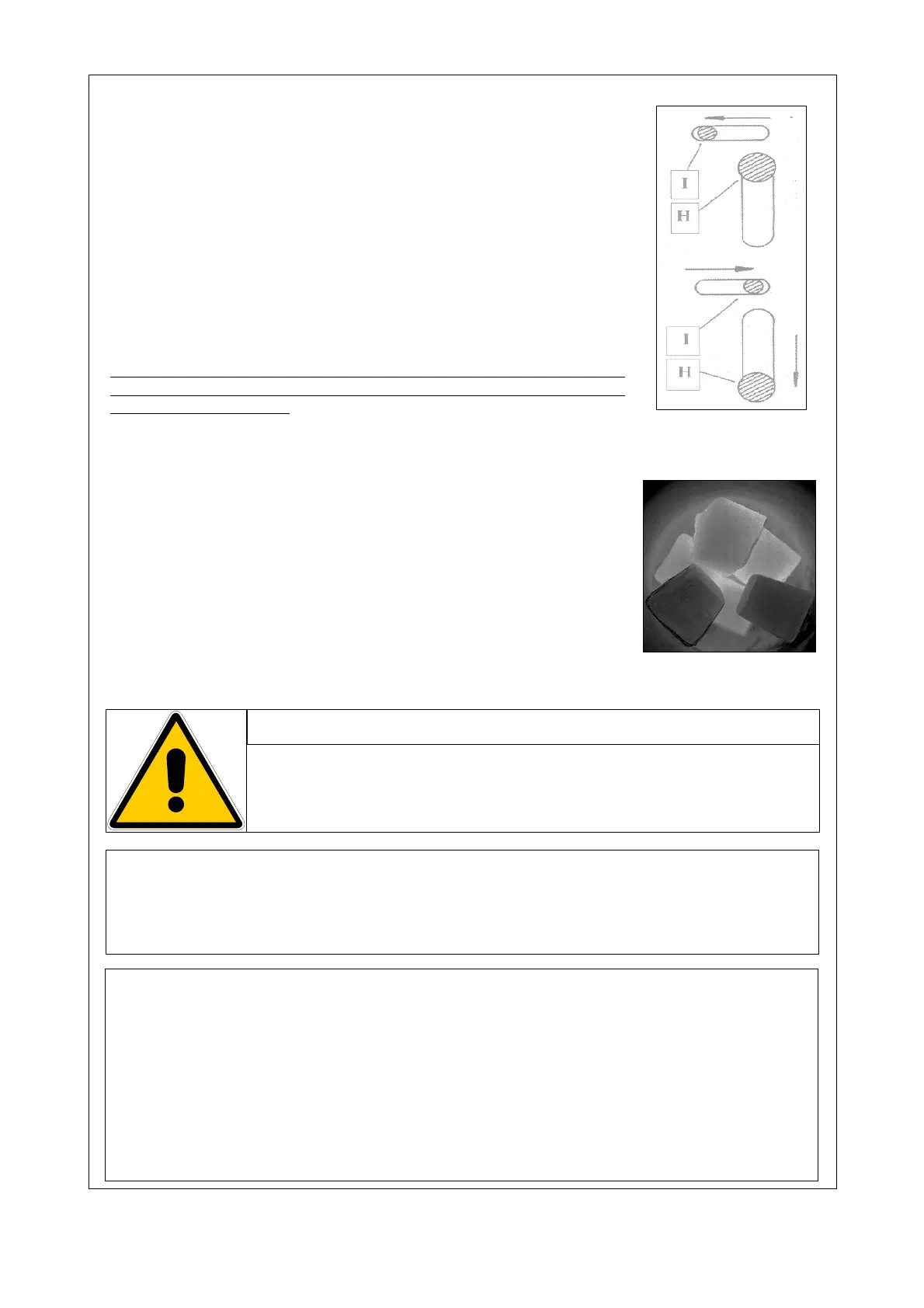
– Check the melting process carefully. The melt must take place uniformly
throughout the alloy mass.
– If the metal pieces in the crucible does not lie together the pieces lying on the
crucible bottom will melt quickly whereas the isolated pieces on the top will
reach the melt with difficulty. If the operator waits until the metal on the top
melts it might happen that the metal on the crucible bottom reaches a so high
temperature to cause the crucible itself to melt and to break with the consequent
loss of metal.
– To prevent this risk, it is necessary to touch, with the steel rod supplied with the
outfit, the metal pieces on the top to join them with the pieces on the crucible
bottom. Regulate the heating power properly.
C
D
PICTURE 8
ATTENTION
THE CASTING MACHINE REGULATES THE WORK OF THE LABORATORY. IT
IS ADVISABLE TO KEEP IN STOCK THOSE PARTS WHICH ARE SUBJECT TO
WEAR-OUT, ARE NOT COVERED BY WARRANTY AND MIGHT NOT BE
AVAILABLE FOR A PROMPT DELIVERY.
CRUCIBLES
CRUCIBLE HOLDING PLATE code A107.126
DURING THE MELTING AND CASTING PROCESS WITH THE GRAPHITE
CRUCIBLE THE CERAMIC LID COVER MUST BE ON THE CRUCIBLE TO
PROTECT THE OPERATOR FROM POSSIBLE SPARKS OF MOLTEN METAL
WARNING
ATTENTION
PRACTICAL RECOMMENDATIONS FOR THE MELTING PROCESS WITH DIF-
FERENT ALLOYS WILL FOLLOW IN THE NEXT CHAPTER.
MODULAR 6


 To Next Page