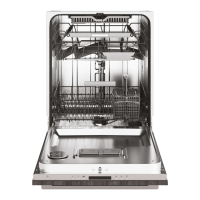
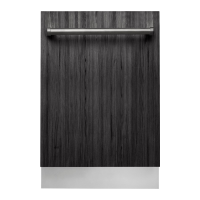
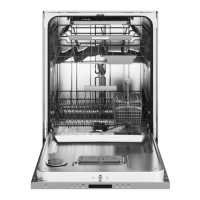
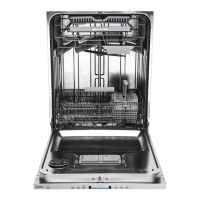
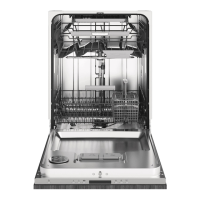
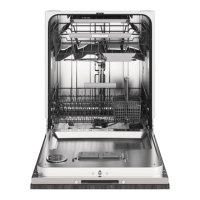
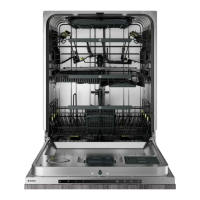
This document provides operating instructions for the ASKO DFI644GXXL dishwasher, covering its functions, usage, and maintenance.
Front Panel and Basic Operation
The dishwasher features a front panel with a main power switch, a display, programme mode selector, navigation buttons for selecting programmes, and options for Delayed Start and Extra Dry. To begin, open the door and press the main power switch. The first time the dishwasher is switched on, a "Welcome to your new ASKO. This is a first time set up." message appears, guiding the user to set up basic settings for optimal dishwashing results.
Safety Instructions
It is crucial to read and follow the safety instructions. The dishwasher is designed for 14 standard place settings. It should only be used for its intended purpose of washing household dishes. Never load the door or baskets with items other than dishes, and avoid leaving the door open to prevent tripping hazards. Only use dishwasher detergent, as washing-up liquid can create excessive foam and hinder operation. Children aged 8 and above, and individuals with reduced physical or mental capabilities, must be supervised and instructed on safe use. Damaged mains cables require replacement by a qualified electrician. Dishes with solvent residues, ash, wax, or lubricants must not be washed due to explosion risk. Children should be supervised and prevented from playing with the dishwasher, especially when the door is open, as detergent can be corrosive. Knives and pointed items must be placed points down in the cutlery basket or horizontally in other baskets.
Child Lock (Kid Safe™)
The child lock feature can be activated to prevent unintended starts by children. This setting can be managed through the dishwasher's settings menu.
Installation and Transport
Refer to the dedicated installation chapter for detailed instructions. For winter storage or transport, the dishwasher should be kept above freezing temperatures and transported upright or on its back. Before transporting a used dishwasher, all water must be pumped out by running the "Rinse and hold" programme.
Overflow Guard Function
The dishwasher is equipped with an overflow protection system that activates if the water level exceeds normal limits. It pumps out water and shuts off the water supply. If triggered, the water supply should be turned off, and service contacted.
Packaging Material and Disposal
The packaging materials are recyclable, consisting of corrugated cardboard, expanded polystyrene (EPS), untreated wood supports, and polyethylene (PE plastic). Users are encouraged to separate these materials for recycling. At the end of its service life, the dishwasher should be made unusable by pulling out and cutting the power cable, and then disposed of according to local regulations.
Before First Wash: Water Hardness and Basic Settings
To achieve good dishwashing results, soft water is essential. Hard water can leave white coatings. Water hardness is measured in German (°dH) or French (°fH) scales. If the water hardness exceeds 6°dH (9°fH), the built-in water softener must be adjusted to the local water hardness. After adjusting the water softener, use appropriate detergent and rinse aid doses. For water hardness above 50°dH (89°fH), an external water softener is recommended. Never run the dishwasher with an empty salt compartment if water hardness exceeds 6°dH (9°fH).
Basic Settings Configuration
Upon first use, the "Welcome to your new ASKO" message prompts for initial setup.
- Language: Select the desired language for the display.
- Rinse aid (0/1/2/3/4/5/TAB): Rinse aid improves drying speed and results in clear, spotless dishes. The dispenser can be adjusted from 0 (Off) to 5 (High dosage). For all-in-one detergents containing rinse aid, the TAB setting can be activated. The factory default is 5.
- Topping up rinse aid: Open the compartment lid, fill to the 'max' level, wipe any spills, and close firmly.
- Water hardness (0-9): Adjust the water softener setting based on water supply hardness. This is crucial for preventing white coatings. Salt must be added to the salt compartment after setting the water softener to 1-9. If water hardness is below 6°dH (9°fH), set to 0, and no salt is needed. The factory default is 4.
- Topping up salt: Unscrew the lid, place the funnel, pour about 1 liter of water, then add up to 1.0 kg of large grain or special dishwasher salt until full. Wipe excess salt and screw the lid firmly. A dishwashing programme must be started immediately after adding salt to prevent rust stains.
Greener Dishwashing
To promote energy and water saving:
- Do not rinse under running water: Scrape off large food particles instead.
- Choose a green detergent: Check environmental declarations on packaging.
- Run programmes only with a full load: Use the "Rinse and hold" programme to prevent odours while waiting for a full load.
- Run programmes at a lower temperature: For lightly soiled dishes.
- Select ECO wash: This programme is designed for normally dirty dishes, offering the most effective combined energy and water consumption. It washes at a low temperature for a longer duration.
- Select Green mode: Available with "Normal wash" and "Daily wash," this mode extends programme time to save energy and water.
- Open the door a little after the programme: Improves drying results. Ensure surrounding furnishings are condensation-resistant if built-in.
- Connect to cold water: If the building is heated by oil, electricity, or gas.
- Connection to hot water supply (max. 70 °C): If the building uses energy-efficient heating (district heating, solar, geothermal). This reduces dishwashing times and energy consumption. Do not exceed permitted water supply temperature, as some cookware materials cannot withstand strong heat.
Loading the Dishwasher
Some cookware is not dishwasher safe due to heat sensitivity or detergent damage. Exercise caution with handmade items, fragile decorations, crystal/glassware, silver, copper, tin, aluminium, wood, and plastic. Look for "Dishwasher safe" markings.
- Fragile decoration: Porcelain with rough decoration should not be washed.
- Crystal/Glass: Use the "Crystal glass" programme for fragile items, with a small amount of detergent, ensuring items do not touch. Rinse aid improves drying. Hand-painted or antique glassware should not be washed.
- Silver: Avoid contact with stainless steel to prevent discolouration.
- Aluminium: May lose shine, but good quality pans can be washed.
- Cutlery with glued handles: Some glues are not dishwasher safe and handles may loosen.
Loading Principles
- All dirty surfaces should face inwards and downwards.
- Dishes should not touch each other.
- Angle hollow dishes (cups) to allow water runoff, especially for plastic items.
- Small items should not fall through baskets; place them in the top cutlery tray.
- Ensure spray arms can rotate freely.
Dishwasher Baskets
The dishwasher has a top cutlery tray, an upper basket, and a lower basket with a cutlery basket. Basket appearance may vary by model.
- Top cutlery tray: For cutlery, ladles, whisks, serving cutlery.
- Raising: Pull out the tray, pull forward the two locking handles on either side.
- Lowering: Ensure upper basket is in lowest position, pull out tray, slide locking handles downwards and backwards.
- Upper basket: For glasses, cups, bowls, side plates, saucers. Dirty surfaces inwards and downwards. Wine glasses on the wine glass shelf, knives in the knife stand.
- Foldable tines: Lower for pots, release by pressing catch inwards.
- Raising: Pull out basket, grab sides and lift.
- Lowering: Pull out basket, pull two locking handles on either side.
- Washing large plates: Move foldable tines and mounts to widen space for plates over 25 cm.
- Accessory: Optional wine glass shelf for six tall (max. 25 cm height, 7.5 cm diameter) wine glasses, placed in the rear of the lower basket.
- Lower basket: For plates, side plates, serving dishes, pots, cutlery (in the cutlery basket). Pots and pans in the rear right for optimal performance from WideSpray™ nozzles.
- Cutlery basket: Place cutlery handles down (except knives), spread out to prevent stacking. Best placed in the middle front for optimal performance from Power Zone Cutlery™ nozzle.
- Fold-down section: For small items or electric whisk attachments.
- With lid (certain models): Lid can be removed and used as an extra cutlery basket in the upper basket.
- Accessory: Optional extra cutlery basket, flexible and can be dismantled, attached to lower or large cutlery basket.
Adding Detergent
Detergent is added to two compartments: prewash (1) and main wash (2). The detergent compartment must be dry. Follow detergent packaging instructions, adjusting dosage to water hardness. Too much detergent can reduce effectiveness and increase environmental impact.
- Dishwasher tablets: Not recommended for short programmes (under 75 minutes). Use powder or liquid detergent instead. Halve tablets if the dispenser lid is tight to ensure proper release.
- All-in-one detergent: Read product directions carefully. If using one with rinse aid, activate the TAB setting. The salt compartment must still be filled with salt.
- NOTE: Optimal results are achieved with normal dishwasher detergent, separately dispensed rinse aid, and salt.
Starting the Dishwasher
- Open door, press main power switch, turn on water tap.
- Select a programme: ECO wash is default. Use navigation buttons (< or >) to choose.
- ECO wash: For normally dirty dishes, most effective in combined energy/water consumption.
- Normal wash: Powerful, for daily use, dried leftovers (not burnt food). Maximum rinse effect, longer than Daily wash.
- Auto wash: Measures dirtiness, adjusts water/temperature. Needs 5 runs to adapt fully.
- Daily wash: Effective for daily use, slightly dried leftovers (not burnt food).
- Time program: Adapts to specified running/finish time. Choose time based on dirtiness: 0:15-0:45 (slightly dirty), 1:00-1:30 (normally dirty), 2:00-2:30 (very dirty). Use option button to set time.
- Rinse and hold: For rinsing dishes while waiting for a full load.
- Plastic wash: For dishwasher-safe plastic items, extra long drying cycle. Porcelain and glasses can also be washed.
- Hygiene wash: High hygiene demands (baby bottles, cutting boards). High temperature in main wash and final rinse.
- Crystal glass: Gentle, low temperature for fragile crystal/glass. Small detergent amount, items not touching. Porcelain can also be washed.
- Quick Pro wash: Shortens programme by preheating water. Not for dried leftovers. Scrape off large food particles.
- Step 1 (Prepare): Press Start/Stop until "Preheating" shows. Close door. Wait for status light to turn green and "Preheating ready" (within 180 minutes). Dishes can be loaded during preheating.
- Step 2 (Start): Press Start/Stop until "Program started, close door." Close door properly.
- Self-cleaning: For hygienic cleaning of tub, spray arms, pipes. Run without dishes, using normal dishwasher detergent or citric acid. Special cleaners are available for limescale removal.
- Upper half wash: For cups and glasses in upper basket. Slightly dirty dishes in lower basket.
- Lower half wash: For plates and cutlery in lower basket. Slightly dirty dishes in upper basket.
- Select a programme mode: Use programme mode selector. Modes vary by programme.
- Green mode: Less energy/water, extended time.
- Speed mode: Shortened time, more energy.
- Night mode: Lower noise, extended time.
- Intensive mode: Improved results, more energy/water, extended time.
- Select an option: Use option button. Options vary by programme.
- Extra Dry (SSS): Higher final rinse temperature, longer drying cycle. Slightly increased energy consumption.
- Delayed Start: Starts dishwasher 1-24 hours after Start/Stop.
- Activate: Press button once, then multiple times or hold to set hours.
- Start: Press Start/Stop, close door. Timer counts down.
- Cancel: Open door, press and hold Start/Stop for 3 seconds.
- Start the dishwasher: Press Start/Stop until "Program started, close door." Close door properly. If not started or closed within 2 minutes, machine switches off.
- Time remaining: Displays programme duration based on chosen programme, mode, and options.
- Status light™: Light at bottom provides information:
- Blue: Load more (programme started, but dishes can still be added).
- Red: Do not load (risk of poorer results). Flashing red indicates a problem (see Troubleshooting).
- Green: Unload (programme finished). Standby for 60 minutes.
Stopping or Changing a Programme
To change a programme after starting, open the door, press and hold Start/Stop for 3 seconds. Add more detergent if dispenser lid opened. Choose new programme, press Start/Stop, close door.
Loading More Dishes
Open the door. Dishwasher stops automatically. Add dishes, close door. Programme resumes after a while.
Power Failure
If power is restored, the interrupted programme continues.
- NOTE: During drying, programme is interrupted if power is cut or door is open for over 2 minutes.
Programme Finished
One short buzzer signal indicates end. Status light turns green. Dishwasher switches off automatically. Shut off water tap after each use.
Best Drying Results
- Fully load.
- Angle hollow dishes for water runoff.
- Top up rinse aid or increase dosage.
- Activate Extra Dry option.
- Activate High temperature setting.
- Open door slightly after programme.
- Allow dishes to cool before unloading.
Unloading the Dishwasher
Hot porcelain is fragile; let dishes cool. Unload lower basket first to prevent water drops from upper basket.
Care and Cleaning
- Top up rinse aid: Symbol lights on display. Open lid, fill to max, wipe spills, close firmly. Symbol may take time to go out.
- Top up salt: Symbol lights on display. Unscrew cap, fill container with salt (water only needed first time). Wipe clean, tighten. Run programme to rinse salt away.
- WARNING: Start programme immediately after adding salt to avoid rust stains. Never pour detergent into salt compartment; it destroys the water softener.
- Fine filter: Debris is rinsed away during each wash. Clean when necessary.
- Cleaning: Turn handle anticlockwise, lift filter, free coarse filter. Refit in reverse, ensuring edges seal. Lock by turning handle clockwise until it points straight out.
- NOTE: Incorrectly fitted filters affect results. Do not use dishwasher without filters. Check coloured stop in bottom drain is in place.
- Coarse filter: Traps larger food particles. Empty when necessary.
- Cleaning: Lift by handle, empty, refit.
- Spray arms: Holes and bearings can block. Remove debris with a pin. Spray arms have holes underneath.
- Removal (for cleaning):
- Top spray arm: Pull out top cutlery tray, press spray arm up, unscrew bearings counterclockwise.
- Upper spray arm: Pull out upper basket, unscrew bearings counterclockwise.
- Lower spray arm: Pull straight up.
- Refitting: Ensure firmly in place.
- Door and door seal: Regularly clean with a damp cloth and mild cleaner.
- Front panel: Keep buttons clean and grease-free. Wipe with dry or slightly damp cloth. Never use abrasive cleaners. Turn off dishwasher before cleaning buttons.
- Dishwasher tub: Stainless steel, kept clean through normal use.
- Limescale deposits: If hard water causes deposits, run "Self-cleaning" programme with two tablespoons of citric acid (no dishes). Special dishwasher cleaners are also available.
Troubleshooting
- Fault on display (F10, F11, F12, F40, F52, F54, F56): Refer to specific actions like clearing drainage pump, checking water tap/filters, or calling service. Press any button to clear error message.
- Buttons not reacting: Wait, check if child lock is active, ensure door is open (buttons react only when open), clean dirty buttons.
- Cannot close door: Check basket positioning, ensure dishes aren't blocking baskets.
- Dishwasher not starting: Press and hold Start/Stop until "Program started, close door." Check door closure, fuse/circuit breaker, plug, water tap. If whirring sound (drainage pump) doesn't stop, turn off water tap, unplug, call service. Check if Delayed Start is active.
- Dishes not clean: Check spray arm rotation/blockage, programme suitability, detergent dosage (too much/too little), old detergent, incorrect loading (dishes toppled, filters not fitted, drainage pump stop missing).
- Spots on stainless steel/silver: Rinse off foodstuffs like mustard, mayonnaise, lemon, vinegar, salt, dressings if not starting immediately. Separate dishes of different metals.
- Spots/films on dishes: Incorrect rinse aid dosage, TAB setting with insufficient drying effect, empty salt compartment, incorrect water softener setting, leaking salt. Too high temperature/detergent can cause etching on crystal (irreversible).
- Sticky white/blue film: Rinse aid dosage too high.
- Spots after washing: Lipstick and tea can be difficult.
- Detergent residue: Detergent compartment damp when adding, or blocked by dishes.
- Rattling sound: Dishes not correctly placed or spray arms not rotating.
- "Run Self-cleaning program" message: Dishwasher tub, spray arms, pipes need cleaning.
- Water remains in dishwasher: Blocked filters, debris in drainage pump, missing drainage pump stop, kinked/blocked drainage hose.
- Bad odour: Dirt around seals/corners, prolonged low temperature programmes, dishwasher not used for a while.
- Dishes not dry enough: Insufficient drying cycle (depending on load), not fully loaded, low rinse aid, TAB setting with insufficient drying effect.
Provides information on energy labelling in compliance with Commission Delegated Regulation (EU) No. 1059/2010, including model designation (DFI644GXXL), number of standard place settings (14), energy efficiency class (A+++), annual energy consumption (236 kWh), energy consumption of standard cleaning cycle (0.83 kWh), power consumption in off-mode (0.49 W) and left-on mode (0.49 W), annual water consumption (2660 litres), drying efficiency class (A), standard programme (ECO wash, no options), programme time (350 minutes), duration of left-on mode (infinite), noise emissions (42 dB(A)), and construction (integrated product). Consumption values vary.
Electrical Connection
Information on electrical connection is found on the serial number plate. The dishwasher must be connected to an earthed socket. The electric wall socket must be easily accessible outside the installation area. Do not use an extension cord. Repairs and maintenance related to safety or performance must be carried out by a qualified professional.

 Need help?
 General

 To Next Page