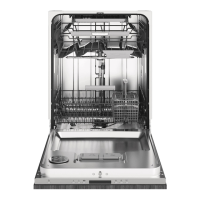
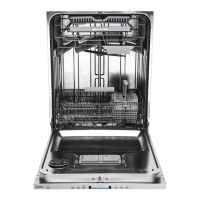
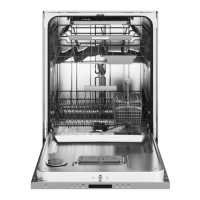
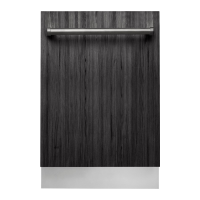
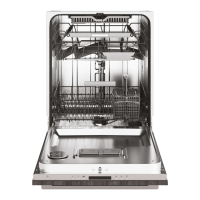
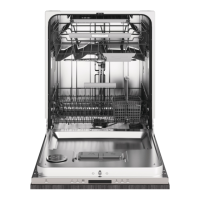
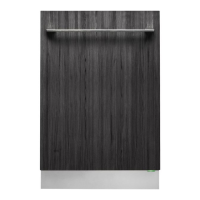
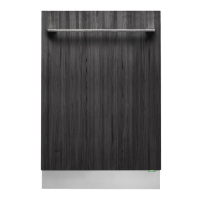
This document provides operating instructions for the ASKO Dishwasher DFI664XXL, covering its functions, usage, and maintenance.
The dishwasher features a display panel that illuminates when the main power switch is pressed and held. The first time the dishwasher is switched on, it displays "Welcome to your new ASKO. This is a first time set up," prompting the user to configure basic settings for optimal dishwashing results. The display panel includes a main power switch, a program mode selector, navigation buttons for program selection, and options for Delayed Start and Extra Dry.
Function Description
The dishwasher offers various programs and modes to suit different needs and soil levels:
- Normal wash: Recommended for daily, regular, or typical use with a full load of normally soiled dishes.
- ECO wash: Most effective in terms of combined energy and water consumption.
- Sanitation wash: An effective program for daily use with slightly dried leftovers, not intended for burnt food.
- Time program: Adapts to a specified running or finish time, requiring the user to select a time appropriate for the soil level (0:15-0:45 for lightly soiled, 1:00-1:30 for normally soiled, 2:00-2:30 for heavily soiled).
- Rinse and hold: Used to rinse dishes while waiting for a full load, preventing unpleasant odors.
- Plastic wash: Designed for dishwasher-safe plastic items, featuring an extra-long drying cycle. Porcelain and glasses can also be washed.
- Hygiene wash: Recommended for baby bottles and cutting boards requiring additional sanitation, with high temperatures in the main and final rinse.
- Crystal glass: A gentle program with low temperature for fragile crystal/glass items. Requires a small amount of detergent and careful placement to prevent items from touching.
- Self-cleaning: For sanitizing the dishwasher tub, spray arms, and spray pipes. Can be run without dishes using regular dishwasher detergent, citric acid, or special dishwasher cleaners.
- Upper half/Lower half: Programs for washing dishes only in the upper or lower basket, respectively.
Program modes include:
- Green mode: Uses less energy and water, extending program time.
- Speed mode: Shortens program time but uses more energy and water.
- Night mode: Lowers noise level during the program, extending program time.
- Intensive mode (Heat Boost): Improves dishwashing results, uses more energy and water, and extends program time.
Available options include:
- Extra Dry: Activates a higher temperature in the final rinse and a longer drying cycle for improved drying results, with a slight increase in energy consumption.
- Delayed Start: Allows the dishwasher to start 1-24 hours after pressing Start/Stop and closing the door.
The dishwasher also features an overflow guard function that pumps out water and turns off the supply if the water level exceeds normal.
Usage Features
To start the dishwasher:
- Load the baskets: Scrape off large food particles; do not rinse under running water.
- Check spray arms: Ensure they rotate freely and the water supply valve is on.
- Add detergent: Use the prewash and main wash compartments according to water hardness and detergent packaging instructions.
- Power on: Press and hold the main power switch until the display lights up.
- Check/Add rinse aid: Top up rinse aid if the indicator lights up, adjusting dosage in settings for optimal washing and drying.
- Select program, mode, and options: Use navigation buttons and the program mode selector.
- Start: Press and hold Start/Stop until "Program started, close door in 4 sec" appears, then close the door within four seconds.
The dishwasher provides a Status light™ at the bottom, indicating:
- Blue: Program has started (do not load).
- Red: Detergent compartment lid opened to add detergent (do not load). Flashing red indicates a problem.
- Green: Dishwashing program finished (unload).
To stop or change a program: Open the door, then press and hold Start/Stop for three seconds. Add more detergent if needed, then choose a new program, press Start/Stop, and close the door within four seconds.
Loading the dishwasher:
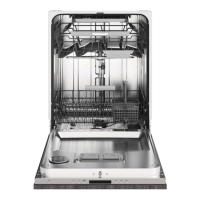
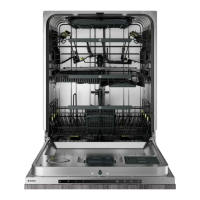
- Top cutlery tray: For cutlery, ladles, whisks, and other utensils. Can be raised or lowered.
- Upper basket: For glasses, cups, bowls, side plates, and saucers. Place soiled surfaces down. Wine glasses go on the wine shelf, knives on the knife stand. Can be raised or lowered.
- Lower basket: For plates, side plates, serving dishes, pots, and cutlery (in the cutlery basket). Pots and pans are best placed in the right rear for optimal cleaning from the WideSpray™ nozzles. Adjustable tines can be moved to accommodate large plates.
- Cutlery basket: Place cutlery with handles down (except knives), spread out to prevent stacking. Best placed in the middle front of the lower basket for optimal performance from the Power Zone Cutlery™ nozzle.
- Fold-down section for small items: In the cutlery basket, for small items or shafts.
- Foldable tines: In the lower basket, can be lowered for large pots.
Energy-efficient dishwashing tips:
- Run programs only with a full load.
- Run programs at a lower temperature if dishes are lightly soiled.
- Use Green mode.
- Open the door slightly after the program ends for better drying.
- Do not rinse under running water; simply scrape off large food particles.
- Choose a green detergent.
- Connect to cold water if the building is heated by oil, electricity, or gas.
- Connect to hot water (max. 160 °F (70 °C)) if heated by energy-efficient means (district heating, solar, geothermal) to cut dishwashing times and energy consumption.
Maintenance Features
Regular maintenance ensures optimal performance:
- Coarse filter: Traps larger food particles. Lift by the handle, empty, and replace as necessary.
- Fine filter: Automatically rinsed during each wash. Clean when necessary by turning the handle counterclockwise, lifting, and removing the coarse filter for cleaning. Replace in reverse order, ensuring edges seal properly and the handle points straight out.
- Spray arms: Holes and bearings can become blocked. Remove debris using a needle. Spray arms can be removed for cleaning by pushing up and turning counterclockwise (top spray arm) or pulling straight up (lower spray arm).
- Door and door seal: Clean regularly with a slightly damp cloth.
- Display panel: Keep buttons clean and free from grease; wipe with a dry or slightly damp cloth. Turn off the dishwasher before cleaning.
- Dishwasher tub: Made of stainless steel, kept clean through normal use.
- Limescale deposits: If hard water causes deposits, run the Self-cleaning program with two tablespoons of citric acid (no dishes). Special dishwasher cleaners are also available. Never use anti-freeze, Draino®, CLR®, or other chemical cleaners.
- Unblocking the drain pump: If water remains after a program, turn off the machine, unplug, remove coarse and fine filters, scoop out water, remove the colored stop in the bottom drain, turn the pump wheel by hand to remove items, replace parts, and plug in. If a whirring sound persists, the overflow protection may be triggered; turn off water, unplug, and call Customer Care.
Access by pressing the Navigation button until "Settings menu" is shown, then confirm with the mode selector.
- Language: Select display language.
- Select programs: Show or hide programs in the menu.
- Child lock: Activate to prevent children from starting the dishwasher. Temporarily deactivate/activate by pressing and holding the left Navigation button and the Delayed Start option button for 3 seconds.
- Display settings: Adjust display contrast and hide/show logo.
- Feedback sound: Adjust volume for button presses.
- Buzzer volume: Adjust volume for program end signal. Error messages always use a loud buzzer.
- Rinse aid: Adjust dosage (0-5). Increase for water marks, decrease for sticky white/blue film or streaks. Dilute 50:50 with water for very soft water and heavy foaming.
- Super rinse: Adds two extra rinses to Normal, ECO, Sanitation, Plastic, Lower half, and Upper half programs.
- High temperature: Activates a higher temperature for improved dishwashing results in Normal, ECO, Sanitation, Plastic, Lower half, and Upper half programs, with slightly increased energy consumption.



 To Next Page


 General
 Weight and Dimensions