781,1*6(7837,36
THESE STEPS PREPAREYOURTRUCK FOR MAXIMUM PERFORMANCE
There are several different adjustments on
your RC10GT truck can help you adjust
steering, traction , and the handling for dif-
ferent track conditions.
CLUTCH ADJUSTMENT AND ENGAGE-
MENT
When the engine revs increase, the
clutch shoes, attached to the flywheel on
the shaft within the clutch bell, are flung
outward by centrifugal force. The shoes
engage the inside of the clutch bell to turn
the bell and accelerate your truck. The
shorter the clutch shoes, the higher the
engine must rev before the shoes engage
(a shorter contact patch contributes to this
too). A clutch shoe at stock length engages
the clutch bell more quickly than the short
ones (we recommend using the stock
clutch shoe length for most conditions).
To adjust when your clutch engages, you
can change the number of clutch shoes or
alter their length. Changing your clutch
shoes mainly depends on the track condi-
tions.
In general, the better the traction, the
longer the shoes (quicker clutch engage-
ment, quicker acceleration).
The slicker the track, the shorter the
shoes (slower engagement), which pre-
vents tire spinning.
To decrease the clutch engagement,
try cutting the PTFE shoes one hole shorter
using a hobby knife. Do not trim away more
clutch than necessary, or engine damage
may occur.
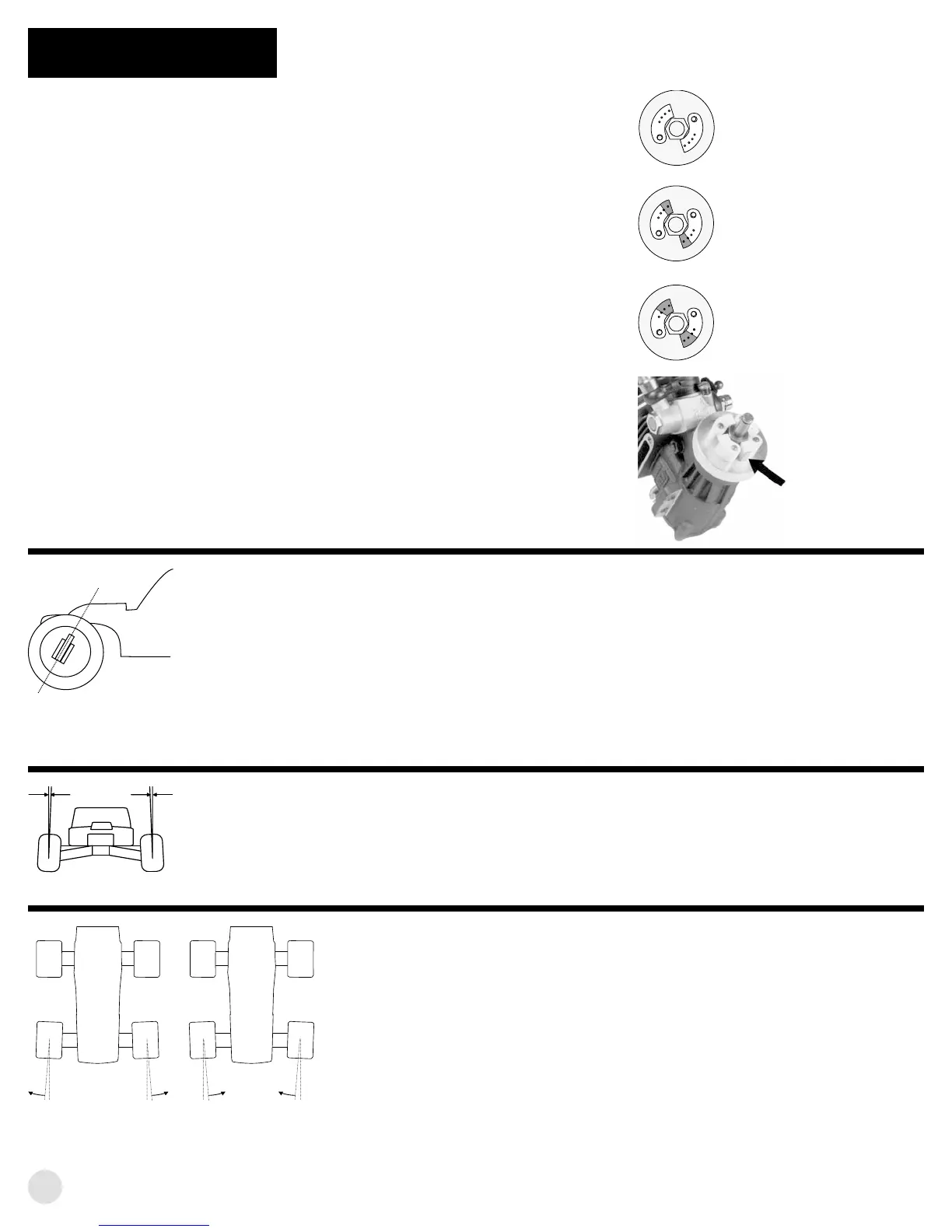
For best performance, try the Associ-
ated 4 shoe clutch #7611 (requires two sets
of #7601 clutch shoes, see photo). This
clutch will allow it to accelerate harder than
a 2-shoe clutch and engages more
smoothly. The four shoe clutch shoes need
to be trimmed before using them. We rec-
ommend cutting the shoes between the
second and third hole.
Maximum cut, for slowest
engagement.
Middle.
Standard, for quickest
engagement (recom-
mended for most condi-
tions).
CASTER
Caster de-
scribes the angle of
the kingpin in rela-
tion to the vertical
plane, when looked
at from the side of
the truck. 30° of
caster means the
kingpin leans rear-
Recommended:
30° caster blocks.
To get this: Use this:
5° caster #6211 front block carrier
10° caster #6212 front block carrier
15° caster #6213 front block carrier
20° caster #6214 front block carrier
25° caster #6215 front block carrier
30° caster #6210 front block carrier
ward at the top. 30° of caster (stock caster
blocks) will give your truck increased steer-
ing exiting corners. It will also be more
stable when accelerating through fast
bumpy track conditions. Less caster
(changing to block carriers with 25° of
caster) will decrease the amount of steer-
ing in the middle and exiting corners. It will
also tend to be less stable in fast, bumpy
conditions.
CAMBER
Describes the
angle at which the
tire and wheel rides
relative to the
ground when looked
at from the front or rear. Negative camber
means that the tire leans inward at the top.
Positive camber means just the opposite.
(Positive camber should never be used.)
Increasing negative camber (more than 3
degrees) will decrease traction and improve
stability in bumps. Less negative camber
(0 to 1 degrees) will have maximum amount
of traction but will be less stable in bumpy
conditions. We suggest using between 1
and 3 degrees of negative camber at all
times.
FRONT TOE-IN AND TOE-OUT
Toe-in will make your truck easier to
drive by improving stability during accel-
eration. Toe-out will increase steering when
entering corners but will be slightly more
difficult to drive. The front toe can be ad-
justed by adjusting the steering turnbuck-
les. We suggest using 0 degree toe on your
gas truck.
REAR TOE-IN
Rear toe-in affects front and rear trac-
tion. Decreasing rear toe-in decreases rear
traction and adds steering . Increasing rear
toe-in will do the opposite. Your Team and
Factory Team kit comes with 3 deg. toe-in
in each rear arm mount and 1.5 deg. toe-in
for each rear hub carrier. The RTR comes
with 0 deg. toe-in in each rear hub carrier.
These combinations work best for almost
all track conditions.
For less rear toe-in for your Team or
Factory Team kit, change to the #7365 hub
carriers. For more toe-in for the RTR,
change to the #7367 rear hub carriers.
Toe-inToe-out
Four shoe clutch
30





 To Next Page