Need help?
Do you have a question about the ATAGO AP-300 and is the answer not in the manual?
Specifies ambient temperature, power supply, and humidity for testing.
Provides an example of setting accuracy standards for measurements.
Describes checking accuracy and repeatability using known concentration samples.
Lists ATAGO part numbers for quartz control plates used for calibration.
Details how to prepare a 100°Z standard sucrose solution for measurements.
Mentions the need for a recording chart for measurement data.
Outlines initial steps for powering on, setting mode, date, time, and printer.
Instructions for zero-setting and measuring quartz plates or sucrose solutions.
Explains how to check recorded data consistency with printer output and memory.
Steps for filling out the report, calculating errors, and assessing results.
Covers instrument connection, power-on, mode setting, and printer checks.
Lists standard quartz control plates or sucrose solutions needed for function tests.
Details navigating menus using the MENU, cursor, and ENTER keys.
Explains the condition for a ZERO SET ERROR during zero-setting.
Describes how to trigger and interpret the OUT OF RANGE error message.
Details the steps to cause and identify a TEMP. ERROR.
Describes the default password and system level settings for security.
Instructions to verify the SYSTEM LEVEL is set to 0.
Section for recording standard values, test results, average, and difference.
A checklist for evaluating switch, key, display, error, and output functions.
Fields for Pass/Fail evaluation and signatures of operator and supervisor.
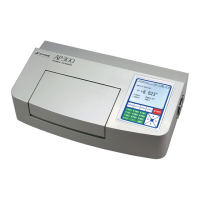
The ATAGO Automatic Polarimeter AP-300 is an optical instrument designed for precise measurement of the angle of rotation of sample solutions. It is suitable for use in various laboratory and industrial settings where accurate polarimetry is required.
The AP-300 measures the angle of rotation of a sample solution by utilizing two polarizing plates. This allows for the determination of the optical activity of substances, which is crucial for quality control, research, and development in fields such as pharmaceuticals, food and beverage, and chemistry. The instrument offers various functions beyond basic angle of rotation measurement, including the ability to export signals to a printer for record-keeping. It also incorporates features for setting measurement parameters and handling error conditions.
To ensure accurate measurements, the AP-300 should be operated in a controlled environment with an ambient temperature between 18.0°C and 22.0°C and relative humidity below 75%. The unit should be placed on a flat, level surface indoors. Before operation, both the instrument and the measurement sample should acclimate to the ambient temperature for at least 30 minutes.
The AP-300 features a user-friendly interface with a measurement screen that displays after a brief startup message. Key functions are accessible through the MENU, ZERO, START, QUIT, ENTER, and SCALE keys, as well as cursor keys (↓,↑) and a numeric keypad. The instrument can store the measurement values of the last 30 measurements in its memory, with newer values replacing older ones once the limit is exceeded. These stored values can be recalled on the screen, exported, and printed.
For standard measurements, the AP-300 can be set to read in either the Angle of Rotation Scale or the International Sugar Scale, with Automatic Temperature Compensation available for sucrose solutions. The instrument supports the use of standard quartz control plates with traceability certificates for calibration and performance verification. These plates, available in various angles (e.g., 8°, 17°, 34°), offer a convenient and accurate method for checking the instrument's performance without extensive preparation. Alternatively, a standard sucrose solution of 100°Z can be prepared and used for verification.
The AP-300 includes several error messages to guide the user in case of incorrect operation or out-of-range conditions. "ZERO SET ERROR" indicates that zero-setting was attempted with a sample outside the acceptable range of -5° to +5° of Angle of Rotation. "OUT OF RANGE" is displayed when a measurement exceeds the set upper and lower limit bars. "TEMP. ERROR" occurs if the thermal sensor is removed or not properly installed when using the International Sugar Scale TC (Automatic Temperature Compensation) screen.
The instrument also incorporates a password function for enhanced security, allowing users to control access to certain settings and functions. The default password and system level can be changed by the user.
Regular operational qualification (OQ) is recommended to ensure the AP-300 maintains its performance and accuracy. This involves conducting performance tests and function examinations. The performance test includes measuring standard quartz control plates or sucrose solutions and recording the measured values to confirm accuracy and repeatability. The function examination involves checking the operation of various keys, display functions, error messages, and output functions.
For record-keeping, the AP-300 can be connected to an exclusive printer. The printer uses heat-sensitive rolled paper, and ATAGO also offers heat-sensitive roll paper designed for long-term storage with limited fading. It is important to check the printer settings, including date, time, average values, and sample numbers, to ensure accurate printouts.
The OQ process concludes with an Operation Qualification Results Report, where measurement data, average values, and errors are recorded. The results are assessed against a discretionary measurement standard, and the report is signed by the operator and an approved supervisor. This systematic approach ensures the instrument consistently meets its operational requirements and maintains data integrity.
 General
| Model | AP-300 |
|---|---|
| Measurement Range (Refractive Index) | 1.3000 to 1.7000 |
| Resolution (Refractive Index) | 0.0001 |
| Minimum Indication (Optical Rotation) | 0.01° |
| Measurement Wavelength | 589 nm |
| Measurement Range (Brix) | 0.0 to 95.0% |
| Resolution (Brix) | 0.1% |
| Accuracy (Brix) | ±0.1 % |
| Display | LCD |
| Light Source | LED |
| Temperature Compensation | Automatic |
| Sample Volume | 0.3 mL |
| Power Supply | AC adapter or battery |
| Battery | Lithium-ion |

 To Next Page