THE COOLING SYSTEM.
Precautions to take against Freezing and
Overheating
T
HE cooling of the engine is maintained by a capacious radiator which
should be filled with rain water if available, up to within about
onc inch of the top of the filler. The capacity of the radiator.
pipes and cylinder jackets is 9-10pints.
In Winter an anti-freezing
mixture should be added to the water
in the radiator, because in very
severe weather the water may freeze
and thus damage the cylinder block
or the radiator itself. Moreover,
when an anti-freeze mixture is used,
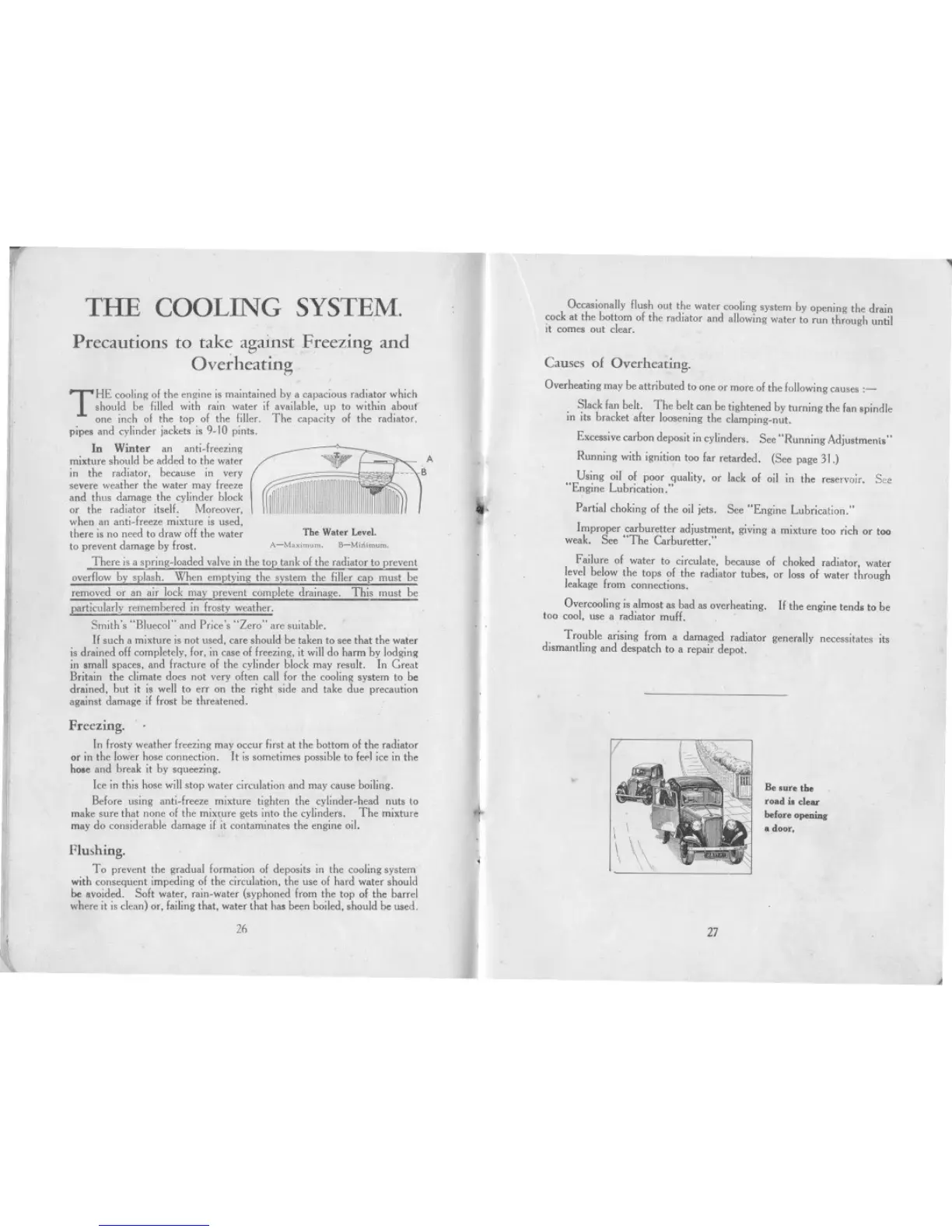
there is no need to draw off the water The Water Level,
to prevent damage by frost, A-M"imum. B-Mioimum.
There is a spring-loaded valve in the top tank of the radiator to prevent
overflow by splash, When emptying the system the filler cap must be
removed or an air lock may prevent complete drainage. This must be
particularly remembered in frosty weather,
Smith's "Bluecol" and Price's "Zero" are suitable.
If such a mixture is not used, care should be taken to see that the water
is drained off completely, for, in case of freezing, it will do harm by lodging
in small spaces, and fracture of the cylinder block may result. In Great
Britain the climate does not very often call for the cooling system to be
drained, but it is well to err on the right side and take due precaution
against damage if frost be threatened.
I;
Kc
Freezing.
In frosty weather freezing may occur first at the bottom of the radiator
or in the lower hose connection. It is sometimes possible to fed ice in the
hOle and break it by squeezing.
Ice in this hose will stop water circulation and may cause boiling.
Before using anti-freeze mixture tighten the cylinder-head nuts to
make sure that none of the mixr.ure gets into the cylinders. The mixture
may do considerable damage if it contaminates the engine oil.
11.
I'
Flushing.
To prevent the gradual formation of deposits in the cooling system
with consequent impeding of the circulation, the use of hard water should
be avoided. Soft water. rain-water (syphoned from the top of the barrel
where it is clean) or, failing that, water that has been boiled, should be used.
26
l'
,.
.
!
-
~
Occasionally flush out the water cooling system by opening the drain
cock at the bottom of the radiator and allowing water to run through until
it comes out clear.
Causes of Overheating.
Overheating may be attributed to onc or more of the following causes :-
Slack fan belt. The belt can be tightened by turning the fan spindle
in its bracket after loosening the clamping-nut,
Excessive carbon deposit in cylinders. See "Running Adjustments"
Running with ignition too far retarded. (See page 31.)
Using oil of poor quality, or lack of oil in the reservoir. Se.
"Engine Lubrication."
Partial choking of the oil jets. See "Engine Lubrication."
Improper carburetter adjustment, giving a mixture too rich or too
weak. See "The Carburetter."
Failure of water to circulate, because of choked radiator, water
level below the tops of the radiator tubes, or loss of water through
leakage from connections.
Overcooling is almost as bad as overheating,
too cool, use a radiator muff.
Trouble arising from a damaged radiator
dismantling and despatch to a repair depot.
If the engine tends to be
generally necessitates its
Be .ure tbe
road it clear
before opeuU,g
a door.
I \
\ \\
27
I


 To Next Page