...",.
,
RUNNING ADJUSTMENTS
dropped on a "live" wire or terminal,
thu" causing a short and possible
edamage. Therefore disconnect the
battery cable at the battery for safety.
First drain the water through
the tap under the radiator. Detach
the top water tube from the head.
Disconnect the high tension wires
from the sparking plugs. Remove
the nuts holding down the head.
Then take hold of the head at each
end and lift it off.
This should be fairly easy to do,
without damaging the joint washer
or gasket. which. in the ordinary
course, may be in a condition to be
used again.
If it is damaged or otherwise not
in good condition the gasket should
be replaced by a new one.
Decarbonising; Valve Grinding; Tappet
Adjustment
,
T
HE adjustments set out below
are all that the owner will find
it necessary to make to keep the
<:arin good running order.
Unless the work i~ thoroughly
understood. however. it is strongly
recommended that the car be taken
to an Austin Dealer. .
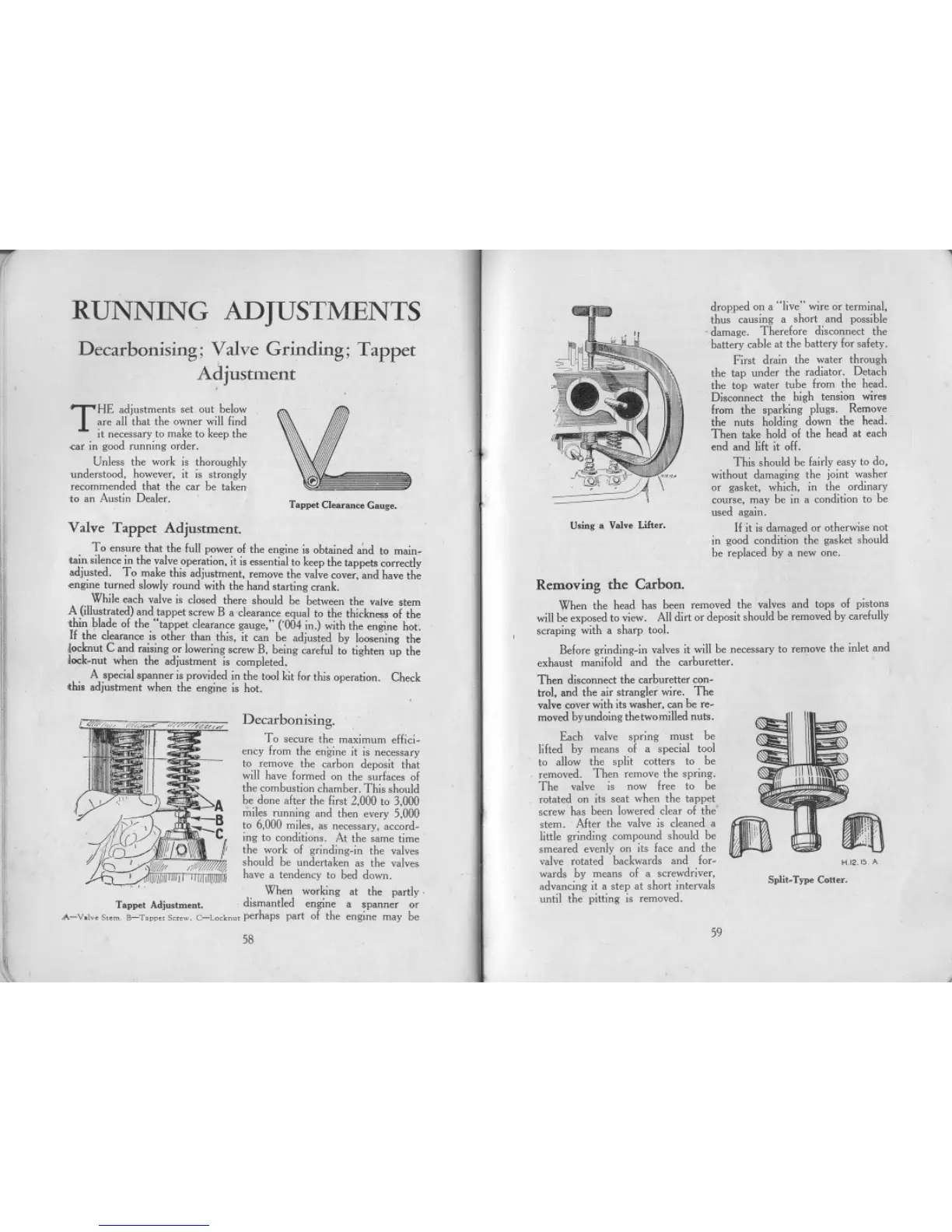
Tappet Clearance Gange.
Us;"g . Valve Lifter.
Valve Tappet Adjustment.
To ensure that the full power of the engine is obtained ';'d to main-
tair"ilence in the valve operation, it is essential to keep the tappets correctly
adjusted. To make this adjustment, remove the valve cover. and have the
"ngine turned slowly round with the hand starting crank.
While each valve is closed there should be between the valve stem
A (illustrated) and tappet screw B a clearance equal to the thickness of the
thin blade of the "tappet clearance gauge," ('004 in.) with the engine hot.
If the clearance is other than this. it can be adjusted by loosening the
locknut C and raising or lowering screw B. being careful to tighten up the
lock-nut when the adjustment is completed.
A special spanner is provided in the tool kit for this operation. Check
this adjustment when the engine is hot.
f
I
Removing the Carbon.
When the head has been removed the valves and tops of pistons
will be exposed to view. All dirt or deposit should be removed by carefully
scraping with a sharp tool.
Before grinding-in valves it will be necessary to remove the inlet and
exhaust manifold and the carburetter.
Then disconnect the carburetter con-
trol, and the air strangler wire. The
valve cover with its washer, can be re-
moved byundoingthetwomilled nuts.
Each valve spring must be
lifted by means of a special tool
to allow the split cotters to be
removed. Then remove the spring.
The valve is now free to be
rotated on its seat when the tappet
screw has been lowered clear of the
stem. After the valve is cleaned a
little grinding compound should be
smeared evenly on its face and the
valve rotated backwards and for-
wards by means of a screwdriver.
advancing it a step at short intervals
until the pitting is removed.
I
I
I
I
,
I
1
I
I
I
I
I
Decarbonising. '.
To secure the maximum effici-
ency from the engine it is necessary
to remove the carbon deposit that
will have formed on the surfaces of
the combustion chamber. This should
be done after the first 2,000 to 3.000
miles running and then every 5.000
to 6.000 miles, as necessary. accord-
ing to conditions. At the same time'
the work of grinding-in the valves
should be undertaken as the valves
have a tendency to bed down.
When working at the partly.
Tappet Adjustment. dismantled engine a spanner or
;'-V.lv< S"rn. B-T.p", Smw. C-Lockno'perhaps part of the engine may be
H.I2.'5. A
Split-Type Cotter.
59
58
" ,


 To Next Page