--;>
~
spindle by lifting it off and add a few drops of thin oil to the top of .the
spindle. Do not remove the screw exposed to view, as tbere is a clearance
between the screw and the inner face of the spindle tbrough which the oil
passes to luhricate tbe cam bearing. Take care to refit the arm correctly and
to push it on to the shaft as far as possihle.
The moving parts of tbe automatic timing control must he lubricated
with a good grade thin engine oil. To render the control accessible,
remove the distributor moulding and lift off the rotating distributor arm.
Then remove the contact hreaker moulding by withdrawing its two
securing screws. Take care to refit the contact hreaker moulding in its
original position. .
11
11
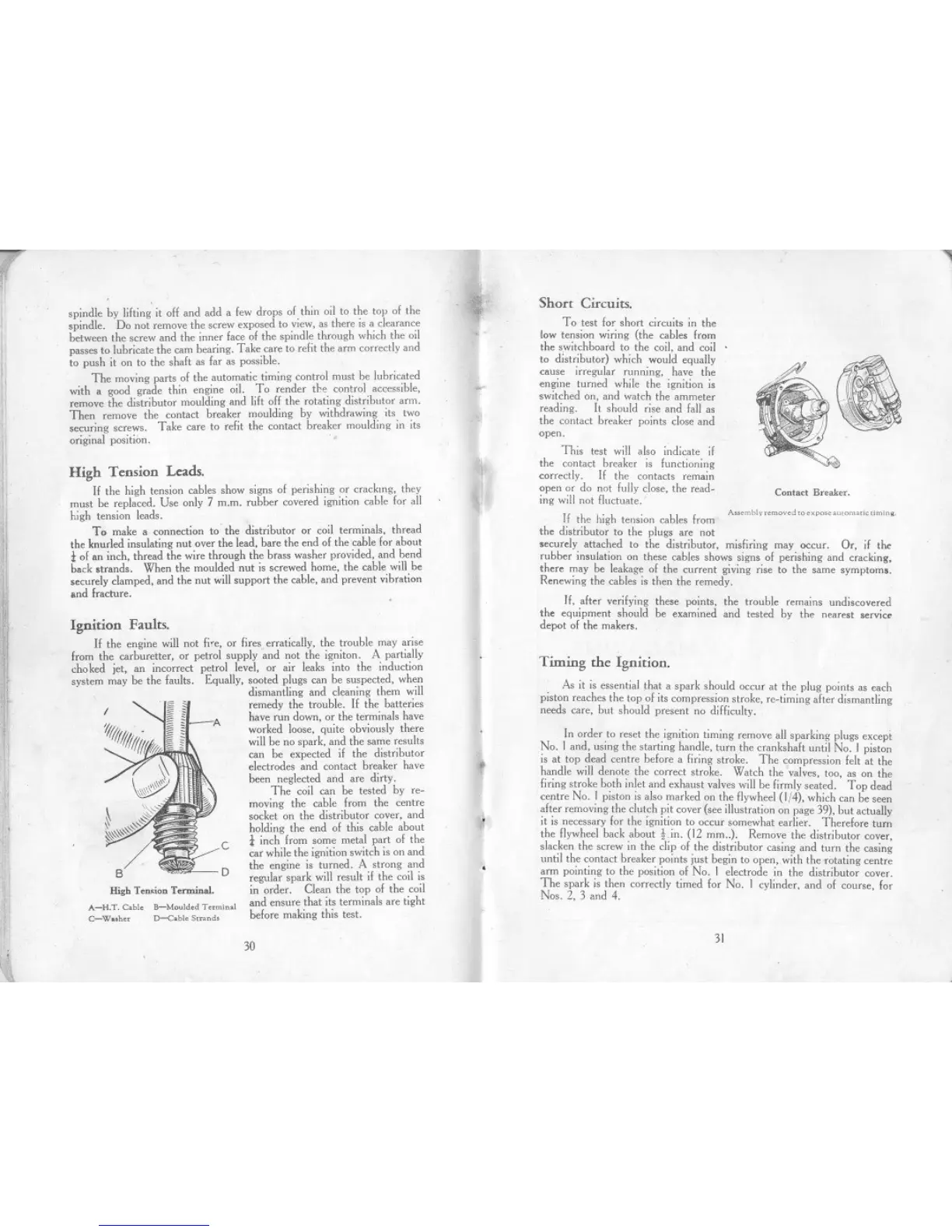
High Tension Leads.
If the high tension cables show signs of perishing or crackmg, they
must be replaced. Use only 7 m.m. rubber covered ignition cable for all
higb tension leads.
To make a connection to tbe distributor or coil terminals. thread
the knurled insulating nut over the lead, bare the end of the cable for about
1of an inch, thread tbe wire tbrough the hrass washer provided, and bend
back .trand" When the moulded nut is screwed home, the cable will be
.ecurely clamped, and the nut will support the cable, and prevent vibration
and fracture.
il
il~i
Ignition Faults.
If the engine will not fi<e, or fires erratically, the trouhle may arise
from the carhuretter, or petrol supply.and not the igniton. A partially
choked jet, an incorrect petrol level, or air leaks into the induction
system may be tbe faults. Equally, sooted plugs can be suspected, when
dismantling and cleaning them will
remedy the trouble. If the batteries
have run down, or the terminals have
worked loose, quite obviously there
will be no spark, and the same results
can be expected if the distributor
electrodes and contact hreaker have
been neglected and are dirty.
The coil can be tested by re-
moving the cable from the centre
socket on the distributor cover, and
holding the end of this cable ahout
1inch from some metal part of the
car while the ignition switch is on and
the engine is turned. A strong and
regular spark will result if the coil is
in order. Clean the top of the coil
A-H.T. C,bl, B-Mould,dT,=io,l and ensure thatit~ terminals are tight
C-Wuh" D-C,bl, S,mod. before making thIS test.
Ii
D
I
cH
'
!
"
I
111
,'"
I:j~ c
,~~
,."
High Temion Terminal.
il
,
'
'I
"
:,
30
l
B;
I
po'
I
'i.
I
il,
"
.
i
'j
,
Short Circuits.
To test for short circuits in the
Iow tension wiring (the cables from
the switcbboard to the coil, and coil .
to distributor) which would equally
cause irregular running, have the
engine turned while the ignition is
switched on, and watch the ammeter
reading. It should rise and fall as
the contact breaker points close and
open.
This test will also indicate if
the contact breaker is functioning
correctly. If the contacts rcmain
open or do not fully close, the read-
ing will not fluctuate.
I
. .
I f
A..,mbl",mo"d<O"'O".u<om"',"m'o,.
f the high tension cab es ram
the distributor to the plugs are not
.ecurely attached to the distributor, misfiring may occur. Or, if the
rubber insulation on these cables shows signs of perishing and cracking,
there may be leakage of the current giving rise to the same symptom..
Renewing the cables is then the remedy.
If, after verifying the,e points, the trouble remains undiscovered
the equipment should be examined and tested by the nearest service
depot of the makers.
Contact Breaker.
Timing the Ignition.
As it is essential that a spark should occur at the plug points as each
piston reaches the top of its compression stroke, re-timing after dismantling
needs care, but should present no difficulty.
In order to reset the ignition timing remove all sparking plugs excepi
No. I and, using the starting handle, turn the crankshaft until No. I piston
is at top dead centre before a firing stroke. The compression felt at the
handle will denote the correct stroke. Watch the valves, too, as on the
firing stroke both inlet and exhaust valves will be firmly seated. Top dead
centre No. I piston is also marked on the flywheel (1/4), which can be seen
after removing the clutch pit cover (see illustration on page 39), but actually
it is necessary for the ignition to occur somewhat earlier. Therefore turn
the flywheel back about t.in. (12 mm..). Remove the distributor cover,
slacken the screw in the clip of the distributor casing and turn the casing
until the contact breaker points just hegin to open, with the rotating centre
arm pointing to the position of No. I electrode in the distributor cover.
Tbe spark is then correctly timed for No. I cylinder, and of course, for
Nos. 2, 3 and 4.
31


 To Next Page
 Loading...