PRELIMINARY NOTES
If tester has not been used for a period of time, moisture may have
condensed between carbon pile discs. This will cause the tester to steam
a little during rst or second load application. This is normal and is not a
malfunction of the tester. (Do not confuse this with heat due to overloading
the tester.)
2. BATTERY RATING
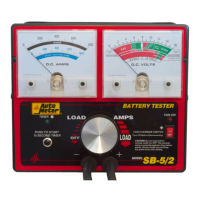
Most batteries are rated in Cold
Crank Amps or Amp-Hours. This
tester uses a stabilized variable
load carbon pile that allows each
battery to be tested at its proper
rating. For batteries rated in Cold
Crank Amps, a load equal to one
half the rated CCA is applied using
the Amps scale on the meter. For
Amp-Hour rated batteries, a load
three times the Amp-Hour rating is
applied using the Amp scale.
3. BATTERY
4. TESTER HOOKUP
Take special care when connecting to
side terminal batteries. If necessary,
use a side post adapter to prevent
thread damage. When testing dual post
batteries always check the post to which
the system is attached. If a load test is
made from a post connection and the
alternator is mounted to side terminals
a battery load test can be completed,
but a continuity problem may still be
in the side terminals when testing the
alternator.
TEMPERATURE
The temperature of the electrolyte
and plates inside a battery affects
its output capability. As a result,
it is necessary for the service
technician to closely estimate the
battery’s temperature when testing.
This tester has temperature ranges
clearly shown on Pass/Fail bands,
so that accurate test results can be
obtained easily.
1. MOISTURE


 To Next Page