Need help?
Do you have a question about the Autool CT500 and is the answer not in the manual?
Before using the instrument, please read this manual carefully for proper operation and safety.
Explains the mechatronics product and its key functions like ultrasonic cleaning and various tests.
Highlights powerful ultrasonic cleaning, electronic pressure control, and a high-quality oil pump.
Details power supply, frequency, humidity, temperature, and magnetic field strength requirements.
Lists specifications like fuel tank capacity, ultrasonic cleaning power, rotation range, and pressure settings.
Labeled diagram illustrating the device's main parts such as the oil rail, measuring cylinders, and cleaning tank.
Explains the operation panel, including the TFT color screen, function buttons, and pressure adjustment controls.
Step-by-step guide for using ultrasonic waves to clean fuel injectors effectively.
Instructions for preparing the fuel injector and cleaning tank before commencing ultrasonic cleaning.
Details how to detect atomization, dripping, blockage, and injection volume of fuel injectors.
Steps to prepare the equipment and add test liquid for accurate injector diagnostics.
Diagram and steps for correctly installing fuel injectors into the oil rail and connecting them.
Procedure for performing the idle speed test on fuel injectors to check their performance.
Steps for conducting medium and high speed tests on fuel injectors.
Procedures for performing accelerating and variable speed tests on fuel injectors.
Tests for injector leakage and spray patterns at idle, medium, and high speeds.
Checks fuel injection volume balance, spray patterns, and valve tightness.
Covers cleaning methods like reverse flushing and cleaning without disassembly.
Steps for performing the pulse injection test on fuel injectors.
Instructions for properly storing the fuel injector tester when not in use.
Procedures for replacing test agent and managing fuses for optimal performance.
Guidelines for maintaining the product's performance, appearance, and longevity.
Details on how to access warranty services and conditions that may void the warranty.
Legal notice regarding manual accuracy, product variations, and limitations of liability.
Information on the policy and steps for returning or exchanging purchased AUTOOL products.
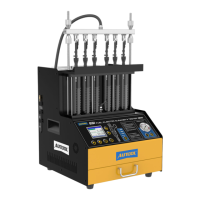
The AUTOOL CT500 GDI Fuel Injector Cleaner & Tester is a sophisticated mechatronics product designed for the diagnostic and cleaning of fuel injectors in various automobiles and motorcycles. It integrates ultrasonic cleaning technology with microcomputer oil pressure closed-loop control for both cleaning and detection. This equipment simulates diverse engine operating conditions, making it an essential tool for the automotive and motorcycle repair and maintenance industry, as well as for research, teaching, and training departments.
The AUTOOL CT500 offers a comprehensive suite of functions for maintaining and diagnosing fuel injectors:
Ultrasonic Cleaning: This core function utilizes penetrating and cavitation shock waves generated by ultrasonic waves propagating through a medium. It effectively cleans objects with complex shapes, cavities, and pores, thoroughly removing stubborn carbon deposits and internal blockages from fuel injectors. This can be performed on single or multiple injectors simultaneously.
Uniformity Detection: The device measures and detects the uniformity of the injection volume for each individual injector, ensuring consistent fuel delivery across all cylinders.
Atomization Observation: Equipped with a bright background light, the CT500 allows for a comprehensive and careful observation of the spray atomization pattern of the nozzle. This helps in identifying irregularities in the fuel spray.
Tightness Test: This function checks the tightness and assesses for any dripping from the fuel injector under high-pressure conditions, ensuring the injector seals properly and prevents leaks.
Fuel Injection Volume Detection: The equipment can accurately detect the fuel injection volume of the nozzle under specific working conditions, such as a set time or a specific number of injection cycles.
Idle Speed Test: Simulates engine operation at idle speed to assess injector performance under these conditions.
Medium Speed Test: Evaluates injector performance at medium engine speeds.
High Speed Test: Tests the injectors under high engine speed conditions.
Accelerating Test: Automatically cycles through three times to simulate the working condition and fuel injection volume of the fuel injector when the engine is accelerating uniformly. The system automatically sets fuel pressure, working time, and pulse width, with a default cycle period of 10 seconds.
Variable Speed Test: Similar to the accelerating test, this function simulates working conditions and fuel injection volume when the engine is idling, at medium speed, and at high speed, cycling three times automatically.
Leakage Test: Specifically designed to detect the tightness of the injector needle valve under high system pressure. Users observe for any leakage within one minute. The pulse width for this test defaults to 3ms.
Idling Spray Value Test: Simulates engine idling conditions to determine the fuel injection volume when the nozzle works for a certain number of times.
Medium Speed Spray Value Test: Extends the spray value test to medium engine speeds.
High Speed Spray Value Test: Conducts the spray value test at high engine speeds.
Flow Balance Test: This test is performed at different speeds. When the liquid level in the measuring cylinder reaches 2/3, the process can be paused or stopped to observe the balance of the fuel injection volume. The deviation of fuel injection volume among all nozzles on a vehicle should ideally not exceed 2%, or users can refer to the injector's technical manual for specific guidelines.
Observation of Fuel Injection Shape: Allows users to observe whether the fuel injection shapes and angles of all fuel injection nozzles on the same car are uniform at various speeds. The opening pulse width can be adjusted to check the minimum opening pulse width consistency.
Leak Detection Test: This test focuses on the tightness of the injector needle valve under high system pressure, with an expectation of no leakage within one minute.
Reverse Flushing: This function allows for cleaning the injectors by installing them in the opposite direction, facilitating a thorough flush.
No-disassembly Cleaning: This feature enables cleaning without disassembling the injectors, by connecting to special parts that can clean the combustion chamber or throttle. The cleaning time can be set up to 20 minutes.
Pulse Injection Test: A general test to set specific pulse width and pulse times for injector operation.
Wide Pulse Injection Test: A variation of the pulse injection test with wider pulse settings.
Continuous Injection Test: Allows for continuous injection testing, with a recommended working time of less than 30 seconds.
The AUTOOL CT500 is designed for user-friendliness and efficiency:
HD Color Display: Features an HD color display that makes operation clear and easy to learn, providing a visual interface for all functions.
Visual Oil Tank Liquid Level: The oil tank liquid level is displayed visually, and the detection liquid can be recycled, promoting economical use.
Bright Background Light: A bright background light enhances visibility, allowing users to clearly observe the fuel injector's operation.
Replaceable Composite Joints: Comes with replaceable composite joints, making it suitable for a wide variety of vehicle types.
Adjustable Parameters: Within the allowable adjustment range, users can arbitrarily adjust test time, working frequency, fuel injection times, and the shortest switching period of the fuel injector.
Powerful Ultrasonic Cleaning: Employs powerful ultrasonic cleaning technology for strong cleaning ability.
Electronic Pressure Regulating Control: Utilizes electronic pressure regulating control technology, ensuring stable oil pressure and a wide adjustable range for precise testing.
High-Quality Oil Pump: Equipped with a high-quality oil pump to ensure long-term stable and reliable performance.
Safety Precautions: The manual emphasizes critical safety warnings, such as not placing objects near the quartz glass test device to prevent breakage, checking power supply and fuse if the display is off, and strictly prohibiting ultrasonic cleaning without cleaning agent in the tank. It also warns against mixing cleaning and testing agents and using unauthorized agents or solvents like kerosene or gasoline, which can damage the equipment.
Proper maintenance ensures the longevity and optimal performance of the AUTOOL CT500:
Regular Cleaning: After each test solution change, the system must be cleaned, and 1L of new test solution should be added. After finishing cleaning, injectors should be wiped with a soft cloth. The control panel should be cleaned regularly, and the pulse signal cable kept away from liquid.
Storage Procedures: For storage, especially long-term, the power should be turned off, the power plug unplugged, all connectors returned to the accessory box, ultrasonic cleaning agent drained, and the equipment wiped clean with a dry soft cloth. The testing agent should be discharged into a bottle and sealed.
Test Agent Replacement: When the test agent accumulates impurities, it must be replaced to prevent blockage of fuel injectors. The process involves draining the old agent, cleaning the tank with a little testing agent, draining again, and then pouring 1L of new testing agent.
Fuse Replacement: The device includes a fuse located in a square box on the power socket. If the fuse is blown, it can be easily replaced with a new one by opening the box.
General Maintenance Guidelines:
The AUTOOL CT500 is designed with durability in mind, undergoing 35 production procedures and 12 testing and inspection steps to ensure high quality and performance. AUTOOL prides itself on superb design and excellent service, offering support and services to its users.
 General
| Connectivity | USB |
|---|---|
| Input Power | 250W |
| Fuel Tank Capacity | 2000ml |
| Power Supply | AC 220V±10%, 50/60Hz |
| Pulse Width | 0.5-25ms; Step: 0.1ms |
| Working Temperature | 0°C - 40°C |
| Storage Temperature | -10°C - 50°C |
| Relative Humidity | <85% |
| Injection Times | 0-9999 times; Step: 100 times |

 To Next Page