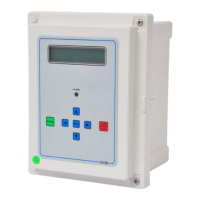
S – 150 Controller User Manual
MKTF – 429-A 8 08/16
INSTALLATION
Physical Installation
Mount the S – 150 Series controller in a convenient location on the RO equipment using the four mounting
ears provided with the unit or the optional panel mounting bracket.
NOTE: All terminals on the board are labeled.
Terminal Strip, Jumper and Adjustment Locations
Refer to Figure 2 for the location of all terminal strips and connectors. Figure 2 also shows all jumper and
adjustment locations. Figure 3 shows a sample wiring diagram.
Power Wiring
Refer to Figure 2 and Figure 3 for the terminal strip locations. AC power for the unit is connected to
terminal strip P1. Connect the ground wire of the AC power to the terminal labeled GND. For AC power
with a neutral and hot wire, the hot wire connects to L1 and the neutral wire connects to L2. For AC power
with two hot wires, either wire can connect to L1 and L2. On AC power with two hot wires, the wire jumper
between P6 and P7 should be removed and a fuse (GMA 1/4A) installed in F2.
Pump and Valve Relay Outputs
The S – 150 Series controller supplies relay outputs to control the RO pump and solenoid valves.
NOTE: The relays output the same voltage as the AC power to the board. If the pump and solenoids
operate on different voltages, a contactor will need to be supplied to operate the pump.
RO Pump Wiring
The RO pump connects to the L1 and L2 RO pump terminals of P1. This output can operate 120/240VAC
motors up to 1HP directly. For motors larger than 1HP or 3 phase motors, this output can be used to
operate a contactor.
Inlet and Flush Valve Wiring
The inlet and flush valves must operate at the same voltage as supplied to the board. These outputs can
supply 5A maximum and are not designed to operate pump motors directly. If these outputs are to be
used to operate a boost or flush pump, the output should be used to operate a contactor. The inlet valve
connects to the L1 and L2 inlet terminals of P1. The flush valve connects to the L1 and L2 flush terminals
of P1.


 To Next Page