9
•Each new tip should be pre-rinsed with the liquid to be
pipetted.
•
Liquid should never enter the AXYPET shaft. To prevent
this:
- Press and release the pushbutton slowly and smoothly.
- Never turn the pipette upside down.
- Never lay the pipette on its side when there is liquid in
the tip.
•
Never force the volume setting beyond its recommended
limits.
•When pipetting liquids with temperatures different from
the ambient temperature, it is recommended to pre-rinse
the tip several times before use.
•Do not pipette liquids with temperatures above 70°C.
•When pipetting acids or corrosive solutions which emit
vapours, it is recommended to disassemble the shaft
and rinse the piston and seal with distilled water after
finishing the pipetting operation.
8 - RECALIBRATION
AXYPETs Pipettes are calibrated by gravimetrically,
using
AXYGEN tips and distilled water, at a temperature
of 20±1°C, according to EN ISO 8655 standard.
If during pipette operation you find that the accuracy
error (the difference between the real aspirated volume
and the preset volume) exceeds the permissible value
given in the table in section 1, the pipette recalibration
procedure should be carried out.
Before starting the recalibration it is necessary to check
whether the following requirements have been met during
error determination:
•the ambient temperature, and the temperature of the
pipette, tips and water was identical
•the density of the liquid used is close to that of distilled
water
•a balance with appropriate sensitivity has been used.
•mg/μl conversion factor has been taken into account
10
ENGLISH
•the requirements shown in sections 3 and 7 have been
met
If the above conditions are satisfied and the accuracy
error for selected volume given in section 1 exceeds the
permissible value, the pipette recalibration procedure
should be carried out.
The recalibration can be performed within one full turn of
the key to the right or to the left only.
Recalibration conditions:
Ambient temperature, the temperature of the pipette, tips
and liquid should be within the range 20-25°C and
stabilised during weighing within ±0.5°C
•Measurements should be conducted using distilled
water
•Balance sensitivity should be suitable for the volume to
be measured
Recalibration procedure:
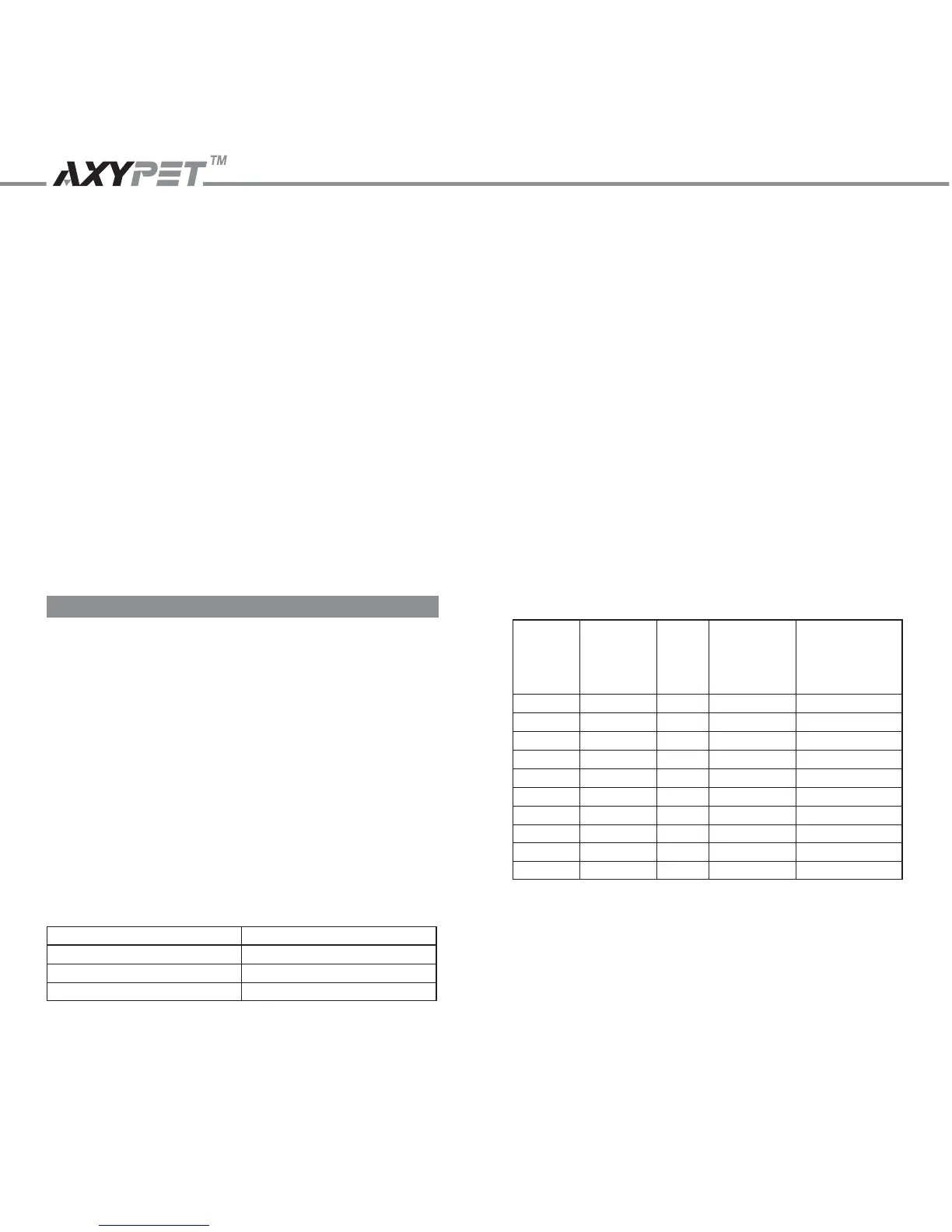
•Set the dose volume depending on the pipette volume
according to the following table:
•Perform 5 aspirations, weigh each one and calculate
the average value of the aspirations
•Calculate average aspirated volume in μl multiplying
the average aspiration amount [mg] by the distilled
water density coefficient [μl/mg], which depends on
temperature and pressure according to the following
table:
Model
Range
of the pipette
volumes
[μl]
Preset
volume
[μl]
Permissible
volumes
[μl]
Volume change
Δ
V for full turn
of the
calibration key [μl]
(24 increments)
AP-2
AP-10
AP-20
AP-50
AP-100
AP-200
AP-250
AP-1000
AP-5000
AP-10ML
0.1 - 2
0.5 - 10
2 - 20
5 - 50
10 - 100
20 - 200
50 - 250
100 - 1000
1,000 - 5,000
1,000 - 10,000
0.2
0.5
2
5
10
20
50
100
1,000
1,000
0.176 - 0.224
0.48 - 0.52
1.94 - 2.06
4.875 - 5.125
9.84 - 10.16
19.76 - 20.24
49.5 - 50.5
98.4 - 101.6
994 - 1,006
975 - 1,025
0.06
0.33
0.63
2.50
2.50
6.30
6.30
25.00
125.00
250.00
Volume checked [μl] Balance sensitivity [mg]
0.1 - 10
≤ 0.001
10 - 100
≤ 0.01
> 100
≤ 0.1


 To Next Page
 Loading...