Need help?
Do you have a question about the Azbil HY7045T1000 and is the answer not in the manual?
Introduces the product as an electronic room sensor for measuring relative humidity and temperature.
Highlights the main advantages, including wide sensing range, high accuracy, stability, and environmental resistance.
Specifies applications where the product should not be used or requires specific safety measures, along with hazard symbols.
Details the expected safe and reliable operational period based on design specifications.
Lists available model numbers for humidity and temperature/humidity sensors with their specifications.
Describes optional parts such as mounting kits and other accessories that can be used with the sensor.
Provides detailed technical data for measuring range, accuracy, output, and time constant for humidity sensors.
Details technical specifications for combined temperature and humidity sensors.
Outlines common specifications like power supply, environmental conditions, weight, and materials.
Presents diagrams and measurements for the main sensor unit and its various mounting kits.
Specifies ideal and prohibited locations for sensor installation to ensure accurate measurements.
Step-by-step instructions for installing the sensor using the wall-direct mounting kit.
Guides for installing the sensor with thermoplate for open wiring and standard thermoplate mounting.
Instructions for mounting the sensor within the multi-thermocase, including cover removal.
Details how to adjust the sensor's position for optimal accuracy against heat radiation and conduction.
Illustrates wiring configurations for different sensor models and power supply types.
Provides guidance on DC and AC power supply wiring, including important warnings about sharing transformers.
Instructions for wiring when replacing an existing sensor with the new model.
Addresses potential electrical noise issues and provides notes for signal wiring to ensure accuracy.
Advises on proper installation practices to avoid heat or steam interference and confirms wiring.
Covers sensor inspection, accuracy tuning, and troubleshooting common abnormal conditions.
Provides instructions for protecting the sensor in special environments and for its industrial waste disposal.
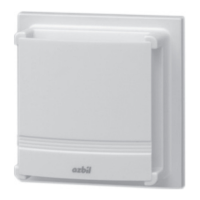
This document describes the Azbil Room Humidity Sensor and Room Temperature/Humidity Sensor, electronic devices designed for wall-mounted installation to measure relative humidity and temperature in indoor environments. These sensors are suitable for various indoor applications, including air conditioning in general buildings.
The sensor is an electronic device that measures relative humidity and, for specific models, temperature. It is designed to be mounted on a wall within a room to provide accurate environmental data.
Two main types of sensors are available:
The temperature sensing element utilizes a highly accurate and reliable resistance temperature detector (Pt100). The humidity sensing element is a polymer capacitive humidity detector, a technology developed by Azbil Corporation, ensuring wide measurement range and excellent stability.
Room Humidity Sensor (Model HY7045T1000 series):
Room Temperature/Humidity Sensor (Model HTY7045T1100, HTY7045T1P00 series):
Common Specifications:
 General
| Brand | Azbil |
|---|---|
| Model | HY7045T1000 |
| Category | Security Sensors |
| Language | English |

 To Next Page