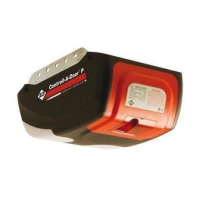
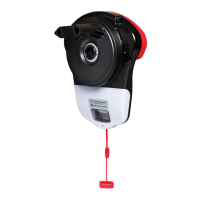
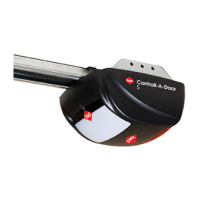
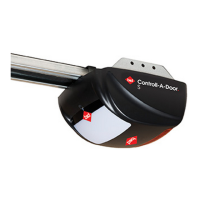
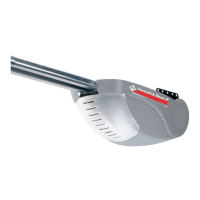
The Controll-A-Door® S SDO-3 is a sectional garage door opener designed for residential use, offering a range of features for safety, security, and convenience. It is designed to operate sectional garage doors with a maximum opening width of 5500mm (16.5m²), a height of 2150mm, and a weight of up to 100kg. The opener requires a minimum headroom of 25mm.
Function Description:
The primary function of the Controll-A-Door® S SDO-3 is to automatically open and close sectional garage doors. It utilizes a UHF Multi-frequency FM Receiver and Transmitter with Tri-Tran™ technology, which sends a signal over three different frequencies simultaneously to reduce interference. The system also incorporates Code Hopping Technology, generating a new security code from over 4.29 billion possible combinations with each use, enhancing security against "code grabbing."
The opener features a Safety Reversing System that significantly reduces the risk of injury by automatically reversing the door if it encounters an obstruction while closing. The safety reverse force is adjustable to accommodate environmental conditions like wind.
A Soft Start/Soft Stop feature ensures smoother and quieter operation by easing the door into and out of each cycle, reducing wear and tear on both the door and the opener.
The Self Locking mechanism positively locks the door when closed, eliminating the need for manual locking. This inbuilt locking facility works whether the power is on or off, provided the opener is engaged.
In the event of a power failure, the Manual Release handle allows the door to be operated by hand. An optional Battery Back Up accessory provides continued operation during power outages.
The opener includes a Courtesy Light that automatically switches on for approximately three minutes during door operation. This light can also be controlled independently via a programmed transmitter button.
Dynamic Door Profiling allows the opener to automatically compensate for and "learn" changing door characteristics with each operation, ensuring consistent performance.
For enhanced security and convenience, the opener offers several programmable modes:
- Vacation Mode: A transmitter can be programmed to disable the garage door opener's radio receiver, ideal for prolonged periods when the door will be idle.
- Pet (Pedestrian) Mode: A transmitter can be programmed to open the door partially to allow pets access to the garage. The opening height is adjustable via a handheld programmer (contact your dealer for more information).
Important Technical Specifications:
- Input Voltage: 230-240Vac 50Hz
- Input Power: 140W
- Rated Operating Time: 4 minutes
- Rated Temperature: +5°C to +40°C
- Rated Force (Lift Force): 450N (45kg) with Chain, 400N (40kg) with Timing Belt
- Short-Term Peak Force: 700N (70kg)
- Nominal Force: 150N (15kg)
- Receiver Type: UHF Multi-frequency FM Receiver
- Receiver Code Storage Capacity: 8 x 4 button Transmitter Codes
- Transmitter Frequency: UHF Multi-frequency FM Transmitter
- Coding Type: Tri-Tran™
- Number of Code Combinations: Over 4.29 billion random codes
- Code Generation: Non-linear encryption algorithm
- Transmitter Battery: CR2032 (3 Volts)
- Courtesy Light: Festoon style lamp 24 volts 15 watt
Usage Features:
- Transmitter Operation: To operate the opener, press the programmed transmitter button until the door begins to move. The transmitter should be aimed through the windscreen if used from a vehicle. Pressing the transmitter while the door is moving will stop it; the next press will move it in the opposite direction.
- Manual Door Operation: To disengage the opener for manual operation (preferably with the door closed), pull down on the string handle at an angle towards the door. To re-engage, pull the handle away from the door and release, then press a programmed transmitter button. The motor will run until the shuttle assembly engages the chain index.
- Emergency Evacuations: The manual release cord allows disengagement of the opener in emergencies, enabling manual door opening. The cord should be a maximum of 1.8m from the ground.
- Coding Transmitters: Up to eight transmitter codes can be stored in the receiver's memory. The process involves pressing the DOOR CODE button, then the desired transmitter button twice. Separate programming steps exist for controlling the courtesy light and activating Vacation Mode via a transmitter button.
- Erasing Programmed Codes: Holding the DOOR CODE button for 6 seconds will erase all programmed codes.
- Wall Mounted Transmitter: Can be installed in a convenient location, out of reach of children (at least 1.5m off the ground), with a clear view of the door.
- Door Status Indicators: LEDs (OPEN, CLOSE, SERVICE, DOOR CODE) and a beeper provide visual and audible feedback on the door's status (e.g., opening, closing, obstructed, overloaded, power interrupted).
Maintenance Features:
- Service Indicator: The opener has a built-in service counter with a factory default of 3000 cycles. When this counter expires, the yellow SERVICE LED will light up, and the opener will beep three times at the start of each cycle. The courtesy light will also flash, and the beeper will sound five times after opening or closing the door. These signals indicate that service is recommended. The counter can be reset by pressing the SET button.
- Service Fault Indicator: Flashing LEDs on the control panel help identify operational problems or service requirements.
- Door Maintenance (Every 3-6 months):
- Guide Tracks: Clean internal sections with a cloth dampened with mineral turps or methylated spirits.
- Steel Hinges (if fitted): Sparingly lubricate with an all-purpose machine oil. Also lubricate wheel to axle bearings.
- Plastic Hinges: Generally require no lubrication, but silicon spray may be used if necessary.
- Springs: Wipe over with an oily rag if accessible.
- General Inspection: Regularly examine cables, springs, and mountings for signs of wear, damage, or imbalance. If repair or adjustment is needed, contact a professional garage door service.
- Opener Maintenance: Monthly, run the Safety Testing procedures (Section 7) to ensure the garage door is fit for use. If the door does not operate smoothly, contact an Approved Dealer.
- Battery Replacement (Transmitter): The transmitter uses a CR2032 (3 Volts) lithium battery. Use a non-metallic object (e.g., pen) to remove the battery. Light status (solid, flashing, no light) indicates battery status (OK, requires replacement).
- Professional Service: It is recommended that the garage door be serviced by an experienced technician every 12 months or earlier if required. This includes checking lifting cables for wear, fasteners for security, and spring tension. Failure to maintain the garage door may void the opener's warranty.
Safety Rules:
- Always ensure the door is in full view, free of obstructions, and properly adjusted when activating the opener.
- Do not allow children or persons to enter or leave the garage while the door is in motion.
- Do not disengage the opener to manual operation if children, persons, or objects (including motor vehicles) are within the doorway.
- If the door is closing and does not re-open when obstructed, discontinue use and contact a dealer for faulty obstruction sensing.
- Place the opener in a protected area, away from water. Do not spray with water or open protective covers.
- Do not operate the opener if the cable is damaged.
- If there is no pedestrian entrance door to the garage, an emergency access device should be installed for manual operation from outside during power failure.
- Keep hands and loose clothing clear of the door and guides at all times to prevent entanglement or laceration.
- Do not attempt any garage door adjustments yourself; contact a professional service.
- Regularly conduct Open and Close cycle testing.
- Install wall transmitters out of reach of children (at least 1.5m high) where the garage door is visible.
- Safety Beams are recommended for additional protection.
The Controll-A-Door® S SDO-3 comes with a five-year/10,000 cycles full parts and labour warranty on the motor, electronics, and mechanical components when installed by a B&D Dealer, subject to annual garage door servicing.


 To Next Page
 General