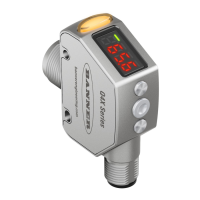
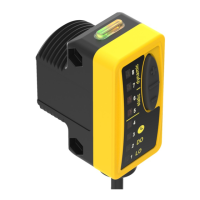
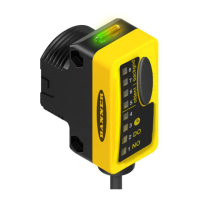
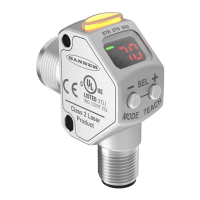
The Q3X Laser Contrast Sensor is an advanced device designed for reliable detection of small contrast differences, even on challenging backgrounds. It utilizes a diffuse laser with a 1 PNP & 1 NPN output, and its patent-pending technology allows for high-speed detection, capturing up to 2,000 events per second. The sensor is capable of detecting objects with small contrast differences, making it suitable for a wide range of industrial applications.
Function Description
The Q3X Laser Contrast Sensor operates by emitting a laser beam and analyzing the reflected light to detect contrast differences. It features background suppression, which allows for reliable contrast detection even when background conditions vary. The sensor's three-digit display provides real-time information about signal strength, making it easy to monitor and adjust performance. The display also shows the current TEACH mode, output state, and other relevant parameters.
The sensor offers multiple vantage points for mounting, and its bright output indicator provides high visibility of sensor operation. An intuitive user interface with two tactile buttons simplifies setup and programming. The rugged nickel-plated zinc die-cast housing ensures durability, even in harsh environments where cutting fluids and oils might be present. The sensor is also robust to fluorescent light interference.
The Q3X sensor is an Expert laser diffuse contrast sensor, meaning it can ignore targets beyond a factory-set background suppression distance. This innovative combination of low contrast diffuse sensing and background suppression effectively minimizes the biggest problem in diffuse mode sensing: namely, changing background conditions affecting the contrast detection.
The sensor supports various TEACH modes, including Two-Point Static TEACH, Dynamic TEACH, Window Set, Light Set, and Dark Set. These modes allow the user to optimize the sensor's performance for specific applications and target characteristics. The sensor's output can be configured for light operate (LO) or dark operate (DO), and it supports both normally open (NO) and normally closed (NC) output configurations.
The Q3X sensor also features a remote input, which allows for remote programming and control. This feature is particularly useful in applications where the sensor is difficult to access or where centralized control is desired. The remote input can be used to select TEACH modes, adjust parameters, and reset the sensor to factory defaults.
Important Technical Specifications
- Sensing Range: The Q3X sensor offers various sensing ranges depending on the model. For example, the Q3XTBLD-Q8 model has a contrast sensing range of 0 to 300 mm (11.81 in) with no background suppression. Other models like Q3XTBLD50-Q8, Q3XTBLD100-Q8, Q3XTBLD150-Q8, and Q3XTBLD200-Q8 offer background suppression distances of 60 mm (2.36 in), 120 mm (4.72 in), 190 mm (7.48 in), and 280 mm (11.02 in) respectively.
- Output Type: Bipolar: 1 NPN, 1 PNP.
- Connection: 5-pin M12 Euro-style integral connector.
- Laser Classification: Class 2 laser, 655 nm wavelength, 0.65 mW output power, 5 µs pulse duration.
- Supply Voltage (Vcc): 10 to 30V dc.
- Power and Current, exclusive of load: Supply Power: < 675 mW, Supply Current: < 28 mA at 24 V dc.
- Protection Circuitry: Protected against reverse polarity and transient overvoltages.
- Response Speed: User selectable: 250 µs, 1 ms, 5 ms, 25 ms (Master-Slave Sync).
- Output Configuration: 1 NPN (sinking) and 1 PNP (sourcing) output, 100 mA maximum (protected against continuous overload and short circuit).
- Off-state Leakage Current: < 10 µA.
- NPN On-state Saturation Voltage: < 200 mV at 10 mA and < 1.0 V at 100 mA.
- PNP On-state Saturation Voltage: < 1 V at 10 mA and < 2.0 V at 100 mA.
- Ambient Light Immunity: > 5000 lux.
- Maximum Torque: Side mounting: 1 N·m (9 in·lbs), End mounting: 1.5 N·m (13 in·lbs).
- Connector: 5-pin M12 Euro-Style Integral Connector.
- Input Wire: User selectable input voltage range: 0 to Vcc. Active Low (internal weak pullup—sinking current): Low State < 2.0 V at 1 mA max.
- Operating Conditions: Temperature: -10 °C to +50 °C (+14 °F to +122 °F). Humidity: 95% at 50 °C relative humidity.
- Environmental Rating: IEC IP67, NEMA 6, IEC IP68 per IEC60529, IEC IP69K per DIN40050-9.
- Vibration: Mil-Std-202G, Method 201A (10 Hz to 60 Hz, 0.06 inch (1.52 mm) double amplitude, 20 G max acceleration).
- Shock: Mil-Std-202G, Method 213B condition I (100G 6x along X, Y and Z axis, 18 total shocks), with sensor operating.
- Storage Temperature: -25 °C to +75 °C (-13 °F to +167 °F).
Usage Features
- Intuitive Setup: The sensor features a user-friendly interface with two tactile buttons for easy setup and programming. The three-digit display provides clear feedback during the setup process.
- Multiple TEACH Modes: The Q3X offers various TEACH modes to optimize performance for different applications:
- Two-Point Static TEACH (2Pt): Sets a single switching threshold between two taught conditions.
- Dynamic TEACH (dYn): Sets a single switching threshold during machine run conditions, continuously adjusting to changes in target intensity.
- Window Set (Un): Sets a symmetric window around the taught condition, useful for detecting objects within a specific range.
- Light Set (Lt): Sets a switching threshold based on the lightest condition, ideal for detecting dark objects on a light background.
- Dark Set (dr): Sets a switching threshold based on the darkest condition, ideal for detecting light objects on a dark background.
- Offset Percentage (Pct): Allows users to adjust the window offset percentage for Window Set, Light Set, or Dark Set TEACH modes, providing fine-tuning capabilities for specific applications.
- Response Speed (SPd): User-selectable response speeds (250 µs, 1 ms, 5 ms, 25 ms) allow for optimization based on application requirements, balancing speed and reliability.
- Output Timing Delays (dLY): Configurable output timing delays (off, on, 1Sh) enable precise control over the sensor's output behavior, including one-shot output for fixed pulse duration.
- Input Wire Function (InP): The input wire can be configured for various functions, including ignoring all pulses, laser off when pulled low, remote TEACH input, master sync line, and slave sync line, providing flexibility in system integration.
- Sensitivity (SEn): User-selectable sensitivity levels (Hi, Std, Lo) allow for adjustment based on the contrast differences of the targets, from high sensitivity for low contrast to low sensitivity for high vibration applications.
- Cut-Off Operation (CUt): Configures the output to follow LO/DO selection, ensuring the sensor treats targets in background (or loss of signal) as the dark state.
- Display View (dSP): The display can be configured to show right-reading, inverted, or sleep after 60 seconds, enhancing readability and power saving.
- Remote Input: The remote input allows for remote programming and control, including TEACH mode selection, manual adjustments, and resetting to factory defaults. This is particularly useful for inaccessible sensors or centralized control systems.
- Locking and Unlocking Sensor Buttons: The sensor buttons can be locked to prevent unauthorized or accidental programming changes, ensuring system integrity.
- Detection Reliability: The manual provides a table indicating the application reliability based on the difference between light and dark target NSS values, helping users assess the sensor's suitability for their application.
Maintenance Features
- Cleaning: The sensor window should be cleaned regularly to maintain optimal performance. Fingerprints, dust, water, oil, and stray light can degrade the peak performance. The window should be cleaned using filtered, compressed air, then cleaned as necessary using 70% isopropyl alcohol and cotton swabs or a soft cloth.
- Error Codes: The sensor provides error codes (e.g., "ErrC" for output short circuit, "ErrL" for laser fault, "EEPROM or System Fault") to help diagnose issues. Resolutions typically involve checking wiring or contacting Banner Engineering.
- Factory Reset: The sensor can be reset to factory defaults either through the menu or via the remote input, which can be useful for troubleshooting or reconfiguring the sensor.
- Overcurrent Protection: The sensor is designed with overcurrent protection. For additional protection, external fusing or current limiting may be required, and the manual provides a table for required overcurrent protection based on supply wiring AWG.

 Need help?
 General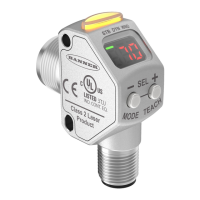




 To Next Page