Page 12 For technical questions, please call 1-888-866-5797. Item 59583
SAFETY OPERATION MAINTENANCESETUP
Spindle Turning
Spindle Turning is performed when a workpiece
is mounted between centers. Bowls, table
legs, tool handles, and candlesticks are
typical Spindle Turning projects.
Spindle Turning Operation:
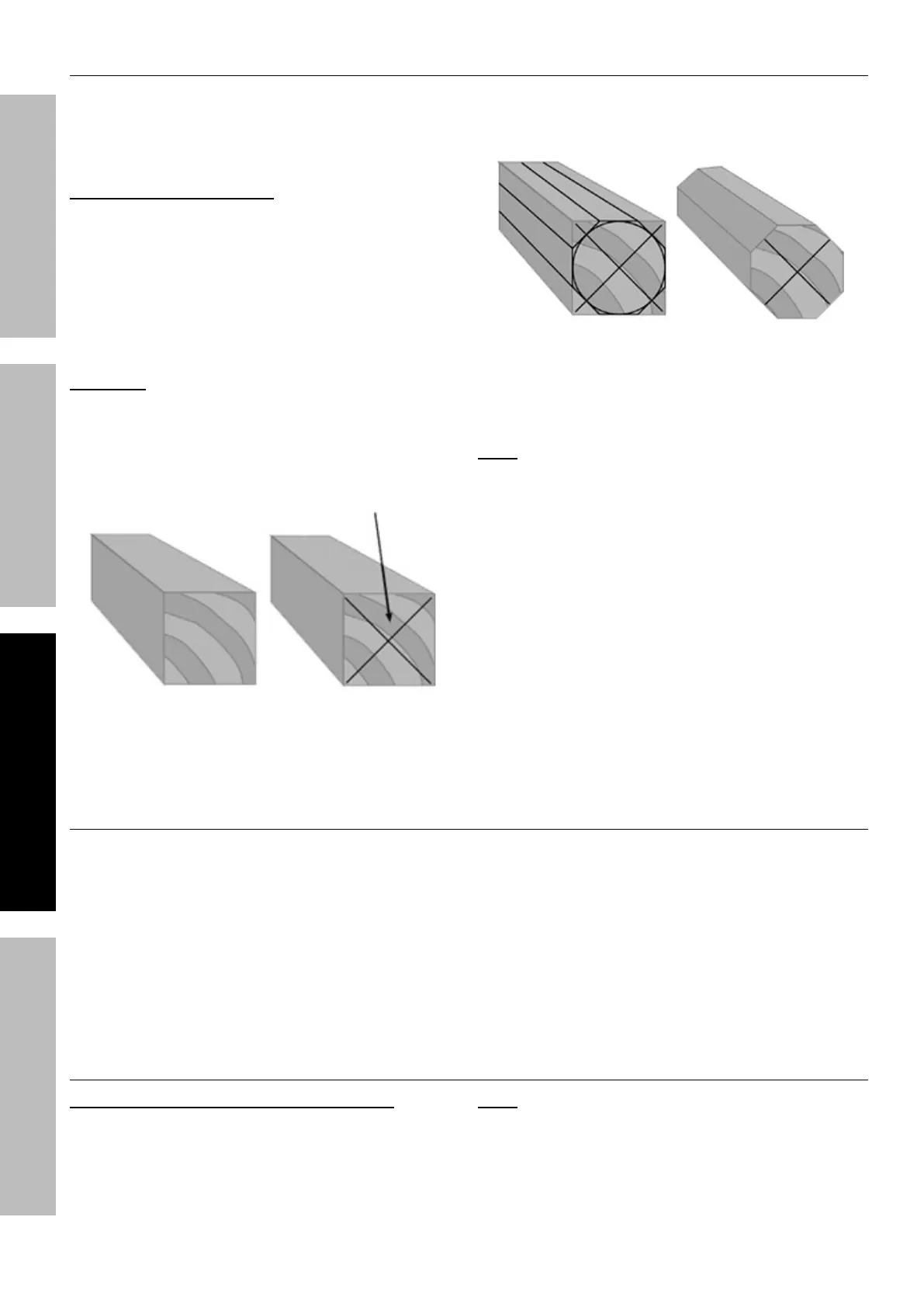
1. Mark both ends of the workpiece by drawing
diagonal lines from corner to corner. The
intersection point of these two lines will
indicate the center of the workpiece.
2. Use a wood mallet and punch or nail to
tap the point of the center of the workpiece
so that it leaves a center mark.
CAUTION! Do not drive workpiece onto Spur Center
while Spur Center is mounted in headstock.
3. Using a 1⁄4″ drill bit, drill a hole at center mark on
end of the workpiece to be mounted on Spur Center.
PENCIL LINES
MARKED DIAGONALLY
ACROSS CORNERS
WORKPIECE
4. To embed Spur Center into workpiece, cut 1⁄8″
saw kerfs in the Headstock-end of workpiece along
the diagonal lines that were marked in Step 1.
5. If workpiece is over 2″ x 2″, cut corners off
lengthwise to make turning safer and easier.
6. Drive Spur Center into end center mark with a wood
mallet to embed it at least 1⁄4″ into workpiece.
7. With workpiece still attached, insert Spur
Center into headstock spindle.
Note: Use Tool Rest to support opposite end
of workpiece so that workpiece and Spur
Center do not separate during installation.
8. Install Live Center into Tailstock Quill and tighten
Quill-Lock Handle to lock Quill in position.
9. Slide Tailstock towards workpiece until the end
of the Live Center touches the center mark of
workpiece. Lock Tailstock in this position.
10. Loosen Quill Lock Handle and Rotate
Tailstock HandWheel (43) to push Live
Center into workpiece at least 1⁄4″.
11. Properly adjust Tool Rest to the workpiece.
12. Before beginning lathe operation, rotate
workpiece by hand to ensure that there
is safe clearance on all sides.
Spindle Turning Tips
1. When turning the lathe ON, stand out of the
path of the spinning workpiece until the Spindle
reaches full speed and workpiece is secured.
2. Use the slowest speed when
starting or stopping the lathe.
3. Select the right speed for the size of
workpiece that you are turning.
4. Keep the tool on the Tool Rest the entire
time it is in contact with workpiece.
5. Learn the correct techniques for each tool
you will use. If you are unsure about how
to use the lathe tools, seek training from
experienced and knowledgeable lathe users.
6. Practice on scrap material to become familiarized
with the operation process and make the necessary
adjustments before working on your work piece.
Bowl Turning
Mounting the workpiece onto the Faceplate:
1. For bowls or plates with a large diameter, mount to
the Faceplate for the maximum amount of support.
Note: While Faceplates are the most reliable method
for holding a larger block of wood for turning, a lathe
chuck can also be used. A chuck is useful when
working on more than one piece at a time, allowing
the user to open the chuck and change workpieces
instead of having to remove the mounting screws.


 To Next Page