GENERAL INFORMATION AND INSTRUCTIONS
FOR USING CERAMIC GLASS HOBS
• Ceramic glass is a natural product and, like any other
material in ceramic, can have an uneven surface. You
might even see some bubbles inside the ceramic glass
itself: these will not inuence cooking or the lifetime of
the hob.
• Illumination of the single cooking zones might differ.
This depends on the technical characteristics of the
heating elements. This has absolutely no effect on
quality or operation.
• According to how you look at it, the incandescent
heating might appear to go over the edge of the cooking
zone.
• Do not put very hot pans on the outer edge of the hob.
• Do not use pans with aluminum bottom.
• Do not use the hob as a work top and take care not
to let hard or sharp objects fall on it. The top could be
damaged.
• Do not put empty enamelled pans on the heat. Both
the bottom of the pan and the ceramic glass could be
damaged.
• Do not drag pans or other objects over the glass top
which could get scratched.
• Clean and dry the bottom of the pan before putting it on
the hob. Salt, sugar or grains of sand, for example, that
could be in greens, can scratch.
• Clean off immediately any spilled liquid.
• Do not cook or reheat food wrapped in tin foil or plastic
containers. Both the tin foil and the plastic containers
would melt, sticking to the hob.
J
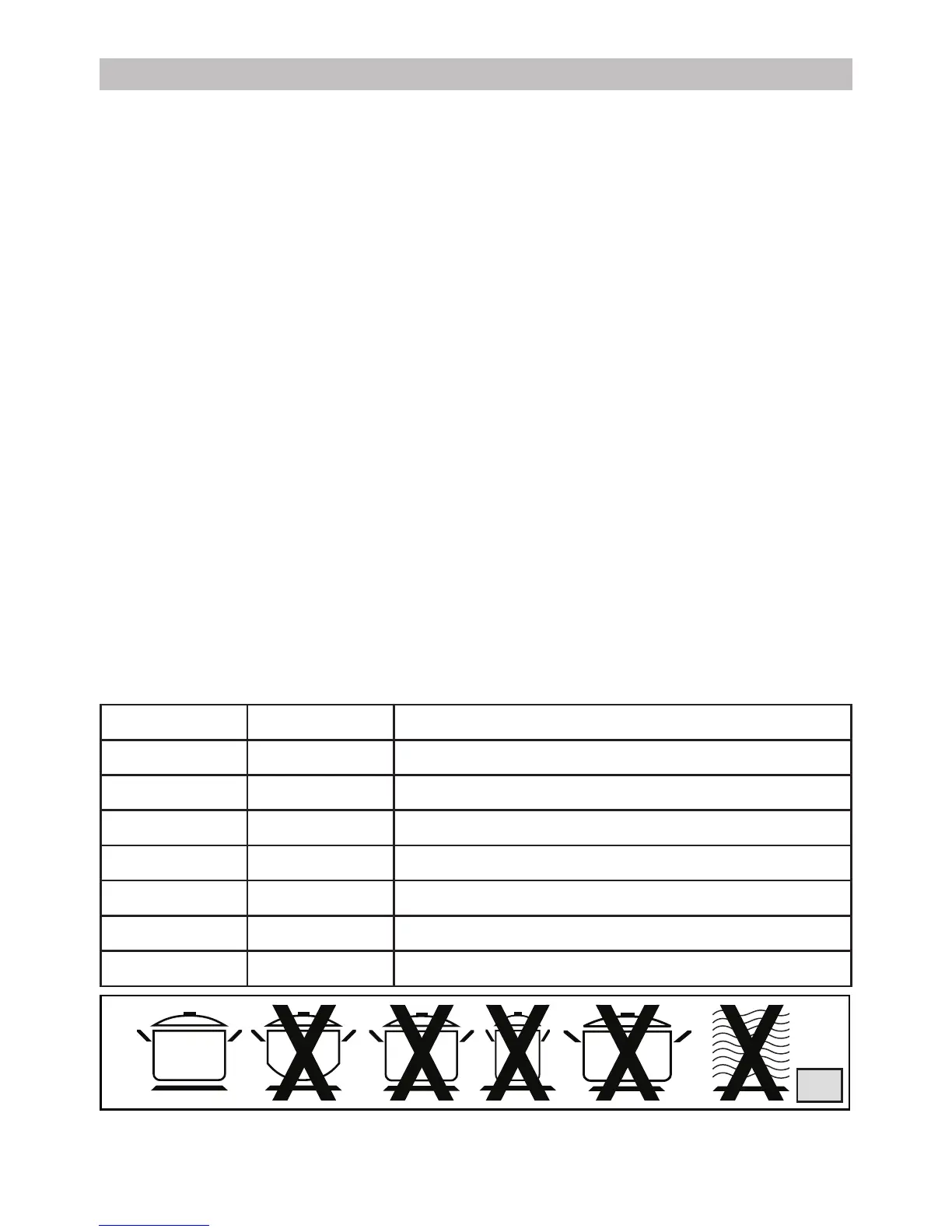
Position of knobs Heat intensity Possible cooking processes
0
Off
1-2
Low To dissolve butter, chocolate, etc. To heat small amounts of liquid.
3-4
Moderate To heat greater quantities of liquid.
5-6
Slow Thawing frozen food and preparing stews, boiling or simmering.
7-8
Medium Bringing foods to boiling point. For delicate roasts and sh.
9-10
Strong For roasts, chops and steaks. For large amounts of boiled meat.
11-12
Hot Bringing large amounts of water to the boil. Frying.
GOOD QUALITY
FLAT BASE
CONVEX
BASE TOO
CONCAVE
BASE
TOO
SMALL
TOO
LARGE
NO PAN
ELEMENT
N.B.: Using the glass scraper, push immediately away
from the cooking zone, any pieces of tin foil or plastic
objects that could have melted or stuck; likewise
sugar or sugary food spilled over during cooking.
HOW TO SAVE ELECTRICITY (g. J)
To get the maximum yield with the minimum
consumption of electricity it is recommended to keep
the following points in mind:
• Switch the hob heating element on only after you
have put the pan on the cooking zone or plate
• Thoroughly dry the bottom of the pan before putting
it on the cooking zone or plate.
• Do not use pans with a diameter that is less than that
of the cooking zone or plate. When you are buying
saucepans keep in mind that the manufacturer
usually gives the largest diameter of the pan which
is normally bigger than the base diameter.
• Use pans with at, thick bottoms. Bottoms that are
not at will make cooking times longer.
• Always put a lid on the pan.
• If cooking time is longer than 40 minutes you can
switch the plate off 5 to 10 minutes before the end
of cooking time and make use of the residual heat.
• For your information only, the table gives hints on
how to use the cooking zones and plates.
INSTRUCTIONS FOR THE USER



 To Next Page