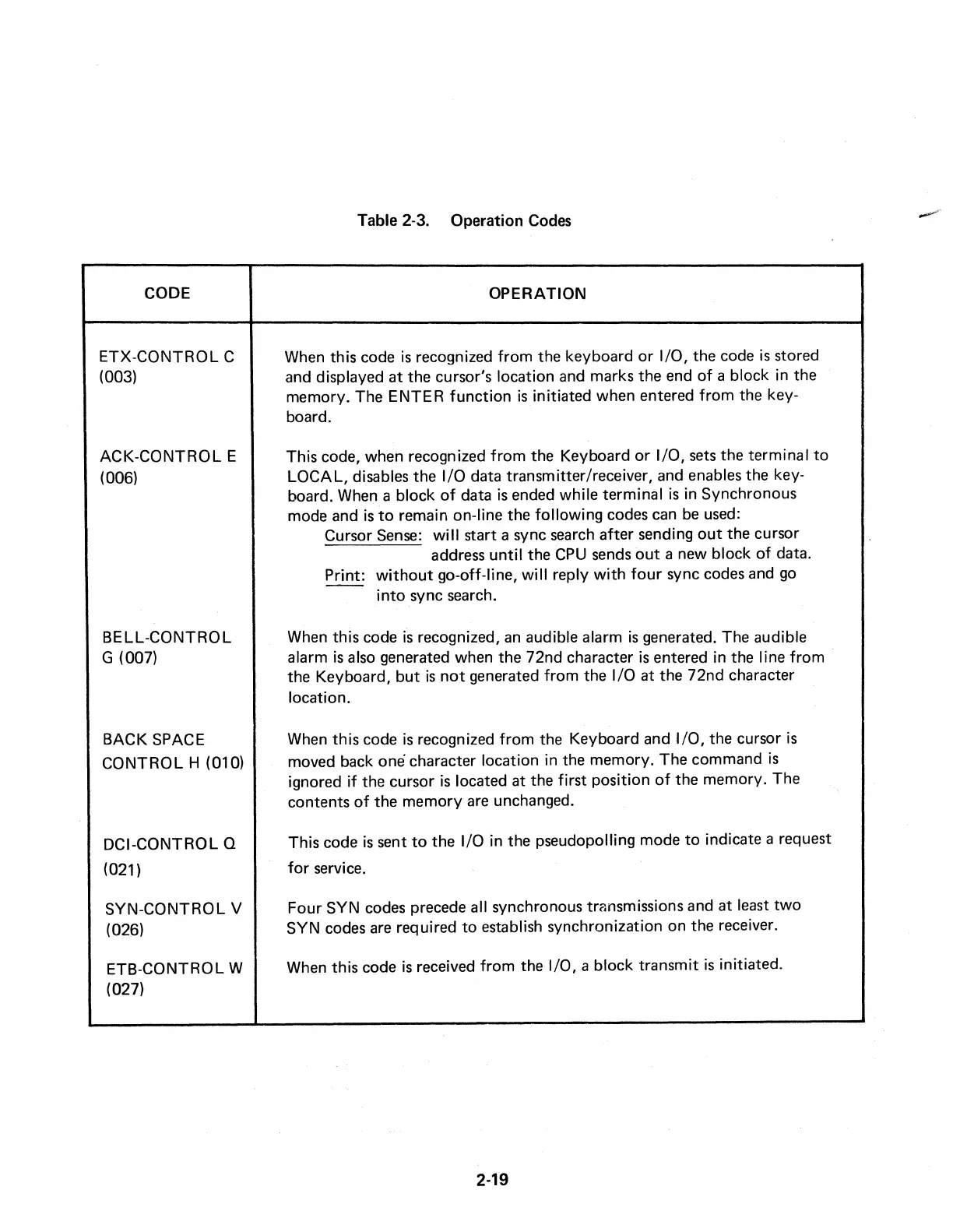
CODE
ETX-CONTROL
C
(003)
ACK-CONTROL
E
(006)
BELL-CONTROL
G (007)
BACK SPACE
CONTROL
H (010)
DCl-CONTROL
Q
(021)
SYN-CONTROL V
(026)
ETB-CONTROL W
(027)
Table 2-3. Operation
Codes
OPERATION
When this code
is
recognized
from
the keyboard
or
1/0, the code
is
stored
and displayed at the cursor's location and marks the end
of
a block in the
memory. The ENTER
function
is
initiated when entered
from
the key-
board.
This code, when recognized
from
the Keyboard
or
1/0,
sets
the terminal
to
LOCAL,
disables the 1/0 data transmitter/receiver, and enables the key-
board. When a block
of
data
is
ended while terminal
is
in Synchronous
mode and
is
to
remain on-line the
following
codes
can
be
used:
Cursor
Sense:
will
start a sync
search
after
sending
out
the cursor
address
until
the
CPU
sends
out
a new block
of
data.
Print:
without
go-off-line,
will
reply
with
four
sync codes and
go
into
sync search.
When this code
is
recognized,
an
audible alarm
is
generated. The audible
alarm
is
also generated when the 72nd character
is
entered in the line
from
the Keyboard,
but
is
not
generated
from
the 1/0 at the 72nd character
location.
When
this code
is
recognized
from
the Keyboard and 1/0, the cursor
is
moved back one character location in the memory. The command
is
ignored
if
the cursor
is
located at the
first
position
of
the memory. The
contents
of
the memory
are
unchanged.
This code
is
sent
to
the 1/0 in the pseudopolling mode
to
indicate a request
for
service.
Four SYN codes precede all synchronous transmissions and at least
two
SYN codes
are
required
to
establish synchronization on the receiver.
When
this code
is
received
from
the 1/0, a block transmit
is
initiated.
2-19



 To Next Page