(Longer if it has been brought in from the cold.) This will allow the precision analog circuits time to reach their normal
operating temperature and tuned performance.
SETTING SYNC and CLOCK TYPE
Selector switches 1, 2, 3, or 4 represent clock source INT, MIDI, USB, or TRIG respectively
Selector switches 5, 6, 7, or 8 represent clock rate 1PPs, 2PPQ, 24PPQ, or 48PPQ respectively
1. Press Function.
2. Make sure no sequence is playing.
3. Press BACK and WRITE/NEXT at the same time to enter Sync setting mode.
4. Selector 1 to 8 LEDs will turn on, and the current clock source (1 to 4) and clock rate (5 to 8) will flash, you have about
3 seconds to make any changes.
5. Press Selector 1, 2, 3, or 4 to change the clock source
to INT, MIDI, USB, or TRIG respectively
6. Press Selector 5, 6, 7, or 8 to change the clock rate to 1PPs, 2PPQ, 24PPQ, or 48PPQ respectively.
7. Press any other buttons or after no changes for a 3 seconds, the changes are saved.
8. Repeat step 3 to check your selection.
Caution: Clock source must always be INT (internal) if you are not using an external clock. Note: Clock rate 24 or 48 PPQ
(Pulses per quarter) are recommended.
TUNING
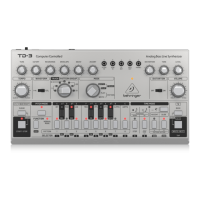
To quickly start making sounds with your TD-3, use the tuning feature as follows. Note that in this mode, the notes are
transposed one octave higher.
1. Make sure the VOLUME is turned down.
2. Set the MODE switch to PATTERN PLAY.
3. Press and hold down the PITCH MODE switch and then press the PATTERN 6 switch (note A).
4. Now, each time you press WRITE/NEXT, you will hear this note in your headphones or speakers. Adjust the VOLUME
level to a comfortable listening level.
5. Use the TUNE control to adjust the output frequency to exactly 220 Hz. The frequency can be adjusted up or down,
and allow fine tuning to other instruments.
6. To tune to other notes instead of A, press and hold PITCH MODE and then the desired note.
7. Now that the TD-3 can make sounds, you can experiment with the synthesizer controls, and the distortion, and listen to
the effects on the sound.
SIGNAL FLOW
The signal path within the TD-3 can be thought of as moving from left to right as follows:
1. The TD-3 has one voltage controlled oscillator (VCO) which generates the sound, and can be adjusted by its
WAVEFORM and TUNING. The waveform can be selected from reverse-sawtooth or pulse. Listen to the changes in
sound that both waveforms make.
2. Next in line is the voltage controlled filter (VCF) where the CUTOFF frequency and RESONANCE can be adjusted.
Play with the cutoff frequency, and resonance controls, and listen to their effects on the sound. The classic low-pass
filter allows a great deal of control over the sounds created by TD-3.
It reduces the level of signals that are above the cutoff frequency, so reducing the levels of the higher-order harmonics.
3. The RESONANCE control gives an enhancement to the signals at the crossover frequency. Rotating it towards
maximum will give very interesting effects and self-oscillation.
4. The ENVELOPE and DECAY controls affect the VCF by modulating the cutoff frequency. The controls are dependent
on each other, so if the envelope level is high, then the decay effect on the sound will be more noticeable.
5. The ACCENT control affects only those notes in a pattern that have accent assigned.
6. The voltage controlled amplifier (VCA) output then moves through the DISTORTION section (if this is selected). Use
the VOLUME control to adjust the level going to your headphones and the main output.
7. Keep the level down low when first putting on headphones.
PATCH BAY SECTION
This section allows you the versatility to connect to other units and modular synthesizer equipment to create many different
sounds. The connections are standard 3.5 mm TS, and the voltage requirements are shown in the specifications table. The
TD-3 does not need these connections in order to operate, they are used for further expansion of your system


 To Next Page
 Loading...