
 Need help?
Do you have a question about the Behringer CAT and is the answer not in the manual?
Provides an overview of the unit's calibration and potential issues.
Lists the necessary tools and accessories for calibration procedures.
Details the process of calibrating oscillators using a guitar tuner.
Specific steps for calibrating the first voltage-controlled oscillator (VCO1).
Specific steps for calibrating the second voltage-controlled oscillator (VCO2).
Calibrating the octave function in factory mode using a voltmeter.
Calibrating the octave function in user mode using a guitar tuner.
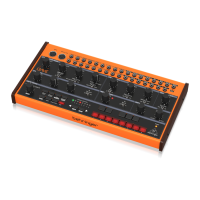
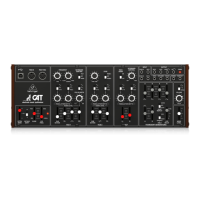
The Behringer CAT is a legendary duophonic analog synthesizer designed for electronic music production. It boasts a rich feature set that allows for extensive sound design and expressive performance, making it a versatile tool for both studio and live applications.
At its core, the CAT is a powerful analog synthesizer featuring dual Voltage Controlled Oscillators (VCOs). These VCOs are the primary sound sources, capable of generating four mixable waveforms, providing a wide palette for sonic exploration. The duophonic architecture allows for two distinct voices to be played simultaneously, enabling complex harmonies and layered textures.
The synthesizer incorporates an external signal processor, which expands its capabilities beyond internal sound generation. This allows users to route external audio signals through the CAT's filters and modulation sections, integrating it seamlessly into existing setups and transforming other instruments or audio sources.
A key feature for modern integration is its 16-voice poly chain capability. While the CAT itself is duophonic, multiple units can be chained together to achieve true polyphony, allowing for the creation of rich, multi-layered compositions with up to 16 simultaneous voices. This scalability makes it suitable for intricate arrangements and complex soundscapes.
The CAT is also designed with Eurorack format compatibility, allowing it to be integrated into modular synthesizer systems. This opens up a world of possibilities for expanding its functionality with a vast array of Eurorack modules, from additional oscillators and filters to complex sequencers and effects. This modularity ensures the CAT can evolve with a user's needs and creative vision.
The CAT offers a comprehensive set of controls for shaping its sound. The front panel is intuitively laid out with dedicated sections for each component, including VCOs, Voltage Controlled Filter (VCF), Voltage Controlled Amplifier (VCA), and Transient Generators (ADSR/AR envelopes).
Each VCO features controls for frequency (fine and coarse tuning), waveform selection, and modulation depth, allowing for precise pitch adjustments and dynamic sound variations. The ability to mix four different waveforms from each VCO provides a foundation for creating unique timbres.
The VCF section is crucial for tonal shaping, offering controls for cutoff frequency (Fc) and resonance (Q). This allows users to sculpt the harmonic content of the sound, from bright and open to dark and muted, with the added ability to create resonant sweeps and self-oscillation effects.
The VCA controls the overall amplitude of the sound, often modulated by an envelope generator for dynamic expression. The Transient Generators provide ADSR (Attack, Decay, Sustain, Release) and AR (Attack, Release) envelopes, which are essential for shaping the amplitude and filter characteristics over time, creating everything from percussive plucks to long, evolving pads.
Modulation sources, such as the Low-Frequency Oscillator (LFO) and Sample & Hold (S+H), can be routed to various parameters, including pitch, filter cutoff, and pulse width, to introduce movement, vibrato, tremolo, and random variations into the sound.
Connectivity options include MIDI In and Thru, enabling the CAT to be controlled by external MIDI keyboards, sequencers, or digital audio workstations. This allows for precise note input, parameter automation, and synchronization with other gear. Audio outputs include a main 1/4" output and a headphones jack for monitoring.
The CAT also features a Keyboard Control section with options for polyphonic or monophonic operation, as well as glide and pitch bend controls for expressive performance.
The CAT is designed for user maintenance and calibration, ensuring its long-term performance and accuracy. The unit is carefully calibrated at the factory, but its performance may change over time due to environmental factors or general use.
A detailed recalibration procedure is provided, allowing users to restore the unit to its factory settings. This procedure involves adjusting internal potentiometers to fine-tune the oscillators and other critical parameters. While users can perform these calibrations, it is recommended that they be done by an experienced audio service technician, especially for procedures that require opening the unit and accessing voltage test points.
The recalibration process requires specific equipment, including a small insulated trimmer screwdriver, a small Phillips screwdriver, a flat sheet of cardboard or other insulator to protect the top panel during inversion, a digital DC voltmeter capable of displaying accurately to 0.001 V, a guitar tuner, an external MIDI keyboard with at least 6 octaves (including A1 and A7), a MIDI cable, and a pair of headphones or a sound system for monitoring.
Before any calibration, the unit should be left on for approximately 30 minutes to allow the circuits to warm up and components to stabilize with temperature. This warm-up period is crucial for accurate calibrations.
The manual provides step-by-step instructions for disassembling the unit to access the internal circuit board, emphasizing caution to avoid straining ribbon cables and ensuring the circuit board does not touch any bare metal when powered up.
Specific calibration steps are outlined for VCO1 and VCO2, involving adjustments of OFFSET and SCALE trimmers while monitoring pitch with a guitar tuner. An OCTAVE Calibration procedure is also included, which involves measuring voltage at specific test points and adjusting a potentiometer to ensure accurate octave tracking.
While re-calibration does not invalidate the warranty, any damage caused during the re-calibration process may void it. This highlights the importance of careful execution and, if necessary, professional assistance. The detailed instructions and warnings empower users to maintain their CAT's optimal performance, extending its lifespan and ensuring consistent sound quality.
 General
| Type | Analog Synthesizer |
|---|---|
| Oscillators | 2 VCOs |
| Polyphony | Monophonic |
| LFO | 1 LFO |
| Envelopes | 2 ADSR |
| Arpeggiator | No |
| Effects | No |
| Filter | 24dB/octave low-pass |
| Connectivity | MIDI In/Out |
| Waveforms | Sawtooth, Square, Triangle |
| Keyboard | No keyboard |
| MIDI | MIDI In/Out |





 To Next Page