
 Need help?
Do you have a question about the Behringer CRAVE and is the answer not in the manual?
Purpose and context of the user support bulletin regarding calibration.
Lists necessary tools for performing calibration procedures.
Steps to prepare the unit before starting the calibration process.
Procedure to adjust the OSC SCALE trimmer for pitch accuracy.
Procedure to adjust the OSC OFFSET trimmer for fine pitch tuning.
Instructions on how to activate the CV calibration mode on the unit.
Adjusting the KBCV voltage to the target level of -5V.
Adjusting the KBCV voltage to the target level of 0V.
Adjusting the KBCV voltage to the target level of 5V.
Procedure to save calibration settings and exit the mode.
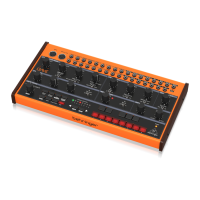
The Behringer CRAVE is an analog semi-modular synthesizer designed for musicians and producers seeking a versatile and powerful sound creation tool. Its semi-modular architecture offers a blend of classic analog synthesis with modern control, making it suitable for a wide range of musical genres and sound design applications. The CRAVE features a 3340 VCO (Voltage Controlled Oscillator), a classic ladder filter, a 32-step sequencer, and the ability to be poly-chained for up to 16 voices, expanding its sonic potential significantly.
At its core, the CRAVE is built around a single 3340 VCO, known for its rich and stable waveforms. This VCO provides a fundamental sound source that can be shaped and modulated in various ways. Users can control the oscillator's frequency and pulse width, allowing for a broad spectrum of timbres from deep basses to sharp leads. The inclusion of an OSC MOD input further enhances the VCO's capabilities, enabling external or internal modulation sources to dynamically alter its characteristics.
The sound generated by the VCO then passes through a classic ladder filter (VCF - Voltage Controlled Filter). This filter is a cornerstone of analog synthesis, celebrated for its warm, resonant, and expressive qualities. The CRAVE's VCF offers controls for cutoff frequency and resonance, allowing users to sculpt the harmonic content of the sound. A VCF MOD input provides additional flexibility, enabling dynamic filtering effects through modulation. The interplay between the VCO and VCF is crucial for creating the distinctive analog sounds that the CRAVE is capable of.
The output stage of the CRAVE includes a VCA (Voltage Controlled Amplifier) with a volume control, which determines the overall amplitude of the sound. This VCA can be controlled by an envelope generator, allowing for dynamic amplitude shaping over time.
A key feature of the CRAVE is its comprehensive modulation section. It includes an LFO (Low-Frequency Oscillator) with adjustable rate, offering various waveforms to modulate parameters such as the VCO's pulse width, frequency, or the VCF's cutoff. The envelope generator (ENV) is another vital modulation source, providing controls for attack, decay, and sustain. This envelope can be routed to modulate the VCO, VCF, or VCA, enabling a wide array of dynamic and expressive sounds, from percussive plucks to evolving pads. The modulation routing is flexible, allowing users to assign modulation sources to different destinations with adjustable intensity.
The integrated 32-step sequencer is a powerful tool for creating rhythmic patterns and melodic lines. It allows users to program sequences of notes, gate lengths, and other parameters, bringing dynamic movement and complexity to their compositions. The sequencer features controls for tempo and gate length, and offers functions like rest, accent, and glide, providing extensive creative possibilities for pattern generation. The ability to save and recall sequences makes it practical for live performance and studio work.
The semi-modular design of the CRAVE is a significant aspect of its functionality. While it offers a complete signal path for immediate use, it also provides a patch bay with multiple inputs and outputs. This allows users to re-route signals, bypass internal connections, and integrate the CRAVE with other modular synthesis equipment. This flexibility opens up a vast world of sound design possibilities, enabling users to create unique and complex patches that go beyond the capabilities of a fixed-architecture synthesizer.
The CRAVE is designed for intuitive operation, making it accessible to both beginners and experienced synthesists. The front panel is clearly laid out with dedicated knobs and switches for each parameter, providing direct hands-on control over every aspect of the sound. This tactile interface encourages experimentation and allows for real-time sound manipulation during performance or recording.
The 32-step sequencer is particularly user-friendly. Users can program sequences step-by-step, adjusting note values, gate lengths, and accents. The sequencer's ability to store patterns makes it a valuable tool for building complex arrangements and transitioning between different musical ideas. The "KYBD" and "STEP" keys, along with the octave/location LEDs, facilitate easy navigation and programming within the sequencer.
The poly-chain feature is a notable usage advantage, allowing multiple CRAVE units to be linked together to create a polyphonic synthesizer with up to 16 voices. This significantly expands the instrument's expressive capabilities, enabling the creation of chords, pads, and more complex harmonic textures that would not be possible with a single monophonic unit.
The patch bay, while offering advanced routing, is also designed with clarity in mind. Clearly labeled inputs and outputs for various modules like the VCO, VCF, VCA, LFO, and envelope generator make it straightforward to understand and implement custom patching. This encourages users to explore the modular aspects of the synthesizer and discover new sonic territories.
The CRAVE's compact size and robust build quality make it suitable for both studio environments and live performances. Its straightforward interface ensures that users can quickly dial in sounds and integrate it into their existing setups.
The CRAVE is designed for long-term reliability, but like all analog instruments, its performance can be affected by environmental factors and the passage of time. The manual provides detailed recalibration procedures to ensure the unit maintains its factory settings and optimal performance.
One of the primary maintenance features is the VCO Tuning Adjustment. This involves calibrating the oscillator's pitch to ensure accurate tracking across the keyboard. The process requires a high-quality tuner and involves adjusting internal trimmers (OSC SCALE and OSC OFFSET) to achieve precise frequencies at specific note intervals (e.g., 110Hz for A2, 880Hz for A5, and 440Hz for A4). This ensures that the CRAVE plays in tune and that its pitch remains stable. The instructions emphasize the importance of allowing the unit to warm up for at least an hour before calibration to ensure temperature stability.
Another critical maintenance procedure is KB CV Calibration. This process ensures that the keyboard's control voltage (CV) output is accurate, which is essential for precise pitch tracking and modulation. This calibration requires a digital voltmeter with high precision (more than 4 significant digits) and involves measuring the output of the "KB CV" jack. Users will enter a special calibration mode by pressing specific key combinations during power-up. Within this mode, they will adjust the CV output to target voltages (-5 V, 0 V, and 5 V) using the "KYBD" and "STEP" keys, with different "STEP" keys controlling the adjustment speed. This meticulous process ensures that the CRAVE responds accurately to keyboard input, maintaining its musical integrity.
The manual also recommends using a small insulated trimmer screwdriver for adjusting the internal potentiometers, highlighting the importance of proper tools for delicate internal adjustments. Removing unnecessary cables before calibration is also advised to prevent interference and ensure accurate readings.
These detailed calibration procedures empower users to maintain their CRAVE in optimal working condition, ensuring consistent performance and accurate sound reproduction over its lifespan. The emphasis on precise measurements and step-by-step instructions makes these maintenance tasks manageable for users, extending the life and reliability of the instrument.
 General
| Type | Analog Synthesizer |
|---|---|
| Polyphony | Monophonic |
| Waveforms | Sawtooth, Pulse |
| Filter | 24dB/octave Ladder Filter |
| Sequencer | 32-step Sequencer |
| Connectivity | MIDI In, USB, CV/Gate |
| LFO | Triangle, Square |
| Envelopes | ADSR |
| Dimensions | 320 x 167 x 90 mm |
| Weight | 1.5 kg |
| Oscillator | 1 VCO with Pulse Width Modulation |
| Power Supply | 9V DC Adapter (included) |




 To Next Page
