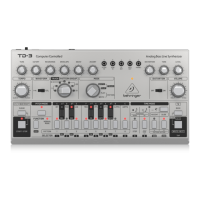
24. 13-NOTE KEYBOARD – these switches are laid out as a
13-note keyboard, allowing notes to be selected when creating patterns. The lower eight switches are also used when
creating, saving, and selecting patterns and tracks.
25. TIME MODE LED – the LED will light when in TIME MODE.
26. TIME MODE ON/OFF – select the TIME MODE on or off. This mode is used when entering the timing (note, tie, or
rest) after the notes have been entered in PITCH MODE.
27. BACK – when stepping through a pattern, this allows you to select the last played note, so it can be edited.
This switch and WRITE/NEXT (35) are used to view and change SYNC and CLOCK settings.
28. START / STOP – this allows you to start or stop playing the patterns and tracks. The LED will turn on when playing.
29. FUNCTION – this multipurpose switch is used to return the TD-3 to normal mode from PITCH MODE and TIME
MODE, and for various operations during pattern and track writing.
30. NORMAL MODE LED – this LED will light when the unit is in normal mode.
31. TRANSPOSE DOWN/NOTE/STEP – this is used to transpose the octave downwards in PITCH MODE, enter a note in
TIME MODE, and to enter the number of steps in a pattern.
32. TRANSPOSE UP/TIE/TRIPLET – this is used to transpose the octave upwards in PITCH MODE, enter a tie in TIME
MODE, and set the pattern to triplet mode.
33. ACCENT / PATTERN A – this allows an accent to be added to notes in PITCH MODE, and to select “A” patterns such
as 1A, 2A, to 8A.
34. SLIDE / PATTERN B – this allows a SLIDE to be added to notes in PITCH MODE, and to select “B” patterns, such as
1B, 2B, to 8B.
35. D.S./WRITE/NEXT/TAP – this allows a pattern to be written to a track, to select the next note in a pattern, and to add
manual timing by tapping. This switch and BACK (27) are used to view and change SYNC and CLOCK settings.
Rear Panel
36. OUTPUT – connect this 1/4″ TS output to the line-level audio input of your system. Make sure the volume is turned
down and the system is turned off before making connections.
37. MIDI OUT/THRU – this 5-pin DIN jack is used to output MIDI OUT data, and pass through MIDI data received at the
MIDI INPUT.
38. MIDI IN – this 5-pin DIN jack receives MIDI data from an external source. This will commonly be a MIDI keyboard, an
external hardware sequencer, a computer equipped with a MIDI interface, etc.
39. USB PORT – this USB type B jack allows connection to a computer. The TD-3 will show up as a class-compliant USB
MIDI device, capable of supporting MIDI in and out. USB MIDI IN – accepts incoming MIDI data from an application.
USB MIDI OUT – sends MIDI data to an application.
40. POWER – turn the synthesizer on or off. Make sure all the connections are made before turning on the unit.
41. DC INPUT – connect the supplied 9V DC power adapter here. The power adapter can be plugged into an AC outlet
capable of supplying from 100V to 240V at 50 Hz/60 Hz. Use only the power adapter supplied.
Getting started
Step 3: Getting started
OVERVIEW
This ‘getting started’ guide will help you set up the TD-3 analog bass line synthesizer and briefly introduce its capabilities.
CONNECTION
To connect the TD-3 to your system, please consult the connection guide earlier in this document.
SOFTWARE SETUP
The TD-3 is a USB Class Compliant MIDI device, and so no driver installation is required. The TD-3 does not require any
additional drivers to work with Windows and MacOS.
HARDWARE SETUP
Make all the connections in your system. Keep the TD-3 power turned off when making any connections.
Use only the supplied power adapter for the TD-3.
Ensure your sound system is turned down.
Turn on the TD-3 before turning on any power amplifiers, and turn it off last. This will help prevent any turn on or turn off
“pops or thumps” in your speakers.
WARM UP TIME
We recommend leaving 15 minutes or more time for the TD-3 to warm up before recording or live performance.


 To Next Page
 Loading...