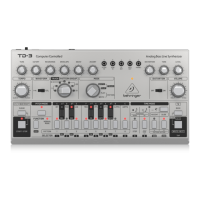
Caution: Do not overload the 3.5 mm inputs. They can only accept the correct level of voltages as shown in the
specification tables. The 3.5 mm outputs should only be connected to inputs capable of receiving the output voltages.
Failure to follow these instructions may damage the TD-3 or external units.
SEQUENCER SECTION
Please see the section later in this guide for details of pattern writing and playing, and track writing and playing.
FIRMWARE UPDATE
Please check our website behringer.com regularly for any updates to the firmware of your TD-3 synthesizer. The firmware
file can be downloaded and stored on your computer, and then used to update the TD-3. It comes with detailed instructions
on the update procedure.
HAVE FUN
The TD-3 has many useful controls to recreate different bass instruments, and to create bass lines. The patch bay allows for
further experimentation and expansion to other units and modular synthesizer equipment.
With all these controls, the possibilities for musical creativity are endless!
We hope that you will enjoy your new TD-3, and that it will become an essential part of your system.
Operation
diagram
OVERVIEW
The following details show some of the basic operations of the TD-3. Keep it simple to start with, until you become familiar
with the steps required, and it becomes routine.
There are four pattern groups, I, II, III and IV.
Each pattern group can have up to eight A patterns and eight B patterns. Each pattern can have up to 16 steps. The default
step is a 16th note.
A pattern of desired notes is first entered in PITCH MODE, and then the timing of each note is added in TIME MODE.
WRITING A PATTERN
As an example, we will program pattern 1A of pattern group I. All writing (pitch and timing) is done in PATTERN WRITE
Mode.
Writing the notes in PITCH MODE
1. Turn the MODE switch to PATTERN WRITE.
2. Turn the PATTERN GROUP switch to Group I, position 1 or 2 (it does not matter which).
3. Press FUNCTION, and the nearby NORMAL MODE LED will turn on, and one of the PATTERN switch LEDs will be
flashing.
4. Press the PATTERN 1 switch (note C) and its LED will flash, showing that we are getting ready to program it. (Press it
anyway, even if it is already flashing.)
5. Press the PATTERN A switch (100) and its LED will turn on (it may even be on already).


 To Next Page
 Loading...