29
Condition Cause Remedy
The needle thread
breaks.
1. The needle thread is not threaded properly.
2. The needle thread tension is too tight.
3. The needle is bent or blunt.
4. The needle is incorrectly inserted.
5. The needle thread and the bobbin thread are not set
properly under the presser foot at the beginning of sewing.
6. The fabric is not drawn to the rear when the sewing has
finished.
7. The thread is either too heavy or too fine for the needle.
Page 13
Page 14
Page 10
Page 10
Page 14
Page 17
Page 10
The bobbin thread
breaks.
1. The bobbin thread is not threaded properly in the bobbin
case and shuttle.
2. Lint has collected in the shuttle area.
3. The bobbin is damaged and does not turn smoothly.
Page 12
Page 26
Replace the bobbin.
The needle breaks.
1. The needle is incorrectly inserted.
2. The needle is bent or blunt.
3. The needle clamp screw is loose.
4. The needle thread tension is too tight.
5. The fabric is not drawn to the rear when the sewing has
finished.
6. The needle is too fine for the fabric being sewn.
Page 10
Page 10
Page 10
Page 14
Page 17
Page 10
Skipped stitches.
1. The needle is incorrectly inserted.
2. The needle is bent or blunt.
3. The needle and/or threads are not suitable for the work
being sewn.
4. A blue tip needle is not being used for sewing stretch, very
fine fabrics and synthetics.
5. The needle thread is not threaded properly.
6. The wrong needle is being used.
Page 10
Page 10
Page 10
Page 10
Page 13
Change the needle.
Seam puckering
1. The needle thread tension is too tight.
2. The needle thread is not threaded properly.
3. The needle is too heavy for the fabric being sewn.
4. The stitch length is too long for the fabric.
Page 14
Page 13
Page 10
Make stitch shorter.
The fabric is not
feeding smoothly.
1. Accumulation of lint on the feed dog.
2. The stitches are too fine.
Page 26
Make stitch longer.
The machine does not
work.
1. The machine is not plugged in.
2. A thread is jammed in the shuttle race.
3. The clutch is disengaged. The handwheel is pulled out.
Page 8
Page 26
Page 12
Noisy operation
1. A thread is jammed in the shuttle race.
2. Lint has built up in the shuttle or the shuttle race.
Page 26
Page 26
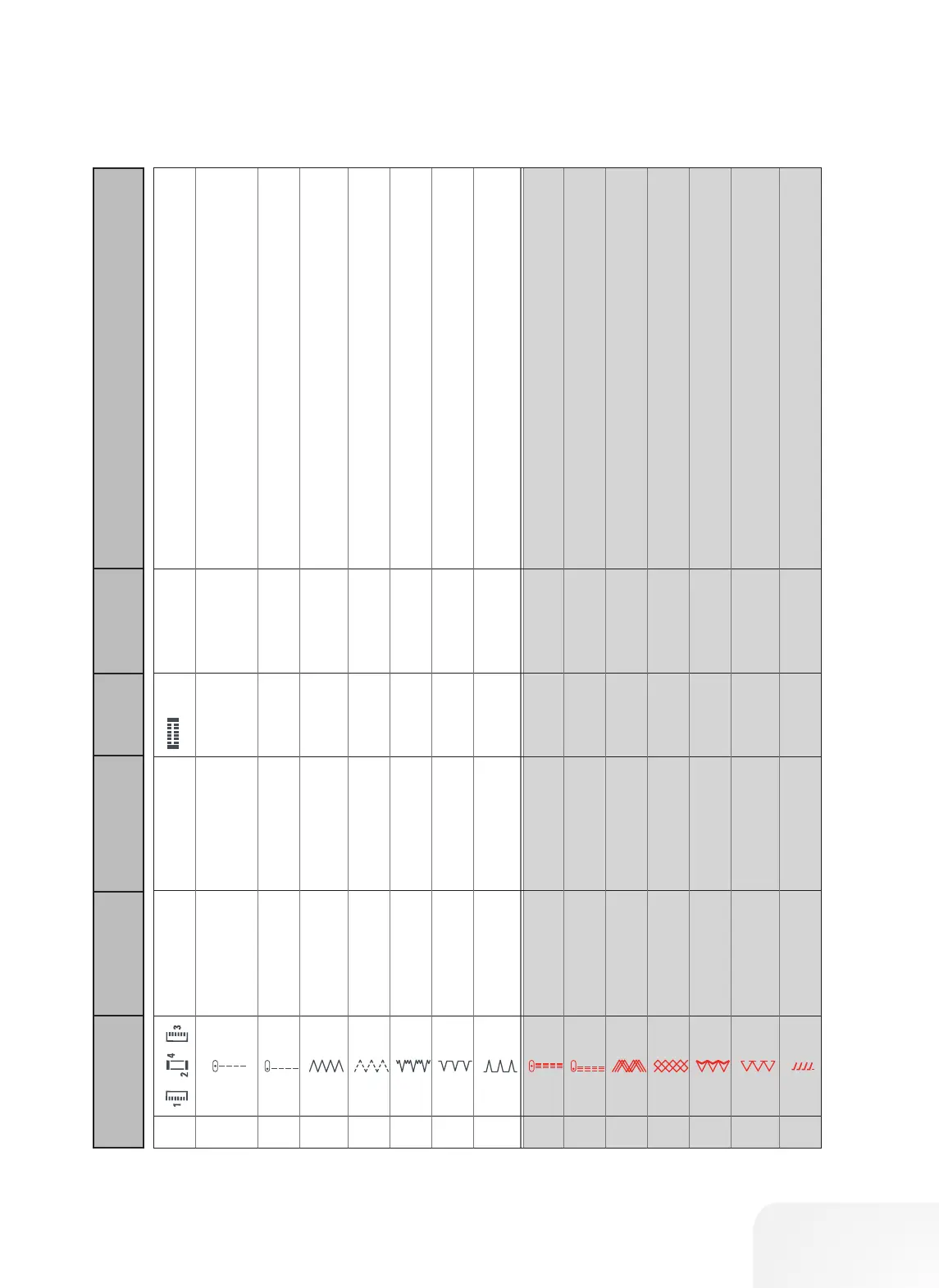
Stitch pattern Stitch Presser foot
Stitch
length
Thread
tension
Description
Four-step button-
hole
Buttonhole foot with
slide
1-5 Standard button hole.
A Straight stitch Zigzag foot 1.5 - 4.0 2-6
Sew together and top-stitch. Can also be used as a basted seam.
A stitch length of approx. 1/10" (2.5 mm) is ideal for normal seams,
while the length should be longer for basted seams or on firmer
fabrics such as jeans.
B
Straight stitch Left
needle position
Zigzag foot 1.5 - 4.0 2-6
Sew together and top-stitch. For top-stitching on edges and sewing
in zippers.
C Zigzag Zigzag foot 0.5 - 4.0 2-5
Overcasting edges, sewing on bands, appliqué, sewing on buttons
and securing lace inserts. Reduce the stitch length to roughly 1/50"
(0.5 mm) for sewing appliqué.
D 3-step zigzag Zigzag foot 0.5 - 4.0 1-4
Overcasting and reinforcing fabric edges, sewing on elastic bands,
decorative seams, darning tears and patching work.
E Elastic blindstitch Blindstitch 1.0 - 3.0 1-3
For an invisible hem fastening with simultaneous edge overcasting
on elastic fabrics.
F Blindstitch Blindstitch 1.0 - 3.0 3-5 For an invisible hem fastening on woven fabrics.
G Vari-Overlock Zigzag foot 1.5 - 3.0 2-6
Overcasting double-knitted fabrics like tricot, jersey or other
lightweight fabrics on edges to create shell edging. Embellishing
any sewing projects.
A Triple straight stitch Zigzag foot S 2-6
For hard-wearing seams in firm fabrics, visible hems and visible
seams.
B
Triple straight stitch
Left needle position
Zigzag foot S 2-6
For hard-wearing seams in firm fabrics, visible hems and visible
seams.
C Triple zigzag Zigzag foot S 2-6 Elastic stitch for decorative hem ends and quilting seams.
D Honeycomb stitch Zigzag foot S 1-4
Elastic, decorative stitch for decorative seams on flexible materials
and for sewing on elastic thread and bands.
E Florentine stitch Zigzag foot S 1-4
Decorative elastic stitch. For decorating knitted or woven fabrics.
Also ideal for crazy quilting.
F Reinforced overlock Zigzag foot S 1-4
Sewing together and simultaneously overcasting elastic fabrics, as
well as decorating items of clothing, household textiles and
handicrafts.
G Stretch overlock Zigzag foot S 1-4 Sewing together and simultaneously overcasting elastic fabrics.
STITCH PATTERN
Overview


 To Next Page