PRODUCT MAINTENANCE CHECKLIST
Wooden Sheds / Playhouses / Summerhouses
Level Base: A firm level base & protection from
moisture penetration is key to maintaining the building.
Seal The Windows: Use a silicone sealant on the inside
& outside of the windows as soon as possible after
assembly is a strong way of sealing the windows.
Annually Treat The Building: Treat your building after
construction with a good quality water resistant
treatment. Repeat this annually inside & out. (You do
not need to treat the building initially if you received a
pressure treated building)
The Building Must Not Be In Contact With Anything:
Overhanging hedges or trees must be cut back as a
branch may pierce roofing felt or glazing & would allow
water ingress.
Regularly Check / Replace Damaged Felt: Check the
felt regularly. Any damaged felt must be replaced.
Lubrication: Use a suitable oil to lubricate all moving
parts, such as hinges, for continued proper use.
CLADDING STYLE
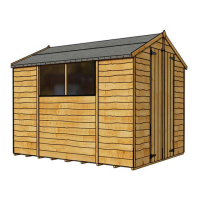
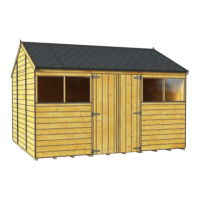
Overlap: This style of
cladding is very traditional &
uses rough sawn timber. This
gives the panels their
unfinished look & helps the
building to blend in to its
natural surroundings. When
the wood has dried through
hotter weather knots may
become loose, which is
natural. Overlap is an
economic solution for lower
impact use.
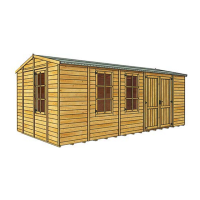
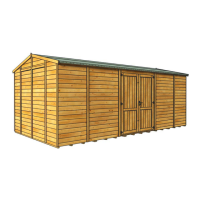
Tongue & Groove: This style
of cladding allows the timber
to interlock giving greater
strength to the building. It
also creates a smoother finish
& continuous lines throughout
the panel. Due to the natural
movement of wood the lines
between tongue & groove
panels may not marry up.
PANEL ORIENTATION
It is essential to ensure that the panels
of your building are in the correct
orientation. Assembly in the wrong
orientation may lead to water ingress &
deterioration.
Boards overhang the edge of the floor:
In most cases the lower edge of the
panels overhangs the floor of the
building & the panel is fixed to floor with
screws through the frame on the inside
of the panel.
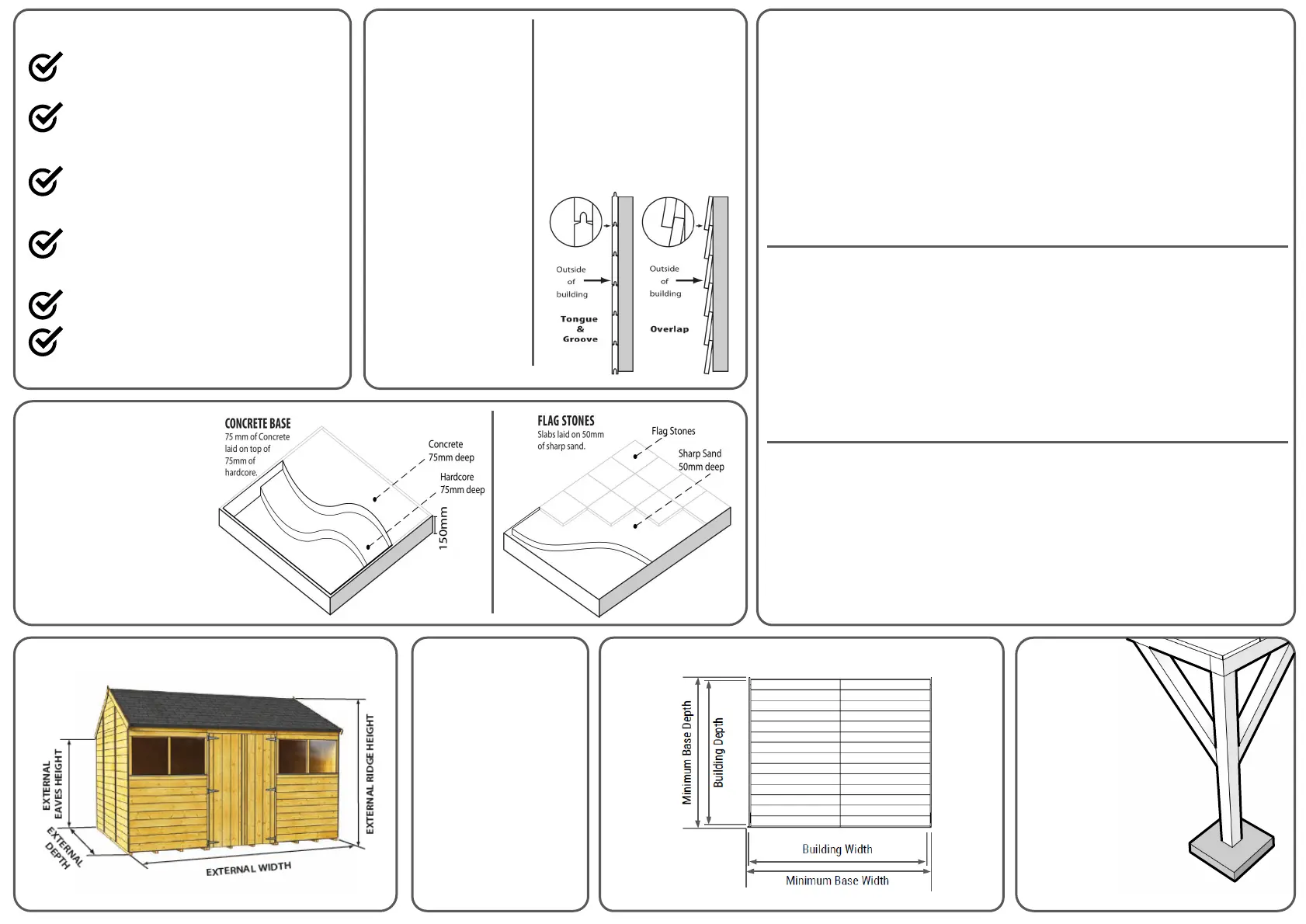
External Depth
External Width
External Eaves Height
External Ridge Height
BASE DIMENSIONS
Use the dimensions that are on
the technical details
documentation for your specific
building to workout the required
dimensions when laying your
solid base.
Do not forget about the roof
overhang when choosing your
building location. Keep in mind
where the roof will finish & how
you will maintain the building.
FOOTPRINT OF BUILDING
BUILDING DIMENSION TERMINOLOGY
TROUBLESHOOTING GUIDE
Pre-Assembly:
Q: What type of base should I use? A: You must lay a solid flat & level base. Failure to do so will result in
your building fitting together incorrectly. We highly recommend a properly laid & flat & level concrete or
flagstone base (see Building a Base section of this instruction document).
Q: I have glazing / fixing kit missing. What should I do? A: Firstly check that all of your building’s parts are
there by laying them all out on the ground. Check between the panels / larger parts as the glazing comes
banded together & is placed between the panels, along with the fixing kit, for safer transportation. If they
are still not found please visit our Support Centre - billyoh.co.uk/help
Q: Are tower playhouses freestanding? A: We recommend that tower playhouses are positioned on a flat /
level base raising the legs away from ground moisture. Please read the Protecting Playhouse Tower Legs
section of this document for more details.
Q: Are my window & plain panels interchangeable? A: On apex buildings the window & plain panels are
interchangeable where they are the same size or make up the same size panel as the opposing wall with
more than one part. Some pent building may also allow for panels to be interchangeable but ensure they
are the same size before securing.
During Assembly:
Q: How are the windows fixed to the building? A: This process depends on the individual building. Please
read the instructions to find out which method your particular building uses.
Q: Which way do the joists run? A: This process depends on the individual building. Please read the
instructions to find out which way the joists run.
Q: My building seems a little flimsy? A: Your building won’t reach full rigidity until fully assembled so do
not panic.
Q: Construction seems tricky? A: Take your time & read the instructions thoroughly. These buildings
should be constructed by two people. If in doubt seek professional help.
Q: The felt seems a little tight? A: To reduce waste, to help protect the environment & reduce costs for our
customers we only supply the required amount of felt for roofing material.
Q: My building isn’t going together properly, it is twisted. A: It sounds like you are building on an uneven
surface. You must build on a flat / level base for your building to fit together correctly.
Post-Assembly:
Q: Why is there a gap around the doors? A: During the year the wood of your building will shrink & expand,
which will create a gap around you building’s doors. This is natural.
Q: Why is there a gap around my playhouse door? A: This gap is to stop finger trapping & is an EN-71
testing requirement.
Q: Why does my playhouse have holes in the back panel? A: These holes are for ventilation & is an EN-71
testing requirement.
Q: My building is not water tight around the windows. A: These products have been designed as an
affordable solution to most popular light domestic uses & we do not state that they are watertight. Use
silicon sealant around the windows to improve the water resistant qualities of the building.
Q: My building has developed a leak A: Use silicon sealant to stop the leak & make sure that your building
is not in a damp area & if necessary move it & replace the damaged boards.
BUILDING A BASE
When thinking about where the building
& base are going to be constructed
ensure that there will be access to all
sides for maintenance work & annual
treatment. This building should be
situated at least 2 feet away from
any structures or obstructions (such
as fences, buildings, trees, laundry
lines, electrical wires etc). We
recommend that areas around playhouses
have a soft surface such as play bark or grass.
All garden buildings must be built on a level, flat base
to be erected correctly
PLAYHOUSES:
PROTECTING
PLAYHOUSE TOWER
LEGS
We strongly recommend that
the legs of all of the platforms in
the tower range of playhouses
should be kept off of grass & soil &
out of moisture.
The minimum protection needed is to
be treated annually with a water
repellent treatment.
Placing the tower legs on a
solid base, preferably concrete or
flagstones, will help prevent water
penetration.


 To Next Page
 Loading...