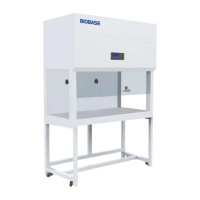
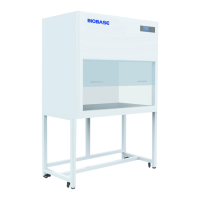
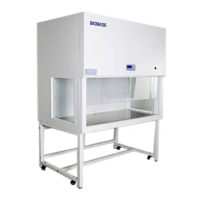
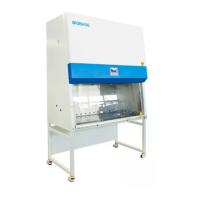
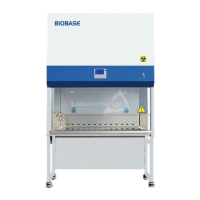
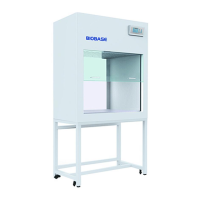
The BIOBASE Vertical Laminar Flow Cabinet, model BBS-V800, is a specialized laboratory workstation designed to provide a particle-free working environment, primarily for sample protection. This cabinet operates by taking in ambient air, filtering it through a high-efficiency particulate air (HEPA) filtration system, and then exhausting it across the work surface in a laminar, or unidirectional, air stream. The enclosed sides and constant positive pressure within the cabinet prevent the infiltration of contaminated room air, ensuring the integrity of the samples being handled.
Function Description:
The core function of the BBS-V800 is to create a clean, controlled environment for sensitive work. It is specifically designed for sample protection, ensuring that experiments and procedures are carried out in an area free from airborne contaminants. The cabinet achieves this through its robust air filtration system, which includes a blower and a HEPA filter. This system is responsible for delivering filtered air to the work area, maintaining the required airflow velocity, and ensuring the cleanliness of the workspace.
The cabinet is equipped with a UV lamp, strategically located at the top of the work zone. This UV lamp emits a wavelength of 253.7nm, effectively disinfecting the entire work zone. For illumination during operation, the BBS-V800 features an LED light, providing standard average illumination for comfortable and clear working conditions.
The front window of the cabinet is part of a driving system that allows for its adjustment. This system, which includes a constant spring, facilitates the smooth movement and positioning of the front window.
Usage Features:
Operating the BBS-V800 involves a straightforward process. Before any experiment, the cabinet should be connected to a suitable and well-grounded power supply, ensuring the voltage and frequency match the instrument's power supply rating. After powering on, the fan, LED lamp, and UV lamp should be checked for normal operation. The air velocity should also meet standard requirements.
A critical step before starting any experiment is to sterilize the cabinet using the UV lamp. The front window should be fully closed during this process, and the UV lamp should run for at least 30 minutes. It is imperative that personnel leave the room during UV sterilization to ensure safety, as UV radiation can be harmful to eyes and skin. The UV lamp's working time should be regularly monitored, and it should be replaced when its total working time reaches 600 hours or if its intensity falls below the required level.
Once sterilization is complete, the front window can be moved up to a proper height above the work table, and the blower should be turned on. Experiments should only commence after the fan has been running for at least 30 minutes to establish the laminar flow. For optimal safety, testing materials should be placed inside the cabinet in advance. After completing an experiment, the front window should be fully closed, and the cabinet should be sterilized again with the UV lamp for at least 30 minutes before being turned off.
The control panel, featuring soft-touch buttons, allows for easy management of the cabinet's functions. Users can control the LED lamp, the blower's working status, and adjust the air velocity. The UV lamp operation is interlocked with the blower and LED light, meaning the UV lamp will automatically turn off if the blower or LED light is activated.
When moving multiple samples within the cabinet, it is recommended to move low-polluting samples first, followed by high-polluting ones. Movement of items should be slow and steady to avoid disrupting the airflow. The weight of items placed in the cabinet should not exceed 23Kg per 25x25cm². To prevent vibrations that could compromise cleanliness and operator protection, vibration-generating equipment (e.g., centrifuges, vortex oscillators) should not be used inside the cabinet. Open flames are strictly prohibited as they can disrupt airflow and damage the filter. If sterilization by heat is required, an infrared sterilizer is recommended.
Maintenance Features:
Regular maintenance is crucial for the longevity and effective operation of the BBS-V800. A detailed daily record of operating time is recommended to track accumulated usage and plan maintenance accordingly. Before any maintenance, it is essential to cut off all power to the cabinet to prevent electric shock. All items inside the cabinet should be removed prior to maintenance.
Daily maintenance includes disinfecting and cleaning the operating area, external surface, and front window. The working zone surface should be wiped with a soft cotton cloth soaked in concentrated liquid soap, then rinsed with clean hot/warm water, and finally dried with a clean cotton cloth or towel. For contaminated areas, medicinal alcohol or other disinfectants (that do not damage 304 stainless steel) can be used. The external surface and front window can be cleaned with a soft cotton cloth or towel and a non-abrasive household cleanser.
Monthly maintenance involves a more thorough cleaning of the external surface and front window. Additionally, the working table, the inner face of the front window, and the inner wall surface of the working area (excluding the top wind grid) should be wiped with a towel soaked in 70% medicinal alcohol or a 1:100 dilution of household bleach. These areas should then be wiped with sterile water to remove any chlorine residue. During both daily and monthly checks, the various functions of the cabinet should be inspected for any abnormalities, and maintenance results should be recorded.
Annually, a comprehensive maintenance check is recommended, or after 1000 working hours. This includes checking the front window tubular motor to ensure proper connection and tightness, and inspecting the UV lamp and LED light. An overall performance test of the cabinet should be conducted annually to ensure it meets safety requirements.
The HEPA filter's life is finite; as usage time increases, dust and bacteria accumulate, leading to increased filter resistance. When the filter resistance reaches its maximum point and the required air speed cannot be met, the HEPA filter needs to be replaced. Used filters should be processed as medical waste. The fan and its underside, which are sealed bellows, should not be tampered with by operators.
The cabinet is equipped with a main power fuse. If the fuse needs replacement, a flat-blade screwdriver can be used to pull out the fuse holder, replace the fuse, and then press it back into place. For LED lamp replacement, the power should be turned off, the old LED stand removed, and a new one inserted into the inclined slot. UV lamp replacement also requires turning off the power; the lamp tube should be screwed 90 degrees, removed, and a new corresponding lamp inserted and screwed 90 degrees in reverse. Regular testing of UV intensity using a test card is recommended to determine if replacement is needed.
The cabinet should be stored in a warehouse with relative humidity no more than 75% and a temperature lower than 40°C, with good ventilation and free from corrosive gases. If stored for more than one year, a performance test should be conducted before use.


 To Next Page
 General