IMPORTANT: Never measure anybody else’s blood pressure with the monitor during an ambulatory
blood pressure monitoring session.
9. Cuffs
Dimensions
Name Arm Circumference Range
Small 18 - 24 cm / 7” - 9.4”
Normal 25 - 32 cm / 9.8” - 12.5”
Large 33 - 42 cm / 13” - 16.5”
If the patient’s arm circumference range is out of the ranges indicated above, use the cuff which
best fits for the patient and make a so-called undercuffing or overcuffing calculation.
9.1 Application
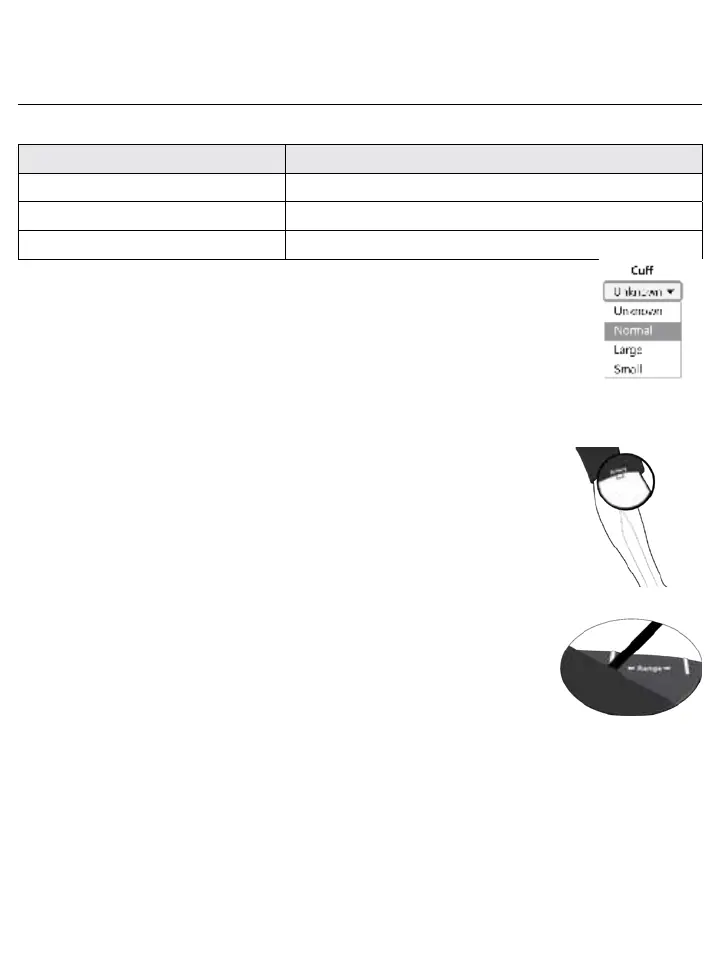
Set the cuff size when programming the monitor.
The monitor recognizes three different cuff sizes. The size to be used should be set during
programming of the device. Inappropriate setting of the cuff size may lead to device malfunctioning, which is
inconvenient for the patient and may lead to an unsuccessful measurement.
9.2 Apply the cuff and be sure the artery indicator is over the
brachial artery
Place the cuff on the upper arm so that the rubber tube points towards the patient’s
shoulder and the ’artery’ indication of the cuff is placed above the brachial artery, if
possible. Contrary to the usual placement with the tube pointing downwards, the advantage
is that the patient can wear a loose jacket over the cuff.
When properly applied, the end of the sleeve (the one closer to the tube) should
fall in the indicated range.
9.3 Connect the hose to the monitor
Connect the air connector of the cuff into the air connector socket of the device by turning it clockwise with slight
pressure.
NOTE: Take care to avoid blocking the air flow in the tube of the cuff and twisting the tube. Make sure the cuff and
its tubing do not cause strangulation or a circulation problem. Should the patient experience arm numbness or pain
remaining after any blood pressure reading is completed, the cuff should be removed to avoid permanent vascular
or neural injury. The application of the cuff over a wound can cause further injury! The application of the cuff and
its pressurization could result in injury to the patient because of temporary interference to blood flow on any limb
where intravascular access or therapy, or an arterio-venous (A-V) shunt is present. The pressurization of the cuff can
temporarily cause loss of function of simultaneously used monitoring medical equipment on the same limb.
No relevance can be shown in the application of the cuff and its pressurization on the arm of the side of a


 To Next Page