3.3ABeforeMeasuring
• Avoideating,smokingaswellasallformsofexertiondirectlybeforethemeasurement.Allthesefactors
inuencethemeasurementresult.Relaxbysittinginanarmchairoratatableinaquietatmospherefor
about 5 minutes before the measurement.
• Alwaystakemeasurementsonthesamearm(normallyleft)andinthesameposture.Donotswitchbetween
right and left arms while recording your blood pressure as there may be a difference of up to 10mmHg
pressure between the two arms.
• Attempttocarryoutthemeasurementsregularlyatthesametimeofday,sincebloodpressurechanges
during the course of the day. The ideal time to measure your blood pressure is in the morning after you wake
up, before breakfast and physical activity and in the absence of the urge to urinate.
• Restfor5minutessittingquietlyandreleaseallthetensioninyourbody,especiallythearmmuscles,before
beginning with the measurement. Remain calm and quiet when the measurement is in process. Do not speak
or move your arm (as well as other body) muscles during the process.
• Ideally,youwillbesittingatatablewithbothfeetontheoorandyourarmrestingonthetablewiththe
cuff at heart level.
3.3B Common Sources of Error
All efforts by the patient to support the arm can increase the blood pressure. Make sure you are in a
comfortable, relaxed position and do not activate any of the muscles in the measurement arm during the
measurement. Use a cushion for support if necessary.
ATTENTION!
Comparable and reliable blood pressure measurements always require the same conditions with a
peaceful and calm environment. Ensure that you take measurements under the same conditions to
obtain an accurate estimate of blood pressure variation patterns.
• Ifthearmarteryliesconsiderablylowerorhigherthantheheart,anerroneousvalueofbloodpressureis
measured. Each 15 cm difference in height results in a measurement error of 10 mmHg.
• Aloosecuffcausesfalsemeasurementvalues.
• Withrepeatedmeasurements,bloodaccumulatesinthearm,whichcanleadtofalseresults.Consecutive
blood pressure measurements should be repeated after at least a 15 second pause or after the arm has been
heldupinordertoallowtheaccumulatedbloodtoowaway.
3.3C Fitting the Wide Range Cuff
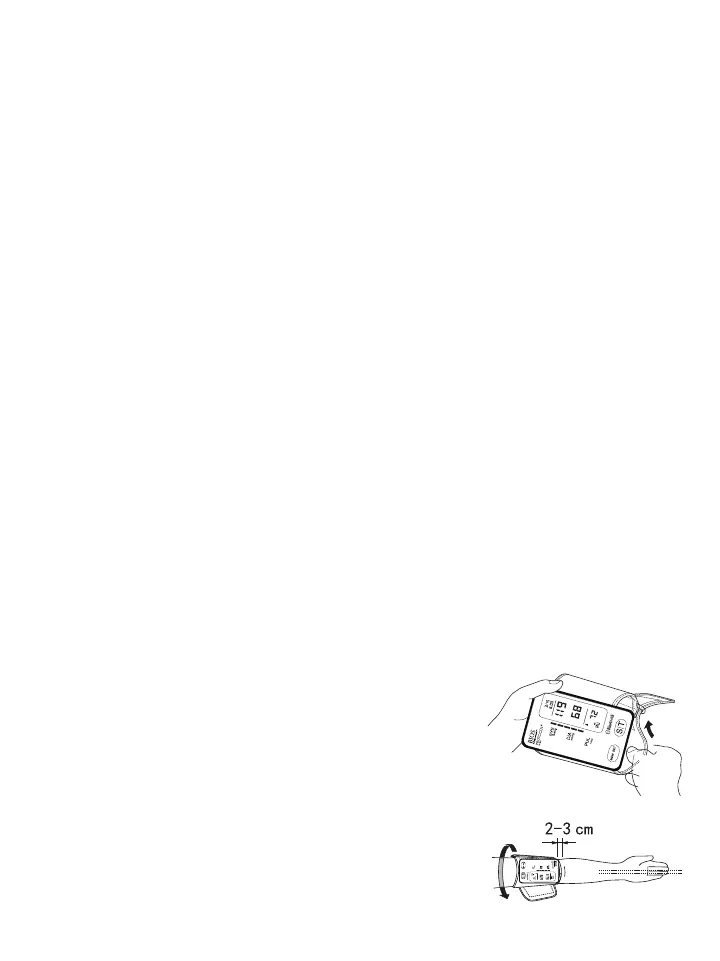
a) Put the end of the cuff (with fastener) through the metal ring,
making the cuff a cylinder (ignore this step if your cuff is already
set up). Proper assembly allows the Velcro
®
to match up properly.
b) Place the cuff with the monitor around your arm. When the cuff is
on your arm, the monitor should be facing towards you so you can
read the screen. Make sure the bottom edge of the cuff is about 1”
(2-3 cm) above the elbow joint. Adjust the cuff so that the brachial
artery mark is positioned over the brachial artery, which runs on
the inside of the arm (see Fig. B). The red material should be over
the brachial artery.
a)
b)


 To Next Page