EasyManua.ls Logo

BIRD MARK 7 - Page 9

Default Icon
58 pages
Print Icon
To Next Page IconTo Next Page
To Previous Page IconTo Previous Page
Loading...
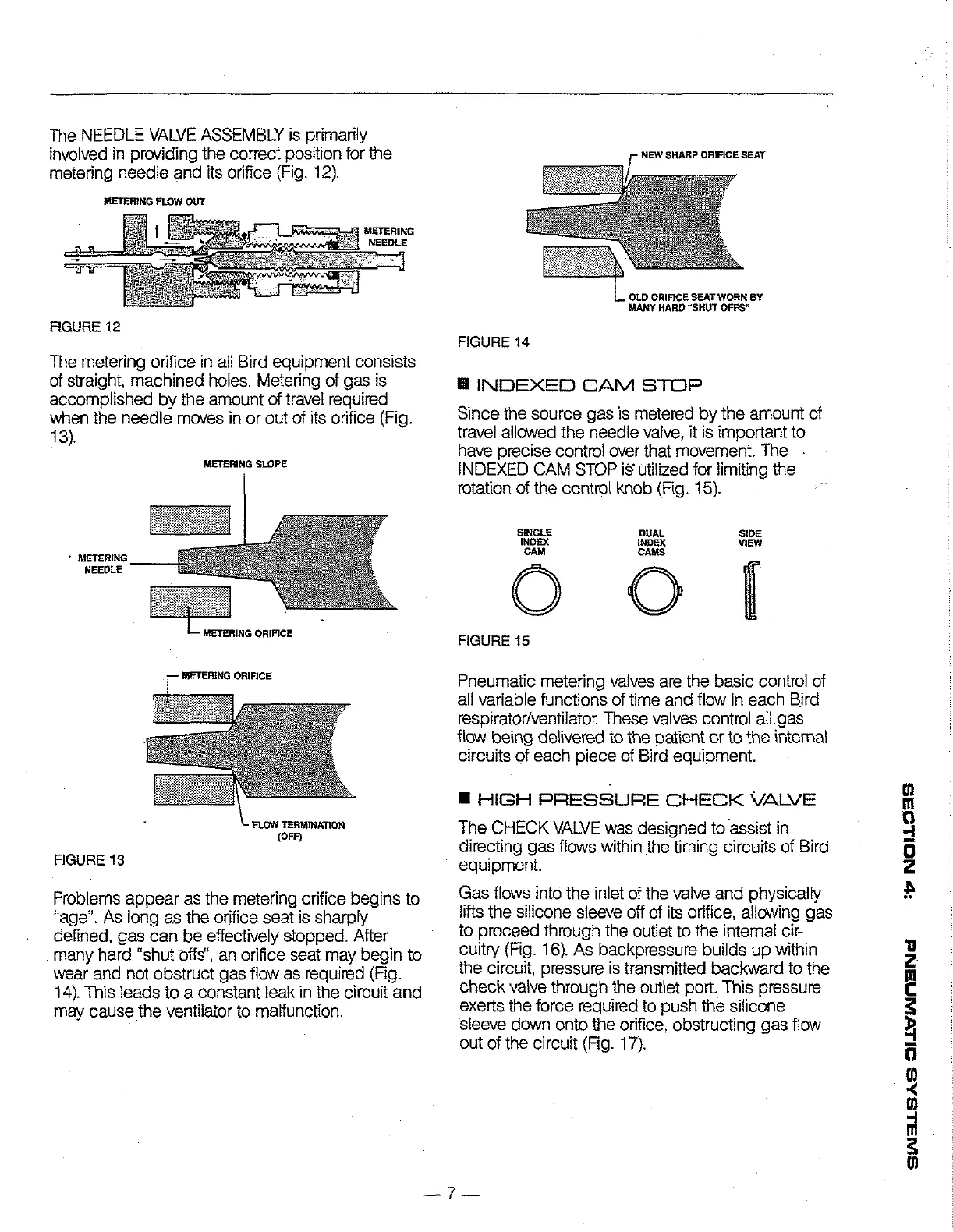
The
NEEDLE
VALVE
ASSEMBLY
is
primarily
involved
in
providing
the
correct
position
for
the
metering
needle
and
its
orifice
(Fig.
12).
METERING
FLOW
OUT
METERING
FIGURE
12
The
metering
orifice
in
all
Bird
equipment
consists
of
straight,
machined
holes.
Metering
of
gas
is
accomplished
by
the
amount
of
travel
required
when
the
needle
moves
in
or
out
of
its
orifice
(Fig.
13).
METERING
SLOPE
*
METERING
NEEDLE
METERING
ORIFICE
METERING
ORIFICE
FLOW
TERMINATION
(OFF)
FIGURE
13
Problems
appear
as
the
metering
orifice
begins
to
“age”.
As
long
as
the
orifice
seat
is
sharply
defined,
gas
can
be effectively
stopped.
After
many
hard
“shut
offs’,
an
orifice
seat
may
begin
to
wear
and
not
obstruct
gas
flow
as
required
(Fig.
14).
This
leads
to a
constant
leak
in
the
circuit
and
may
cause
the
ventilator
to
malfunction.
NEW
SHARP
ORIFICE
SEAT
OLD
ORIFICE
SEAT
WORN
BY
MANY
HARD
“SHUT
OFFS”
FIGURE
14
8
INDEXED
CAM
STOP
Since
the
source
gas
is
metered
by
the
amount
of
travel
allowed
the
needle
valve,
it
is
important
to
have
precise
control
over
that
movement.
The
INDEXED
CAM
STOP
is
utilized
for
limiting
the
rotation
of
the
control
knob
(Fig.
15).
SINGLE
DUAL
SIDE
INDEX
INDEX
VIEW
CAM
CAMS
FIGURE
15
Pneumatic
metering
valves
are
the
basic
control
of
all
variable
functions
of
time
and
flow
in
each
Bird
respirator/ventilator.
These
valves
control
all.gas
flow
being
delivered
to
the
patient
or
to
the
internal
circuits
of
each
piece
of
Bird
equipment.
E
HIGH
PRESSURE
CHECK
VALVE
The
CHECK
VALVE
was
designed
to
assist
in
directing
gas
flows
within
the
timing
circuits
of
Bird
equipment.
Gas
flows
into
the
inlet
of
the
valve
and
physically
lifts
the
silicone
sleeve
off
of
its
orifice,
allowing
gas
to
proceed
through
the
outlet
to
the
internal
cir
cuitry
(Fig.
16).
As
backpressure
builds
up
within
the
circuit,
pressure
is
transmitted
backward
to
the
check
vaive
through
the
outlet
port.
This
pressure
exeris
the
force
required
to
push
the
silicone
sleeve
down
onto
the
orifice,
obstructing
gas
flow
out
of
the
circuit
(Fig.
17).
b
NOJLOZS
SINILSAS
JUYNNINd

Related product manuals