4 5
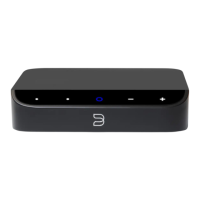
PRESETS The NODE NANO has 2 programmable preset buttons. These are configured using the Presets menu in the
BluOS App.
STATUS INDICATOR Below is a table of the LED blink codes and their corresponding descriptions.
LED BLINK CODE DESCRIPTION
Short blue flash, then red Powering up rebooting the unit
Solid green Hotspot Mode
Flashing green Connecting to Network
White pulse Software update available
Solid red Upgrade Mode
Alternate flashing red and green Upgrading
Flashing blue Mute Mode
Solid white Indexing
Solid blue Connected to Network - ready to use with BluOS App
Flashing red Factory Reset in process
Solid Purple Hotspot Mode timed out
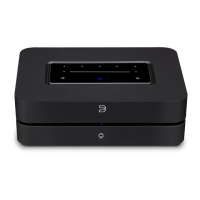
PLAY/PAUSE BUTTON This button has multiple functions – a visual indicator of network connectivity and a PLAY/PAUSE
button. For a full listing of LED Blink Codes, please see #2 – Status Indicator. For an ungrouped Player, press the button to
Play or Pause the stream. If listening to an internet radio stream, the Pause- function will work for 30 seconds. At this point,
the buffer is full and the stream will Stop. When a Player is grouped, pressing the PLAY/PAUSE button will Mute the Player
while other Players continue the stream. The Player’s LED will flash blue when muted. This button is also used for Factory
Rest functions. See steps for Factory Reset later in the manual.
IR RECEIVER The IR receiver is hidden behind the glass.
VOLUME Use the “-“ and “+” buttons to adjust the volume level. Tapping the buttons will adjust the level by 1dB intervals.
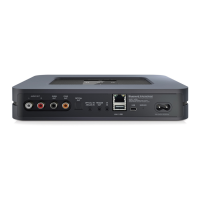
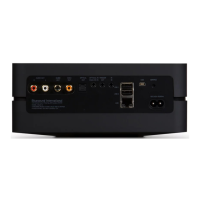
AUDIO OUT Connect to the corresponding analog audio input of an amplifier, receiver, stereo system or active speakers.
Connecting via the AUDIO OUT will use the NODE NANO’s internal DAC.
COAX OUT Using a coax cable (not provided), connect one end to the COAX OUT of the NODE NANO and the other end
to the corresponding coax input of a compatible devices such as receivers, digital-to-analog converters or other digital
processors. Connecting via the COAX OUT will bypass the NODE NANO’S internal DAC.
OPTICAL OUT Using a digital optical cable (not provided), connect one end to the OPTICAL OUT of the NODE NANO and
the other end to the corresponding coax input of a compatible devices such as receivers, digital-to-analog converters or
other digital processors. Connecting via the OPTICAL OUT will bypass the NODE NANO’S internal DAC.
LAN PORT The LAN PORT connection can be used with the Ethernet cable provided. This is an optional connection since
the NODE NANO can be connected to the network through a Wi-Fi connection to your router. To setup the NODE NANO
using the LAN Port a Wired Ethernet connection is required. Connect one end of the Ethernet cable to the LAN port of your
wired Ethernet Broadband router and the other end to the NODE NANO’s LAN port.
USB INPUT (TYPE A) Connect a USB mass storage device to the USB input. Typical USB mass storage devices compatible
with the NODE NANO include portable flash memory devices and external hard drives (FAT32 formatted). [Read about
Server Mode in Settings]
USB OUTPUT (TYPE A) The NODE NANO can transfer digital audio (USB Audio 2.0) through to an external DAC via the
USB Type-A slot. Using a USB cable (not provided), connect one end to the USB output of the NODE NANO and the
other end to the corresponding USB input on a separate DAC device. Select your USB DAC from the NODE NANO’s Audio
settings page in the BluOS App to bypass the NODE NANO’s internal DAC via USB audio out. Note: when USB Output is
selected, all other outputs (Analog and Digital) are dormant.
1
2
3
4
5
6
7
8
9
10
11
NETWORK
The NODE NANO is a network audio player and relies on a well-implemented local area network to operate correctly. Internet
access is required for software updates and to use many of the player’s features, like cloud-based music streaming.
Visit the Bluesound Knowledge Base for more help, tips, and tricks to improve network setup.
https://support.bluos.net/hc/en-us/sections/360000042348-Networking-101
Once the NODE NANO is connected to your equipment and AC power, you need to add it to your network. Watch for the front
panel LED to turn Solid Green, indicating it is ready for network connection in ‘Hotspot’ mode. You can add your player to the
network via wired Ethernet, or wirelessly via Wi-Fi. If using Ethernet, simply plug in an Ethernet cable to the NODE NANO’s LAN
Port. The LED will turn Solid Blue, indicating network connection. If using Wi-Fi, open the BluOS App on a phone or tablet, and use
the ‘Add A Player’ wizard to guide you through the steps. Whether connecting via Ethernet or Wi-Fi, you must finalize setup by
initializing your NODE NANO within the BluOS App.
MOUNTING
On the bottom panel of the NODE NANO there is a rubber cover hiding two keyhole slots. Simply remove the cover to reveal these
slots. Use the cover as a guide for screw placement, by flipping it over and affixing it against the wall. Mounting screws are not
included.
PRESETS
You can set presets for your favorite radio stations, music streams or playlists using the BluOS Controller app. Presets can be
recalled from the two preset buttons on the NODE NANO or from an IR Remote, including the Bluesound RC1 remote (sold
separately).
Visit the Bluesound Knowledge Base for more help, tips, and tricks.
How to add or delete a Preset? – The BluOS Support Crew
TRIGGER OUT A 12V DC signal is available using the TRIGGER OUT. The 12V DC signal can be used to control or activate other
external devices equipped with a corresponding 12V trigger input using a 3.5mm mono audio cable.
IR IN An infrared extender can be connected to allow for programmable learning remotes to control volume and source selection
when a NODE NANO is stored in a way that the front panel IR sensor is not visible.
POWER Use the supplied USB-C cable and USB Power Adapter to power ON the NODE NANO.
12
13
14


 To Next Page
 Loading...