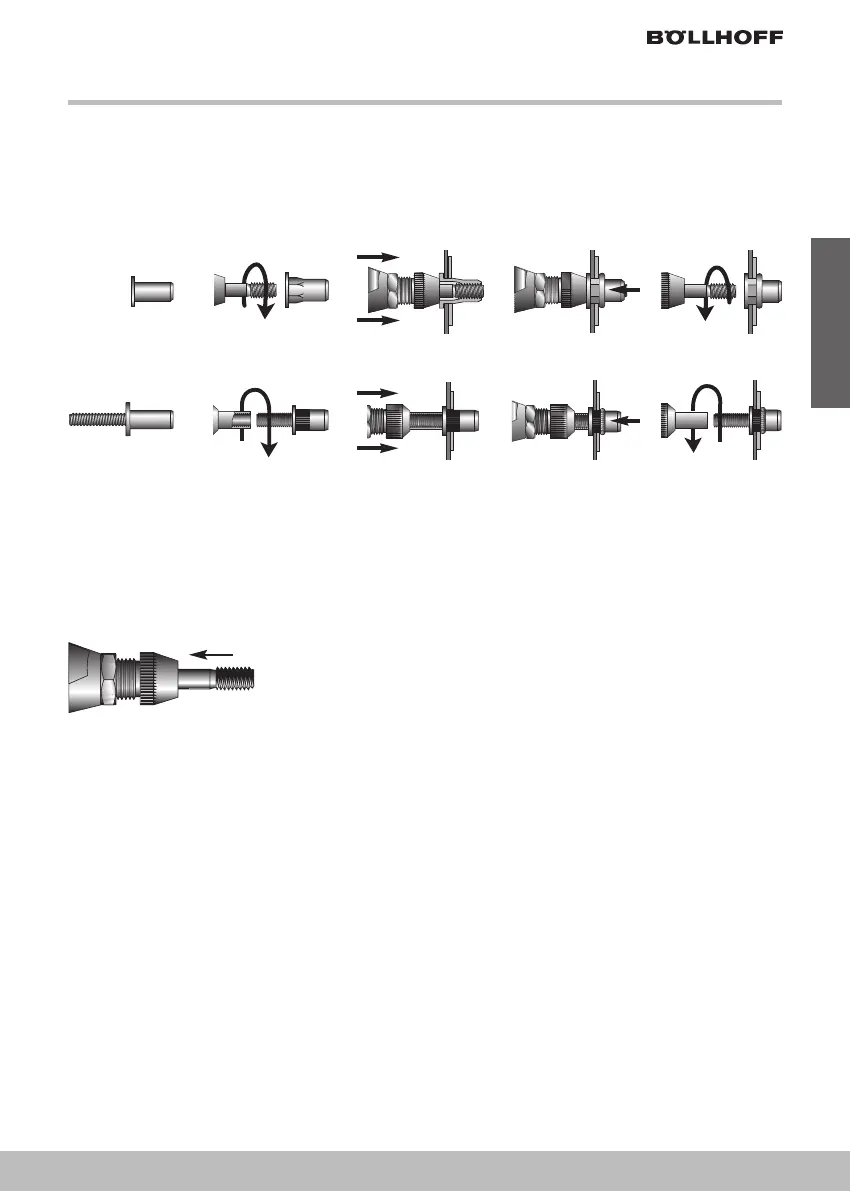
Pressure setting method: force controlled setting
In the stroke setting method, the too
l delivers a constant stroke. When
there is a variation in thickness of the workpiece there is a definite risk
that a blind rivet nut may not be set properly, or become damaged
due to the setting mandrel damaging the Rivet Nut
®
thread. In this
situation there will be premature wear of the mandrel.
This phenomenon is eliminated with the pressure setting method as the
setting force is controlled irrespective of the thickness of the workpiece.
This setting principle is particularly well suited to workpieces with variable thickness (plastic parts,
various layers…) and provides consistent setting quality.
Advantages:
I Optimised setting into panels with thickness variations
I Possibility
to set the same Rivet Nut
®
more than once
I Permits quality control (force indicator…)
I Extended mandrel life
I Can also sett different types of Rivet Nut
®
with one tool and one single
setupK
English
8
1 - Operating principle and technical features of the device
Crimp Spin off
Push pull Insert
Pulling methods
The “pulling method” comprises Push pull, Insert, Pull and Spin off cycles.
F
Call Cardinal Components to Order or for a Quote
800-236-3200 - sales@rivetnutusa.com - www.rivetnutusa.com



 To Next Page