8
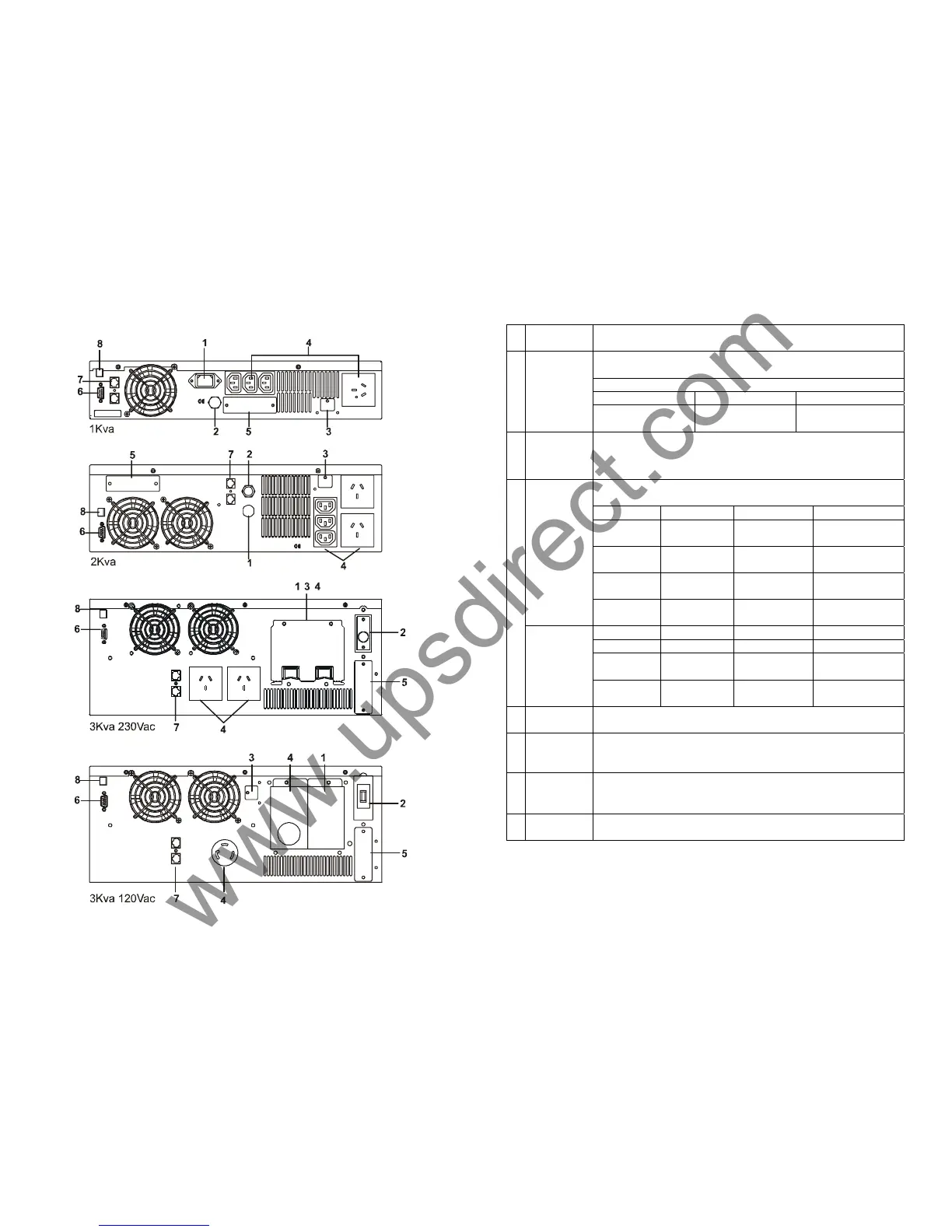
3.2. Rear Panel Descriptions
9
1) AC Inlet This is to be connected with an AC power cord for plugging
into the wall receptacle.
This is to disconnect line input to protect application from
Output overload or short circuit.
Fuse/Breaker Rating for 120Vac/230Vac systems
1Kva 2Kva 3Kva
2) AC Input
Fuse/
Breaker
120Vac: 20A/250V
230Vac: 10A/250V
120Vac: 25A/250V
230Vac: 20A/250V
120Vac: 50A/250V
230Vac: 25A/250V
3) External
Battery
Terminal
This is a battery terminal to be connected with additional
battery banks for longer backup time applications. Only a
Qualified technician is permitted to proceed the installation.
This is to be plugged by the devices to be protected by the
UPS.
Socket type 1Kva 2Kva 3Kva
NEMA
5-15R
4pcs 2pcs N/A
NEMA
5-20R
N/A 2pcs N/A
NEMA
L5-30
N/A N/A 1pce
AC Outlet
For 120Vac
System
Terminal
Block
N/A N/A Yes
Socket Type 1Kva 2Kva 3Kva
IEC 3pcs 3pcs N/A
Local
Sockets
1pce 2pcs 2pcs
4)
For 230Vac
System
Terminal
Block
N/A N/A Yes
5) SNMP Slot It is an optional feature used for SNMP card. Please Refer to
Chapter 3.5 for hardware installation.
6) Comm Port This is an interface to send and receive signals from the
computer. Optional computer software may be required.
Please refer to Chapter 3.3 for its pin assignments.
7) RJ11/RJ45
Jack
This is to allow a modem/internet (RJ11) and 10-Base T
Network(RJ45) protection against line interference.
8) DIP
Switches
For Calibrations.



 To Next Page