
 Need help?
Do you have a question about the Borri B9000FXS 60kVA and is the answer not in the manual?
Converts AC input to DC voltage, feeding the inverter and charging the battery.
Converts DC input to AC voltage, stabilized in frequency and RMS value.
Handles non-linear loads by adjusting PWM generation to maintain output waveform.
Manages overload conditions by limiting output current and using thermal image algorithm.
Transfers load to emergency line or limits current during short-circuit.
Monitors inverter input current to detect and protect against IGBT bridge short-circuits.
Describes battery installation in external cabinets and charging logic.
Composed of thyristors, rated for continuous work, protecting bypass line components.
Transfer to emergency line due to faults like short-circuit or voltage out of tolerance.
Automatic switch back to inverter once it's working and synchronized.
Allows safe maintenance and repair of the unit by switching the load to bypass.
Rectifier supplies inverter & battery, inverter supplies load via static switch SSI.
Battery feeds inverter during mains/rectifier failure, with automatic restart options.
Load is fed via bypass line, either manually or automatically.
Used for checking functionality or during maintenance; load supplied directly by bypass mains.
Describes the functions of the 5 buttons on the UPS front panel for navigation and control.
Explains the status indicated by the various LEDs on the mimic panel.
Lists all possible alarms and their corresponding codes and descriptions.
Details the various measurements displayed on the UPS screen.
Refers to the technical specification document for detailed product data.
Guidelines for receiving, storing, handling, and positioning the UPS.
Inspect the device for damage upon receipt and store it properly.
Instructions for safely moving the UPS and selecting its installation location.
Covers base plan, load, weights, dimensions, clearances, and environmental conditions.
Covers electrical connection, safety, cable selection, and mains connection details.
Optional device to disconnect bypass line during mains failure to prevent voltage feedback.
Identifies terminal board layouts for power connections and auxiliary contacts.
Instructions for connecting DC, AC input, and AC output power cables safely.
Details connecting external controls like manual bypass, generator, EPO, and battery contacts.
Describes serial interfaces for communication like RS232/USB, MODBUS, SNMP.
Guidelines for battery installation, safety, environmental considerations, external batteries, and connections.
Lists standard software-configurable options for UPS functionality.
Enables Diesel Mode function to limit rectifier voltage during generator operation.
Allows load to be supplied by bypass until bypass fails, then transfers to inverter.
Sets charging parameters for vented lead acid or Ni-Cd batteries.
Adjusts rectifier start-up time (5-30s) to reduce disturbances to generators.
Sets delayed rectifier start intervals for parallel UPS systems.
Allows output frequency (e.g., 60 Hz) to differ from input frequency (e.g., 50 Hz).
Increases battery charging current proportionally to UPS input current.
Lists optional hardware features available upon customer request.
Uses a temperature sensor to adjust battery charging voltage based on ambient temperature.
Provides galvanic isolation for the bypass line when input lacks neutral or isolation is needed.
Adapts UPS output voltage or input mains voltage using transformers.
Makes UPS statuses and alarms available via volt-free contacts.
Adds Modbus communication capability for data transmission.
Enables network monitoring and management of the UPS via SNMP.
Displays visual alarms and UPS status remotely.
Allows configuring multiple UPS units for parallel redundant or power parallel operation.
Refers to chapter 4.10.1 for details on external battery cabinets.
Isolates the UPS from the external battery, often in dedicated rooms.
Shows how the battery isolator connects between the UPS and the external battery.
Provides technical specifications and dimensions for the battery isolator.
Option for cable entry from the top via an additional cabinet.
Allows requesting the UPS in any RAL colour at an additional cost.
Synchronizes outputs of two UPS units for specific operating statuses.
Enables synchronized operation for parallel UPS systems using a SYNC BOX.
Prevents risks from power return to mains and faults caused by static bypass switch failure.

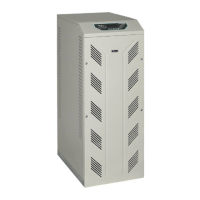
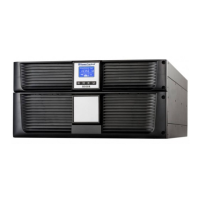
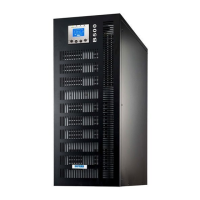
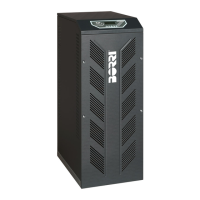

 To Next Page
 General