
 Need help?
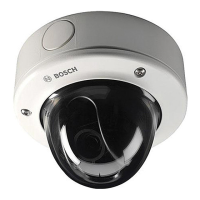
Do you have a question about the Bosch AUTODOME IP 5000 HD and is the answer not in the manual?
Specifies network access, browser version, resolution, and JVM for connection.
Details IP address, subnet mask, and web browser access steps for establishing connection.
Describes the live video stream display and unit control.
Explains using the playback page for recorded sequences.
Details configuring the unit and application interface settings.
Outlines required network information like IP address, subnet mask, and gateway.
Provides steps to access and configure the camera via its web server.
Details setting camera name, ID, and initiator extension.
Explains password protection and authorization levels (service, user, live).
Customizing LIVE page features like audio, alarm inputs/outputs, snapshots.
Options for base frame rate, location, reboot, and factory defaults.
Configuring video signal encoding presets for different streams.
Controls for auto pan, inactivity, auto pivot, freeze frame, turbo mode, azimuth, proportional speed, tilt limit, tours.
Configuring managed VRM, iSCSI, and local media for recording.
Configuring how the camera connects to predefined IP addresses upon an alarm.
Configuring the camera to send alarm notifications via email.
Defining rules to link alarm inputs to specific outputs or camera responses.
Integrating the camera into a network via IP assignment and configuration.
Updating firmware, viewing upload history, and downloading logs.
Displaying live video, text overlays, and camera controls.
Controlling camera pan, tilt, and focus.
Accessing recorded videos for viewing, searching, or exporting.
Finding recorded video by time range and search parameters.
Navigating and controlling playback using the time bar and buttons.
 General
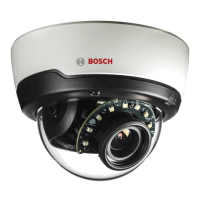
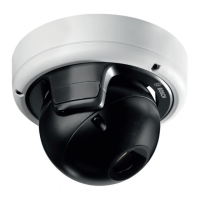
| Camera Type | Dome |
|---|---|
| Frame Rate | 30 fps |
| WDR | Yes |
| IP Rating | IP66 |
| Vandal Resistance | IK10 |
| Image Sensor | CMOS |
| Lens Type | Varifocal |
| Aperture | F1.6 to F3.6 |
| Field of View | Horizontal: 100° to 32° |
| Day/Night Functionality | Yes |
| Minimum Illumination | 0.05 lux (color), 0.01 lux (B/W) |
| Compression | H.264, MJPEG |
| Ethernet Port | 10/100 Base-T |
| Power Supply | PoE or 12V DC |



 To Next Page