
 Need help?
Do you have a question about the Bosch REXROTH DBD and is the answer not in the manual?
Key characteristics and optional configurations of the valve.
Specifies how to order type-examination tested safety valves.
Lists technical data that differs for tested safety valves.
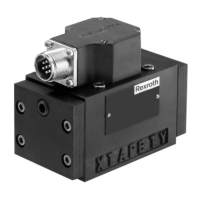
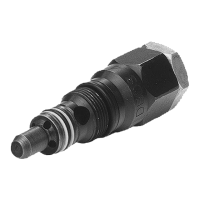
The DBD type pressure relief valve is a direct-operated screw-in cartridge valve designed for installation in block designs, primarily used for limiting system pressure. It is available in size 4 and component series 1X, with a maximum operating pressure of 500 bar and a maximum flow of 20 l/min.
In its initial, closed position, the valve operates by allowing pressure from the main port 1 (P) to act on a spring plate via a control line and a poppet. Should the pressure in main port 1 exceed the value set by the compression spring, the poppet opens, directing hydraulic fluid into main port 2 (T). The system pressure can be adjusted using one of two optional adjustment types: a grub screw with an internal hexagon or a hand wheel.
Key technical specifications include a weight of approximately 0.3 kg and suitability for any installation position. It operates within an ambient temperature range of -20 to +80 °C. The maximum operating pressure is 500 bar at the input and 315 bar at the output (with 50 bar at a set pressure of 500 bar). Set pressures range from 25 to 500 bar, and the maximum flow is 20 l/min. The valve is compatible with mineral oils (HL, HLP) and bio-degradable fluids (HETG, HEES, HEPG), with FKM seals as standard. The hydraulic fluid temperature range is -20 to +80 °C, and the viscosity range is 10 to 800 mm²/s. A cleanliness class of 20/18/15 according to ISO 4406 (c) is required for the hydraulic fluid.
For applications involving bio-degradable and flame-resistant hydraulic fluids, it's important to note that small amounts of dissolved zinc may enter the hydraulic system. Users should consult data sheets or contact the manufacturer for information on other hydraulic fluids, as there may be limitations regarding technical valve data such as temperature, pressure range, life cycle, and maintenance intervals. The ignition temperature of the hydraulic fluid must be at least 50 K higher than the maximum solenoid surface temperature.
The characteristic curves, measured with HLP46 at 9oil = 40 ±5 °C, show the relationship between set pressure and flow, as well as pressure differential and flow. These curves are applicable when the output pressure is zero across the entire volume flow range and were measured without housing resistance. Hydraulic counter pressures in main port 2 (T) add 1:1 to the valve's response pressure. For example, if the spring preload sets the pressure to 200 bar and there's a hydraulic counter pressure of 50 bar in main port 2, the total response pressure will be 250 bar.
The DBD valve is also available as a type-examination tested safety valve (DBD...K) according to the Pressure Equipment Directive 2014/68/EU. These safety valves are factory-set to a fixed maximum response pressure using the adjustment type and are then sealed. They are available with graded response pressures in 5-bar steps. For versions with rotary knobs or hand wheels, the valve spring can be unloaded by the user to set a lower response pressure without removing the lead seal.
For type-examination tested safety valves, specific safety instructions must be followed. The maximum admissible flow (qvmax) of the safety valve must exceed the maximum possible flow of the system/accumulator to be secured. The increase in system pressure due to flow must not exceed 10% of the set response pressure. Discharge lines must end in a risk-free manner, preventing fluid accumulation. Removing the lead seal voids the approval. It is recommended to secure these valves against inadmissible disassembly by wiring and sealing them with the housing/block.
Counter pressure in the discharge line (port T) can reduce the maximum possible flow. The system pressure increases with counter pressure in the discharge line as flow increases. To ensure this increase does not exceed 10% of the set response pressure, the admissible flow must be reduced depending on the counter pressure. Characteristic curves are provided to determine the maximum counter pressure in the discharge line based on flow and response pressure. Interpolation methods are available for intermediate values not explicitly listed in the diagrams.
The ordering code allows for customization based on adjustment type, pressure rating (25 to 500 bar), and seal material (FKM seals are standard). Options for type-examination tested safety valves are also specified in the ordering code. Further information on safety equipment, hydraulic fluids, reliability characteristics, and filter selection is available in various data sheets and operating instructions.
 General
| Brand | Bosch |
|---|---|
| Model | REXROTH DBD |
| Category | Control Unit |
| Language | English |


 To Next Page