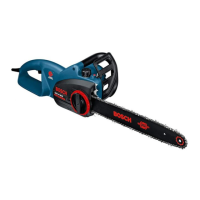
Remove the blunt saw chain.
Never saw above shoulder height.
Never work with the tip of the chain.
Always hold a chain saw firmly with both hands.
Always use a Bosch approved low-kickback saw chain.
Apply the metal gripping teeth (8) for leverage.
Ensure correct chain tension.
General Behaviour (see figures E–G)
Always hold the chain saw firmly with both hands. Front handle with the left hand and rear handle with the right hand.
Fully grip both handles with thumb and fingers at all times during operation. Never operate chain saw using only
one hand.
Use the chain saw only with secure footing. Hold the chain saw at the right-hand side of your body.
The chain must be running at full speed before it makes contact with the wood. Use the gripping teeth (8) to support
the chain saw on the wood. Use the gripping teeth as a leverage point while cutting.
Reset the gripping teeth at a lower point when sawing thicker logs or tree trunks. For this, pull the chain saw slightly
backwards until the gripping teeth release, and reposition at lower level to continue sawing. Do not remove the
chain saw completely out of the cut.
Do not force the saw chain while cutting, let the chain do the work, using the gripping teeth (8) to apply minimal
leverage pressure.
Never operate the chain saw with arms fully extended. Do not attempt to saw areas which are difficult to reach, or on
a ladder. Never saw above shoulder height. Sawing is optimized when the chain speed remains steady during
cutting.
Beware when reaching the end of the cut. The weight of the chain saw changes unexpectedly as it cuts free from the
wood. Danger of injury to the legs and feet.
Always remove the chain saw from a wood cut while the saw chain is running.
Cutting Logs (see figures E–G)
To cut logs, use a saw horse standing on a level and firm surface.
When cutting logs, observe the following safety instructions:
Support logs so that the face sides at the cut do not close in against each other, which would result in the chain being
jammed.
Position and set short logs safely before sawing.
Saw only wood or wooden objects. When sawing, always take care to avoid hitting stones, nails, etc., as these could
be thrown up, could cause damage to the chain, or could result in serious injury to the operator or bystanders.
Keep a running chain saw clear of wire fencing or the ground.
Use of the saw to thin out branches or bushes is not approved.
Length cuts must be carried out with particular care, as leverage with the gripping teeth (8) is not possible. Saw at a
flat angle to avoid kickback.
When working on a slope, operate above or to the side of the trunk or laying tree.
Be careful not to trip over tree stumps, branches, roots, etc.
When cutting logs, combustible wood dust may form. Ensure that you are not near heaters and open flames.
Cutting branches (see figure H)
Always wear hard hat to protect head against falling branches.
A cut branch can lead to personal injury by falling on you or springing back from the ground. Cut longer
branches in sections.
Reduce force before the branch is completely cut off. You can injure yourself if the tool suddenly falls down and
you lose balance and control of the chain saw.
The chain must be running at full speed before it makes contact with the wood. Use the tip protector to support the
undercutting.
Pruning straight through a tree branch from the top edge down is appropriate for branches up to 5 cm in diameter.
Thicker branches should be pruned in three-steps, to prevent damaging the tree. The tip protector is designed to
support the undercutting of branches.
Do not force the pole pruner while cutting, let the chain do the work.



 To Next Page