THE
TAPE
PATH
The
most
frequent cause
of
distortion
of
the
tape path in
the
cartridge
is
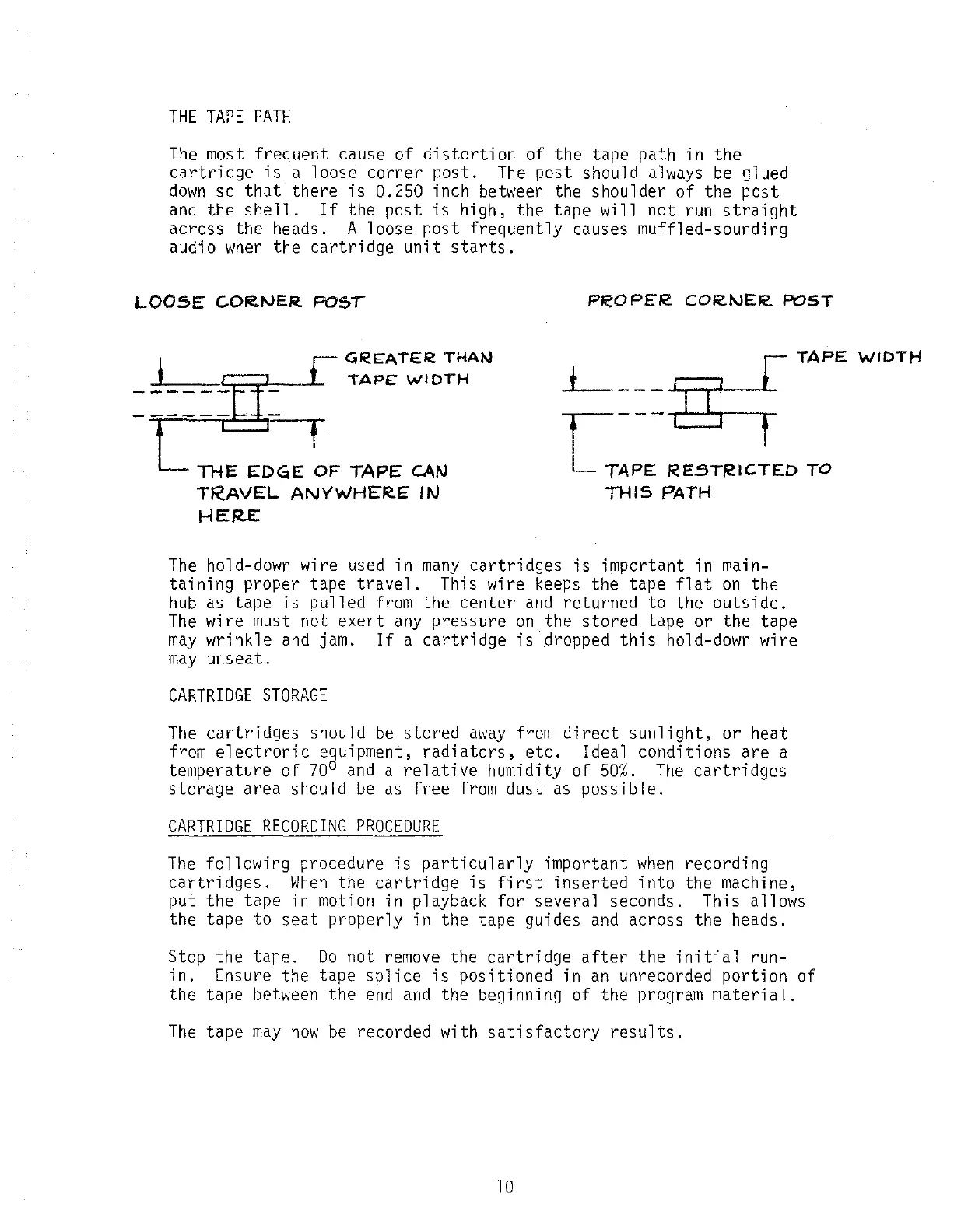
a loose corner
post.
The
post should always
be
glued
down
so
that
there
is
0.250 inch between the shoulder
of
the
post
and
the
shell.
If
the post
is
high, the tape will not run
straight
across the heads. A loose post frequently causes muffled-sounding
audio
when
the
cartridge
unit
starts.
LOOSE
C.OR.NER.
P05T
------
GREATER
THAN
TAP£
WIDTH
THE
EDGE
OF
TAPE
CAlli
TRAVEL
AIIJYWHER.E
11\J
HER-E
PROPER!
COR.IIJER!
POST
TAPE
WIDTH
L ---
.r:;::::;J~
~---
[__
TAPE
RESTf<lCTED
TO
THIS
PATH
The
hold-down wire used in
many
cartridges
is
important in main-
taining
proper tape
travel.
This wire keeps the tape
flat
on
the
hub
as tape
is
pulled
from
the
center
and
returned to the
outside.
The
wire must not
exert
any
pressure
on
the
stored
tape or the tape
may
wrinkle
and
jam.
If
a
cartridge
is
dropped
this
hold-dovm wire
may
unseat.
CARTRIDGE
STORAGE
The
cartridges
should
be
stored
away
from
direct
sunlight,
or
heat
from
electronic
equipment,
radiators,
etc.
Ideal conditions
are
a
temperature of
70°
and
a
relative
humidity
of
50%.
The
cartridges
storage
area should
be
as
free
from
dust as
possible.
CARTRIDGE
RECORDING
PROCEDURE
The
following procedure
is
particularly
important
when
recording
cartridges.
When
the
cartridge
is
first
inserted
into
the machine,
put
the
tape in motion in playback
for
several seconds. This allows
the tape to
seat
properly in the tape guides
and
across the heads.
Stop the
tape.
Do
not
remove
the
cartridge
after
the
initial
run-
in.
Ensure the tape
splice
is
positioned in
an
unrecorded
portion
of
the tape between
the
end
and
the beginning
of
the program
material.
The
tape
may
now
be
recorded with
satisfactory
results.
10



 To Next Page