Equipped record
models
can both playback
and
record the
auxiliary
cue tones.
The
tones are recorded
by
pressing the appropriate
front
panel
switch
(SEC
150Hz or
TER
8
kHz).
As
long as the switch
is
depressed, the
tone will
be
recorded
on
the
cartridge.
To
insure
positive
operation
in
playback,
NAB
standards
call
for
a
minimum
burst
of
100
(at
150
Hz)
or 2
(at
8
kHz)
milliseconds duration.
The
exact positioning of the tone
and
its
duration depends
upon
the requirements in the individual
installation.
When
recording the
150
Hz
(QI)
tone
to
provide automatic
fast
forward, the tone
must
not
end
before the
program
material ends.
3-4.
DELAY
OPTION
To
provide the delay
function,
an
erase/record
head
is
physically
substituted
in place of the record head.
The
positions
of the reproduct
and
record heads are transposed.
As
the
program
material
is
recorded, the tape
passes through the
cartridge,
and
is
played
back
by
the reproduce head.
Hence, the reproduced output lags behind the input
by
the length of the tape
in the
cartridge
used.
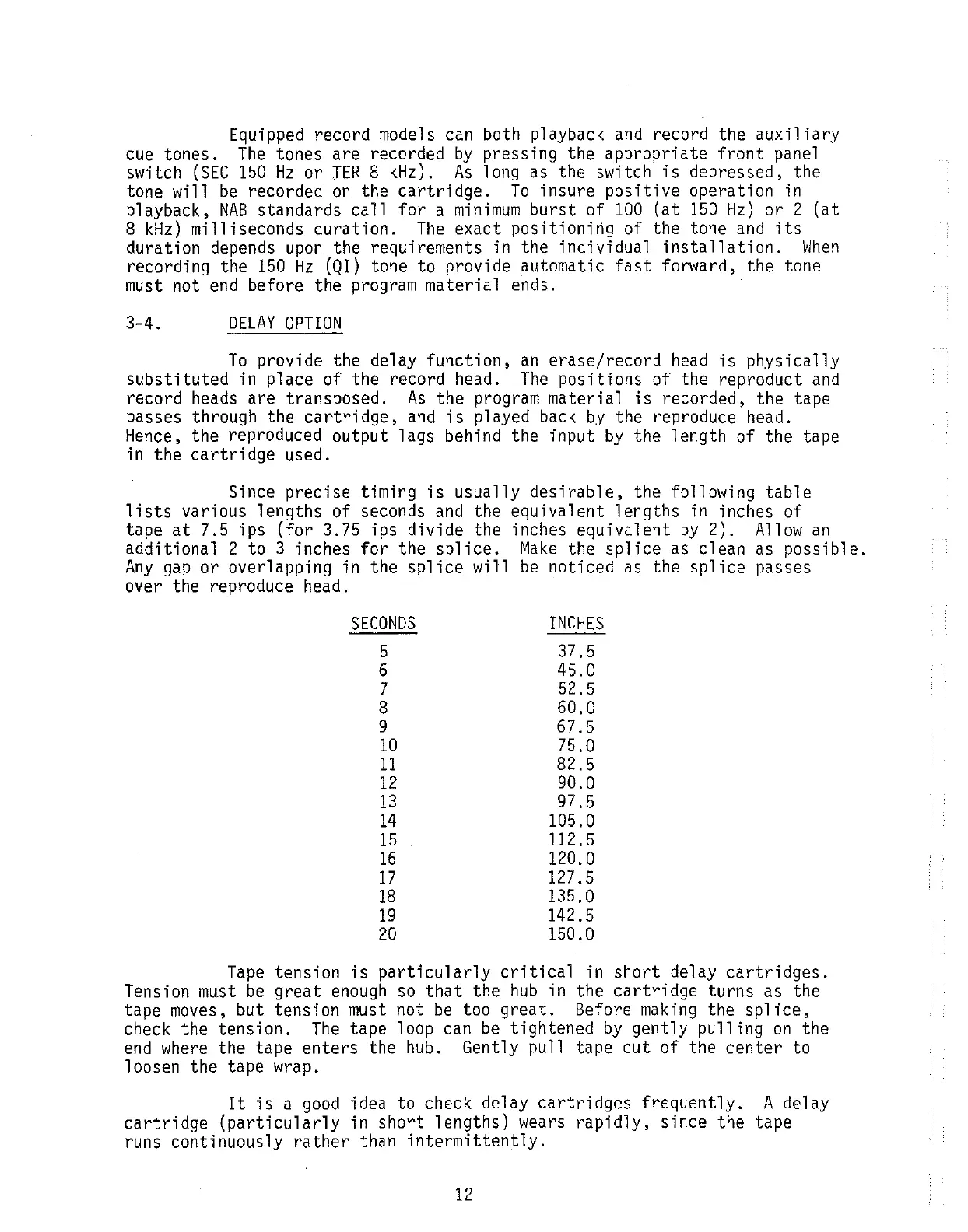
Since
precise
timing
is
usually
desirable,
the following
table
lists
various lengths of seconds
and
the equivalent lengths in inches of
tape
at
7.5 ips
(for
3.75 ips divide the inches equivalent
by
2).
Allow
an
additional 2 to 3 inches
for
the
splice.
Make
the
splice
as
clean as
possible.
Any
gap
or overlapping in the
splice
will
be
noticed
as
the
splice
passes
over the reproduce head.
SECONDS
5
6
7
8
9
10
11
12
13
14
15
16
17
18
19
20
INCHES
37.5
45.0
52.5
60.0
67.5
75.0
82.5
90.0
97.5
105.0
112.5
120.0
127.5
135.0
142.5
150.0
Tape
tension
is
particularly
critical
in
short
delay
cartridges.
Tension
must
be
great
enough
so
that
the
hub
in the
cartridge
turns as the
tape
moves,
but tension
must
not
be
too
great.
Before
making
the
splice,
check the
tension.
The
tape loop can
be
tightened
by
gently
pulling
on
the
end
where
the tape
enters
the
hub.
Gently pull tape out of the
center
to
loosen the tape wrap.
It
is
a
good
idea to check delay
cartridges
frequently.
cartridge
(particularly
in
short
lengths) wears
rapidly,
since the
runs continuously
rather
than
intermittently.
12
A delay
tape



 To Next Page