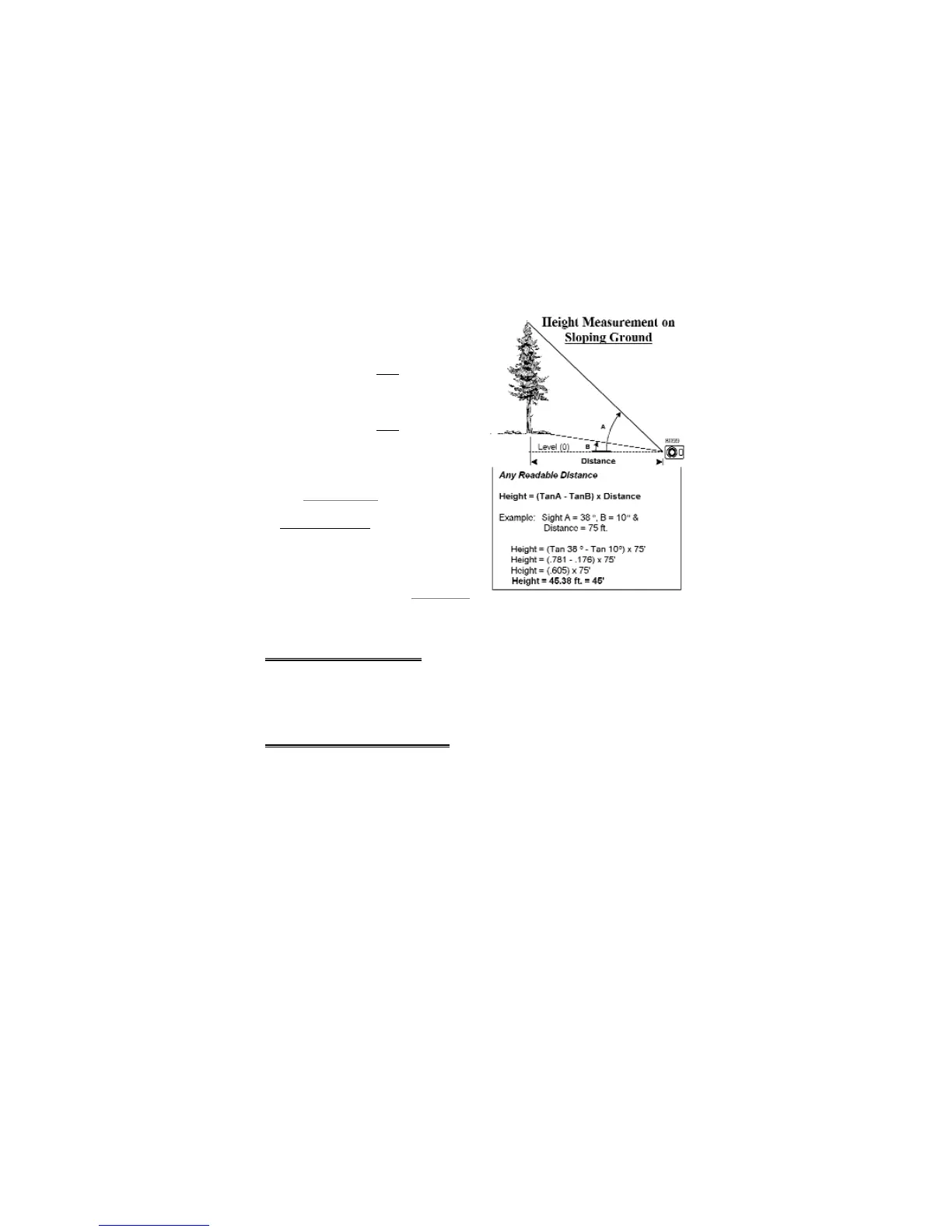
4. Above the horizon (level, 0°), sight top of
object through sight hole. (Fig 44)
5. Read bearing from black
scale (38°, this
example).
6. Above the horizon (level, 0°), sight base of
object through sight hole. (Fig 44)
7. Read bearing from black
scale (10°, this
example).
8. Calculate height of the object.
· Height = (TanA – TanB) x Distance
· Height = (Tan38° – Tan10°) x 75 feet
· Height = 45 feet
12.3 Percent Grade
After measuring angle of inclination (20°) and
finding the tangent of the angle, simply move
the decimal two places to the right.
· Example: Tan20° = 0.364 = 36.4% Grade
Remember to readjust for magnetic declination before sighting a bearing.
13 – Additional Information
Before heading into the field, practice using the Eclipse 8099 and a map in a familiar area. Also,
carefully re-read the instruction manual to gain a full understanding of Eclipse 8099 applications.
Become an expert with map and compass and you should never get lost. Also, carry a complete
survival kit and educate yourself on survival techniques.
14 – Eclipse 8099 Specifications
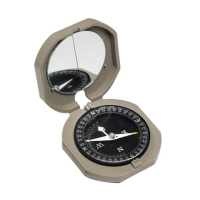
Magnetism: NdFeB needle disk
Accuracy: Bearing -- ± 1° accurate reading (0.5° readable)
Clinometer -- ± 1° accurate reading (0.5° readable)
Size: Length – 4.2 in. (10.7 cm)*
Width – 2.8 in. (7.1 cm)*
Weight – 4.1 oz (116g)**
* Includes Eclipse 8099 compass and rubber shoe
** Includes Eclipse 8099 compass, rubber shoe, reference cards and lanyard
23
Figure 44


 To Next Page