8
Linkwitz-Riley Alignment
4.0 The Linkwitz-Riley advantage
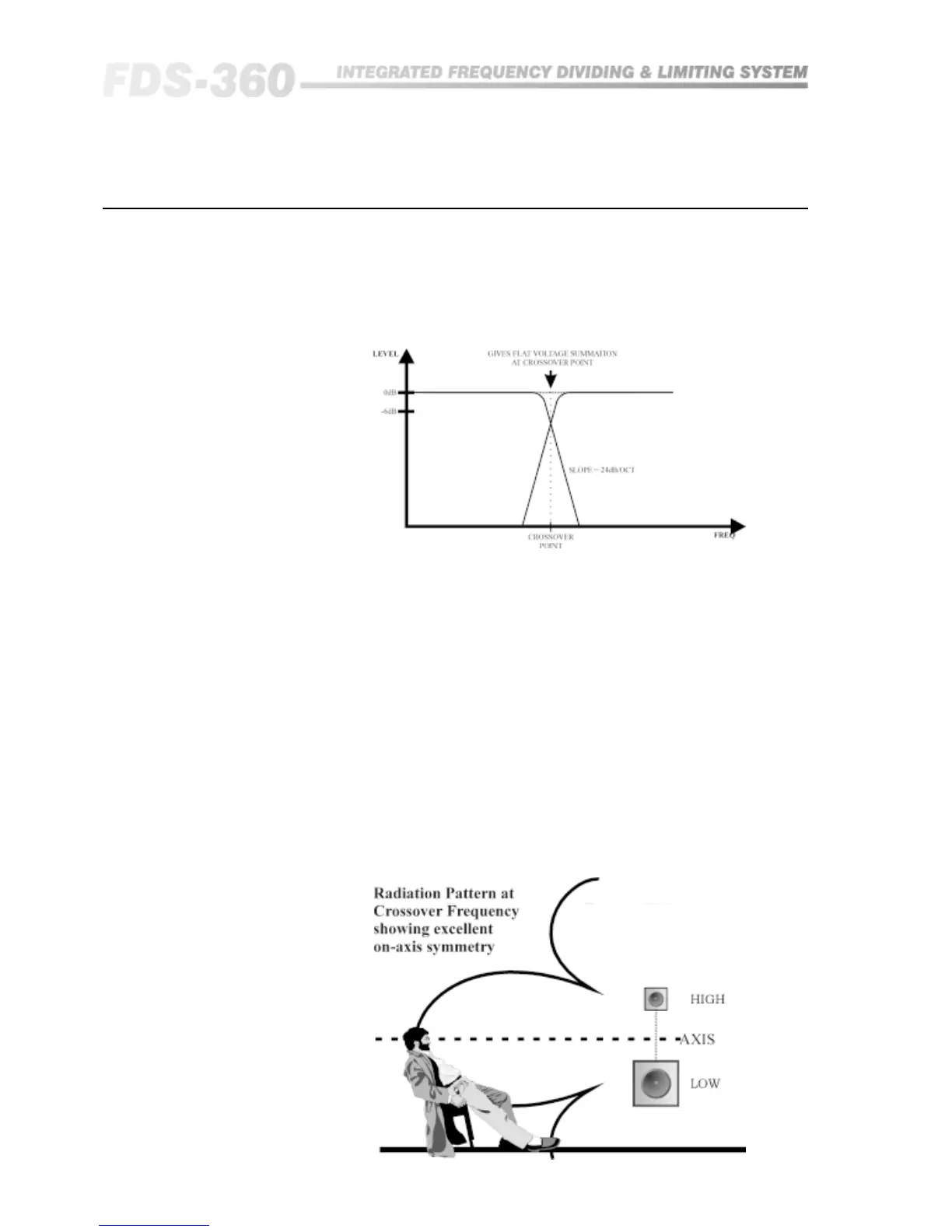
There is an additional set of advantages exclusive to active crossovers made
by BSS, and other manufactures using the Linkwitz-Riley alignment (See
Figure 4.1).
Fig 4.2 Radiation
Pattern Frequency
showing excellent on-
axis symmetry
Zero Phase difference at crossover: The phase difference between drivers
operating in adjacent frequency bands is close to zero degrees at the
crossover frequency.
'Phase alignment' in this manner prevents interactive effects (i.e.: High and
Low drivers 'fighting' each other), over the narrow band of frequencies around
the crossover point; this is where the units from two adjacent frequency ranges
are contributing near equal amounts of sound pressure.
More predictable sound dispersion: By providing in-phase summation at the
crossover point(s), the Linkwitz-Riley alignment provides for more cogent
sound dispersion - it provides on-axis symmetrical radiation patterns. (See
Figure 4.2).
'Invisible' slopes: The absence of electrical phase difference close to the
crossover frequency helps to make the steep -24dB/OCT slope effectively
inaudible,. Response peaks and dips are negligible and inaudible given the
correct polarity ('phasing') of the speaker connections. The same is not true of
the shallower (-6, -12 or -18dB/OCT) rates or rolloff, in other crossovers.
Fig 4.1 Linkwitz-Riley
filters



 To Next Page