subsequent restart of the burner, the
controller resumes the execuon of
the program from the point when the
power interrupon occurred.
3. FUELS
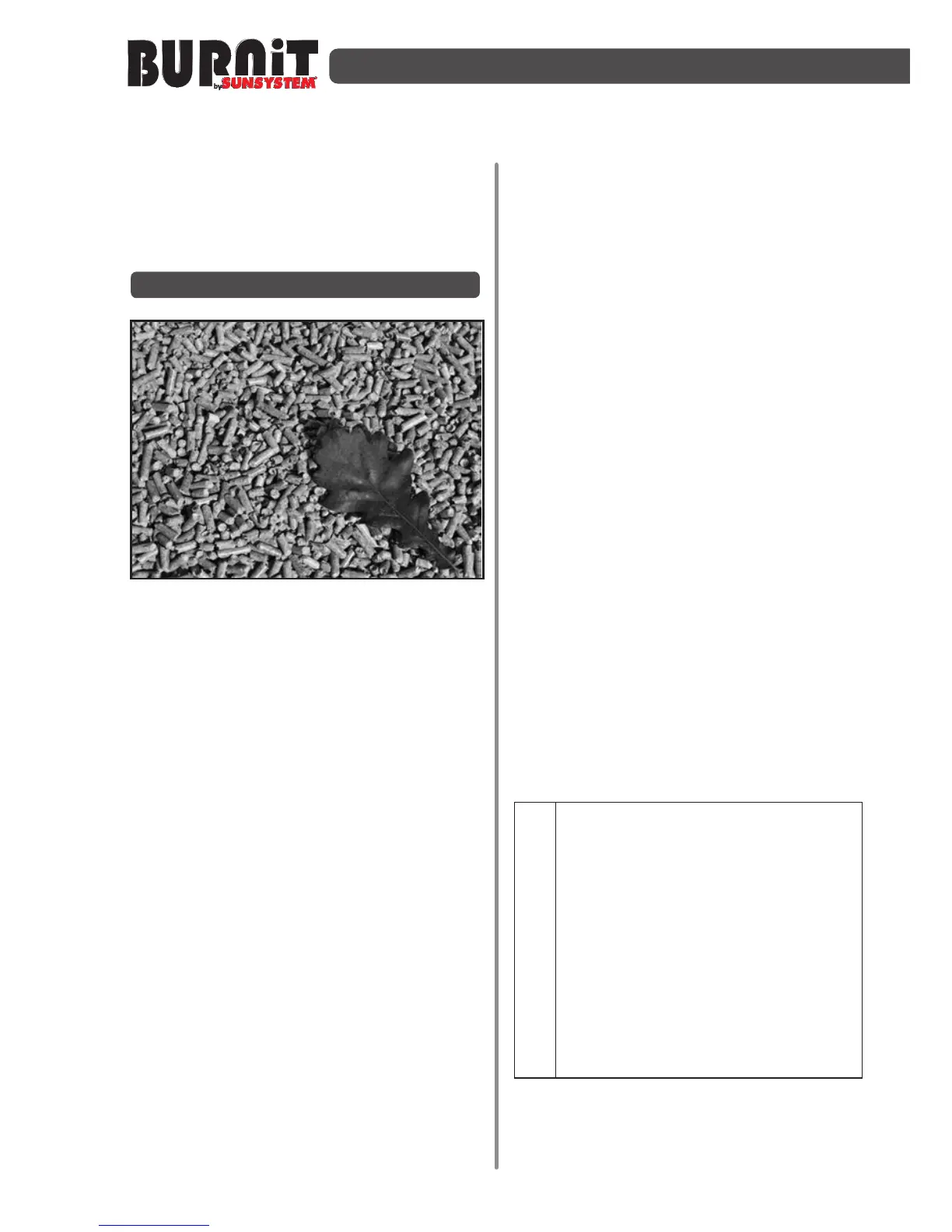
All pellets are biomass manufactured
from common low-growing plants and
trees. The most common household type
pellets are made of sawdust and milled
wood chippings which are waste material
from wood used in the producon of logs,
furniture and other products. Wood is the
richest raw material which does not have
any impact on the producon costs of
food products or ethyl alcohol (ethanol).
The raw material is processed under high-
pressure and temperature and is pressed
to produce small-size cylindrical pellets.
The producon process may ulize so
wood material (such as sowood, pine),
hardwood (oak) as well as recycled waste
wood. Wood pellets are produced in
hammer mills or wood pellet plants.
Advantagesofwoodpellets:
Convenientstorage.
Pellet bags can be stored on a small area
in a dry garage, basement, service room or
shed.
Easyloading.
In most cases the boiler hopper needs
loading only once a week – this depends
on the hopper capacity.
Beercontroloffuelquanty.
The small size of the pellets allows
for precise fuel feeding. On the other
hand, the supply of air for reaching
opmal combuson eciency is easier
to adjust since the fuel quanty in the
combuson chamber remains constant
and predictable.
Fueleciency.
High combuson eciency is also
determined by consistently low moister
content of pellets (consistently under
10% as opposed to 20% to 60% moisture
content of the logs). Low moisture
content, controlled fuel porons and
precise air seng means high combuson
eciency and very low carbon oxides in
the ue gases.
When purchasing pellets, ask
for conformity declaraon and
cercate issued by an accredited
laboratory and make sure the
fuel meets the requirements
indicated in the manual. If you
purchase large amount of pellets
(bulksupplyfortheenreheang
season for example), ask your
supplier to provide accurate and
trueinformaonaboutthestorage
condions.
We recommend to use pellets with size of
6 - 8 mm. Density 600 - 750 kg/m
3
heang
value 4.7-5.5 kWh/kg. Ash content – less
than 1% and moisture content up to 8%.,


 To Next Page