-16-
TECH NOTES—GROUND RADIAL SYSTEMS
In all cases the base of the vertical antenna should not be more
than a few inches away from the MH or RV so that the shortest
possible lead may be run from the ground connection of the
antenna to the metal body, as the length of this ground lead will
effectively lengthen the antenna itself on all bands, and
detuning can occur in some cases. A good electrical
connection between the body of the RV or MH and the antenna
is important, and in the case of mobile homes it would be a
good idea to make sure that good electrical contact exists
between the different parts of the metal body. Discontinuities
can often lead to the production of harmonic radiation and TVI.
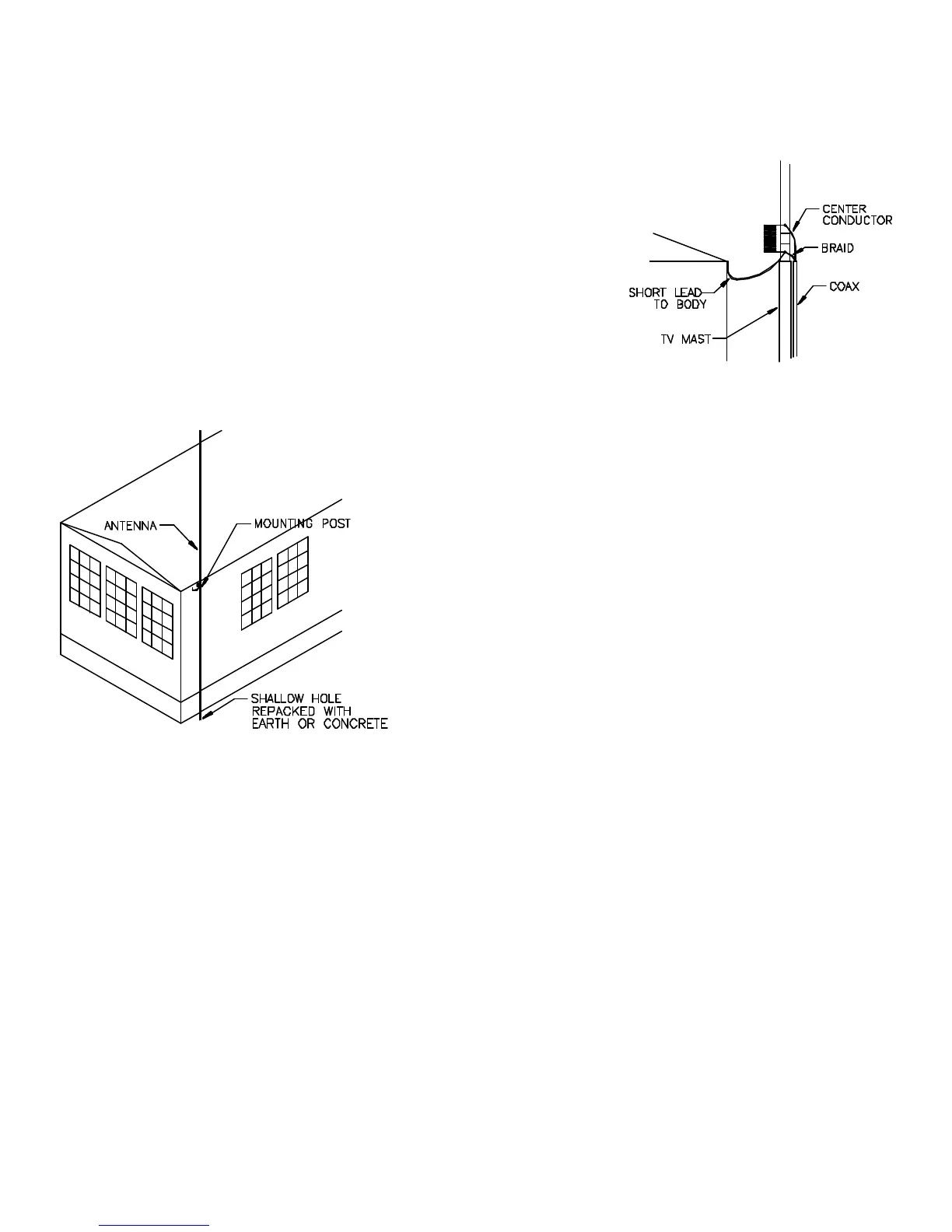
The essential circuit connections are shown in the diagram above.
For permanent installations the bottom of the mast may
be set deeper in the ground, and concrete may be used
for greater strength and stability. The upper portion of
the mast should be securely attached to the side of the
building. Steel TV mast sections are readily available in
lengths of ten feet and the mounting posts of Butternut
HF verticals will slide into those which have an outside
diameter of 1 1/4 inches and a wall thickness of .058
inches. Other vertical antennas may use different
mounting techniques and requirements, so be sure to
select a mast that will be suited to the particular
situation. The main point to keep in mind is that the
mast should not extend more than a few inches above
the level of the roof so that the ground lead may be kept
short.
LIGHTNING PROTECTION
Modern solid state amateur equipment is particularly vulnerable to damage from lightning or
static induced transients that may appear on transmission lines, and conventional air-gap
lightning protectors may provide no real protection at all for solid state gear. A line of very
effective lightning and static protectors has been developed by ALPHA DELTA
COMMUNICATIONS, P.O. Box 571, Centerville, Ohio 45459, for use with solid state equipment,
and since these devices feature much faster transient discharge times than earlier designs,
they should be investigated for possible use with all vertical and other antenna systems.



 To Next Page