-9-
THEORY OF OPERATION
times as greater as that of conventional vertical antennas, an electrical 1/4 8 section of
75-ohm coax is used as a geometric mean transformer to match the 100-odd S of
feedpoint impedance on that band to a 50 S main transmission line of any convenient
length. The HF6V operates as a slightly extended 1/4 8 radiator on 15 meters, a 1/4 8
stub decoupler providing practically lossless isolation of the upper half of the antenna
on that band. On 10 meters the HF6V becomes a 3/4 8 radiator with considerably
greater radiation resistance and efficiency than 1/4 8 trapped types.
ELECTRICAL AND MECHANICAL SPECIFICATIONS
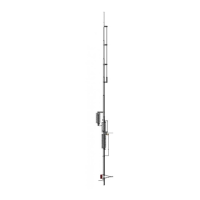
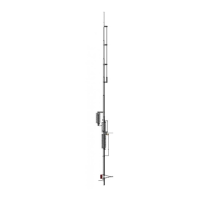
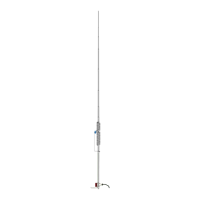
Height (adjustable): 26 ft (7.9 m)
Shipping Weight: 14 lbs (6.3 kg)
Feedpoint Impedance: Nominal 50 ohms through included matching line.
VSWR at resonance: 1.5:1 or less all bands
Power rating: 2 kW PEP 75/80, 40, 20, 15, l0 meters; 500 W PEP 30 meters
Wind loading area: 2 ft
2
(.19 m
2
)
Bandwidth for VSWR of 2:1 or less: entire band 10, 15, 20, 30 meters, 250-300 kHz
40 meters, 40-100 kHz 75/80 meters
GUYING
The HF6V is designed to survive winds of up to 80 mph (129 kph) without guying in
the absence of ice loading or heavy precipitation, but over a period of time it is to be
expected that frequent or even constant flexing or vibration will reduce the chances
for survival in winds that would not damage a newly installed antenna. Therefore in
areas of frequent or heavy winds a set of short non-conductive guys should be used to
reduce the stresses that wind loading will impart to the lower sections of the antenna.
In this connection, it should be noted that light nylon twine is totally unsuitable as
guying material because it has too much stretch per unit length, although the heavier
sizes of nylon rope (or even sash cord) may be suitable if used in short runs.
Polyethylene rope may be used, but because some grades tend to deteriorate fairly
rapidly, periodic inspection should be made. A single set of guys placed just above the
30 meter circuit will contribute greatly to the stability and the longevity of the
antenna, provided that the guys retain a slight amount of slack and do not come off at
too steep an angle. At Angles of less than 45/ the guys begin to exert a downward
compressive force on the structure that can be more of a threat to survival than lateral
wind loading on an unguyed structure. Under no circumstances should guys be placed
higher than one-third of the way up the antenna. The upper two-thirds of the HF6V
has little more than its own weight to support, so these sections may be allowed to
bend with the wind with no serious risk of damage. It is the lower third of the
antenna that must support both the weight of the upper sections and the wind
loading on them and are thus more likely to receive damage in severe winds.



 To Next Page